-
The short version: compare landed cost, not the quote
-
Why I'm writing this
-
The four line items that never make the first quote
-
How to choose chenille fabric for wholesale programs
-
Bulk polyester oxford: what actually moves the price
-
Swimwear fabric private label: the part buyers underestimate
-
Where Glen Raven Mills fits on our shortlist
-
When the cheaper quote is the right call
The short version: compare landed cost, not the quote
If you're buying chenille for a wholesale upholstery program, bulk polyester oxford fabric for bags or covers, or swimwear fabric on a private label run, there's only one number worth comparing: all-in cost per finished unit. Not price per yard. Not FOB port. The number that survives lab dips, freight, duty, and one dye-lot correction.
Across our last three side-by-side fabric comparisons, the lowest quote was also the lowest total cost exactly once. The gap between the lowest quote and the lowest landed cost ran 8% to 22%.
So I stopped opening with “what's your price.” I open with “what's not included in this price.” That one question has saved us more money than any negotiation I've ever run, and it isn't close.
Three follow-ups I ask before anything goes to a sample:
- What's the price at our actual quantity, not at the MOQ?
- Who pays for lab dips, test reports, and freight — and what's the lead time on each?
- What happens if the production dye lot doesn't match the approved standard?
The answers separate the suppliers worth a second call from the ones who are just reading a number off a list.
Why I'm writing this
Office administrator for a 140-person company that does private-label soft goods. I manage all fabric and component ordering — roughly $380,000 annually across 11 vendors. I report to both operations and finance, which means when something goes sideways, I get to explain it twice.
I took over purchasing in 2019. We've placed somewhere around 200 bulk fabric orders since then. Maybe 180 — I'd have to pull the system.
The lesson that stuck hardest came early. In 2021 I found a vendor quoting about 12% under our regular mill on a chenille for a hospitality seating program. Ordered 400 yards. They sent a handwritten receipt and couldn't produce a tax-compliant invoice. Finance rejected the expense report and I ate $2,400 out of the department budget. Now I verify invoicing paperwork before I verify the fabric.
In our 2024 vendor consolidation project I had to re-quote nine fabrics across four programs. Standardizing on one quote template — landed cost, lead time, test reports, payment terms — cut our comparison time from about three weeks to nine days. Same information. Just lined up the same way.
The four line items that never make the first quote
Almost every surprise I've had lands in one of these four buckets:
1. Lab dips and pre-production samples. Usually $150–600 per color depending on the mill and the substrate (based on quotes we collected in 2024; verify current pricing). Some suppliers absorb it on repeat programs. Ask. It's a real line item and it's negotiable more often than people assume.
2. Third-party testing. Who pays, and who owns the report. If your swim or outdoor program needs chlorine, colorfastness, or abrasion data, that report costs money and takes calendar time. Ask whether it's per-lot or per-style, because “we tested it once” and “every lot is tested” are different products at different prices.
3. Freight and duty. Roll width changes how many rolls fit on a pallet. Roll diameter changes whether it ships LTL or needs a container. I've watched freight swing a landed cost by more than the entire price negotiation did.
4. Rework. The most expensive line item is the one nobody quotes, because it isn't supposed to happen. It happens.
What I mean is that the quote is only the opening of the cost — it's the lab dips you didn't budget for, the freight that changes when the roll diameter changes, the two weeks of somebody's time chasing a dye lot, and the rework that never appears on any invoice until it appears on yours.
How to choose chenille fabric for wholesale programs
Chenille is where I've seen the most confusion, mostly because two fabrics can weigh the same and behave nothing alike.
Weight is the starting point, but first make sure you're comparing the same unit. If a supplier quotes ounces per square yard, multiply by roughly 33.9 to get GSM. An 8 oz/yd² chenille is about 271 gsm. That conversion alone has caught two apples-to-oranges comparisons for us.
Weight isn't the whole story. Pile density, backing stability, and how the yarn is locked into the base matter more for how the fabric looks in year three. Ask about abrasion testing — and ask which method. Wyzenbeek and Martindale numbers are not interchangeable, so a “50,000 rub” claim means very little until you know which machine produced it.
Then get the color tolerance in writing. Per Pantone's own color matching guidance:
A Delta E under 2 is the usual target for brand-critical colors. A Delta E of 2–4 is noticeable to a trained observer; above 4, most people can see the difference. (Reference: Pantone Color Matching System guidelines)
Put that target in the spec sheet, not in a conversation. Conversations don't survive a staffing change at the mill.
Which brings me to the mistake I still think about. In 2022 I skipped a lab dip to save $340 and three weeks on a chenille order. It looked fine under our office lights. In the client's showroom, 180 yards read two shades warm. Reweaving, freight both directions, and a rushed replacement lot: about $2,100, plus a genuinely unpleasant phone call. The cheap shortcut wasn't cheap.
Bulk polyester oxford: what actually moves the price
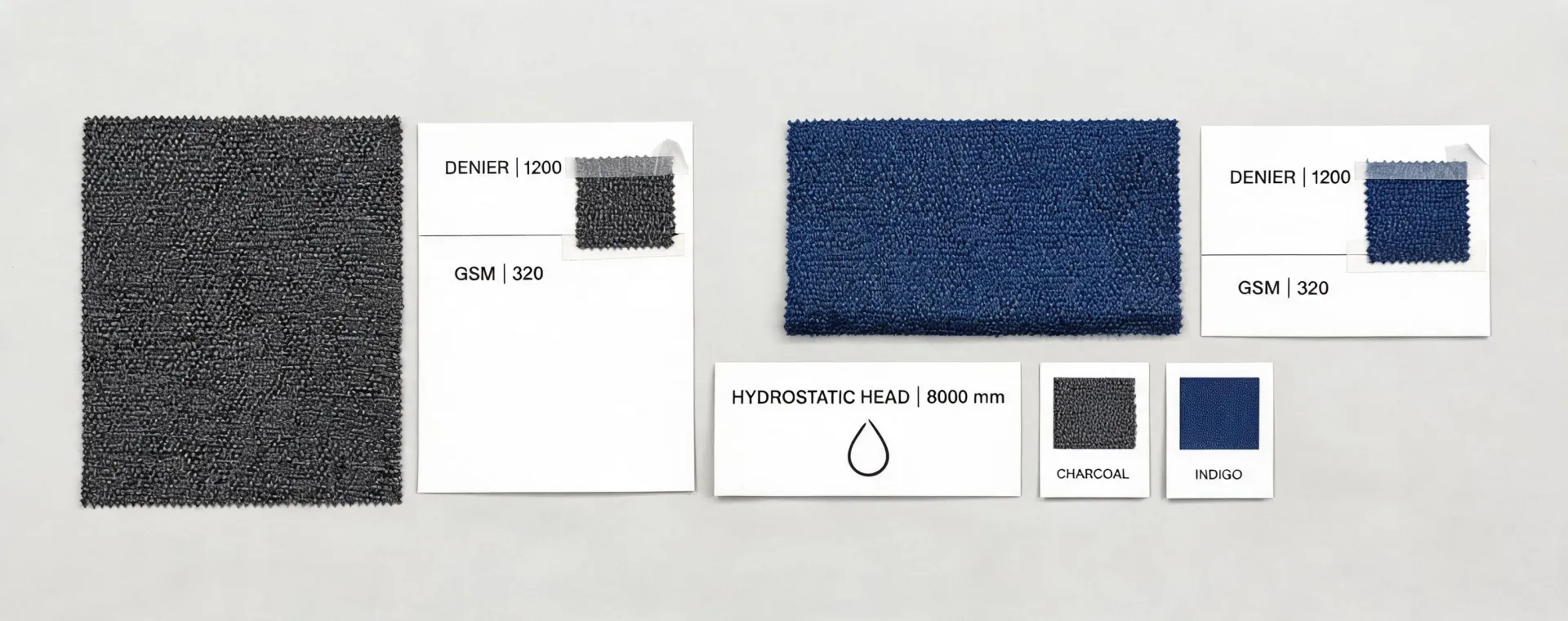
Denier first — 210D, 420D, 600D and 1680D are different products with different jobs, and the price gaps between them are real. Then coating: PU or PVC, and at what add-on weight. Then whether the color is piece-dyed or solution-dyed, which is often the difference between a consistent lot and a color argument in month six.
Here's the counterintuitive part. When we've needed to bring bulk polyester oxford cost down, the biggest wins haven't come from pushing on quantity. They've come from changing the put-up — roll width and roll length. A wider roll that fits your cutting layout better can reduce waste enough to beat a 5% price concession, and the supplier hardly notices because their setup doesn't change.
One more: the numbers said go with the lower quote on a 600D program in 2023. My gut said stick with the mill that had answered every question in under four hours for two years. I went with my gut. Eight months later I learned the cheaper mill had a dye-house backlog that would have pushed delivery past our season.
Swimwear fabric private label: the part buyers underestimate
Swim is its own animal. On a swimwear fabric private label program, chlorine resistance, stretch and recovery, lining compatibility, and colorfastness testing are the line between a program that reorders and one that generates returns.
Two things I now ask for every time: test reports per lot, and the name of the lab. Not because suppliers lie, but because “we meet the standard” and “here's the report from a named lab, dated last quarter” are different levels of confidence — and only one of them holds up when a buyer asks you a direct question on a call.
Also, build the lab-dip cycle into your calendar. Color approval plus testing plus production rarely runs shorter than your sample lead time doubled. If your launch date is firm, that math decides your start date, not the other way around.
Where Glen Raven Mills fits on our shortlist
We keep a mill like Glen Raven on the list for the programs where the construction doesn't exist yet. Glen Raven Custom Fabrics is built around that: you bring the end use and the performance requirements, they come back with a construction and a spec sheet. The Burlington, North Carolina manufacturing base matters to us for one unglamorous reason — when a program needs a variation mid-stream, domestic production shortens the loop.
I'll be straight about the money, since that's the point of this piece. Glen Raven Mills has never been the lowest line in my spreadsheet. What their quote has been is complete — freight, test reports, lead time, and tolerances all on the first page. That's worth something, and working out how much it's worth is the actual job.
When the cheaper quote is the right call
It often is. If you're prototyping, if the color isn't brand-critical, if you need 80 yards for a sample room, or if you're testing a silhouette you might kill in six weeks — take the fast, cheap option and move on. Paying premium prices for fabric that ends up in a scrap bin is its own kind of expensive.
My experience is based on roughly 180–200 bulk orders, mostly in the 500–5,000 yard range, mostly domestic. If you're placing 30,000 yards at a time, you have leverage I don't, and the math shifts. I can only speak to how this plays out on mid-size runs.
And this whole approach assumes you have two or three weeks to compare properly. If you need fabric next Friday, you're not comparing landed cost — you're paying for availability, which is a different decision with different rules. I've made that call too, and I'd make it again.