-
Step 1: Pin Down the Spec Before You Search Anything
-
Step 2: Check Supplier Credentials for Construction-Grade Materials
-
Step 3: Don't Guess on Bedding Specs—Firmness and Fill Matter
-
Step 4: Confirm Fabric Composition and Colorfastness
-
Step 5: Know What You're Actually Buying—Jersey Fabric Isn't One Thing
-
Step 6: Verify Invoicing and Compliance Before You Place the Order
-
Step 7: Inspect on Delivery Before You Sign Anything
-
Common Mistakes I'd Flag
If you're the person who ends up buying materials for both the office side and the facility side of a company, this checklist is probably for you. I'm an office administrator for a 200-person company with a main office, a small warehouse, and a two-bed on-call room. I manage roughly $180K in annual purchasing across eight vendors, and I report to both operations and finance—which means every order has to make sense to two different people.
This list covers seven steps I run through before placing any order for textiles, bedding, or construction-grade materials. I've been doing this since 2019, and I tightened up the whole process during a 2024 vendor consolidation project. No fluff—just the steps, in the order I actually follow them.
Step 1: Pin Down the Spec Before You Search Anything
Most bad purchases start with a vague search. Search "microfiber mattress pad" and you'll get 400 results at wildly different price points, and none of them tell you what you actually need for your specific situation.
Before I search, I write down four things: the size, the intended use, the durability expectation, and the budget ceiling. For our on-call room, that's a full-size pad, used maybe twice a week, needs to survive at least two years of light cleaning, and stays under $90 per unit. Once you have that, the product list drops from 400 to maybe a dozen.
This step is boring. It's also the one that saves the most money. It took me about three years and 150+ orders to understand that the spec sheet matters more than the price quote (honestly, it's not even close).
Step 2: Check Supplier Credentials for Construction-Grade Materials
When we bought DuPont Tyvek house wrap for the warehouse exterior project last spring, I almost went with a discount reseller. Glad I didn't. Tyvek has specific installation requirements (overlapping, taping, fastener spacing), and if the roll isn't genuine or has been stored in bad conditions, the warranty is basically void—and you find that out after the wall's already up.
For any branded construction material, ask two questions before ordering:
- Is the vendor an authorized distributor? (Get it in writing, not just a verbal yes.)
- Can they provide the product data sheet with the current batch date?
If they hesitate on either, that's a red flag. The "local vendors are always safer" thinking comes from an era before modern logistics systems closed the gap—but in this case, local or not, credentials matter more than proximity.
Step 3: Don't Guess on Bedding Specs—Firmness and Fill Matter
We needed a microfiber mattress pad for the on-call room. I initially ordered based on price alone and ended up with something so thin that the staff complained within a week. The replacement order cost me a re-approval conversation with finance I'd rather not repeat.
The Mattress Firm in DuPont actually beat our usual supplier on microfiber mattress pad pricing—about 12% less (this was back in early 2024). But I only found that out because I called and asked for the commercial account rate. The online price wasn't the real price.
Ask about fill weight (oz per square yard), backing material, and wash durability. A "quilted" pad and a "fiberfill" pad are not the same thing, even if the product photos look identical. I've never fully understood why some vendors blur those categories on their spec pages—my best guess is it lets them match more search queries.
Step 4: Confirm Fabric Composition and Colorfastness
We use rayon fabric black for the window treatments in the conference rooms. It looks sharp, but rayon is not a "set it and forget it" material. Dye lot variation is real, and black rayon fades if it's exposed to direct sun without a lining.
Before ordering any fabric in a specific color, ask:
- Is the dye lot consistent across the full order?
- Is the color rated for light exposure? (Ask for the lightfastness rating—usually on a 1-8 scale.)
- What's the shrinkage rate after the first wash?
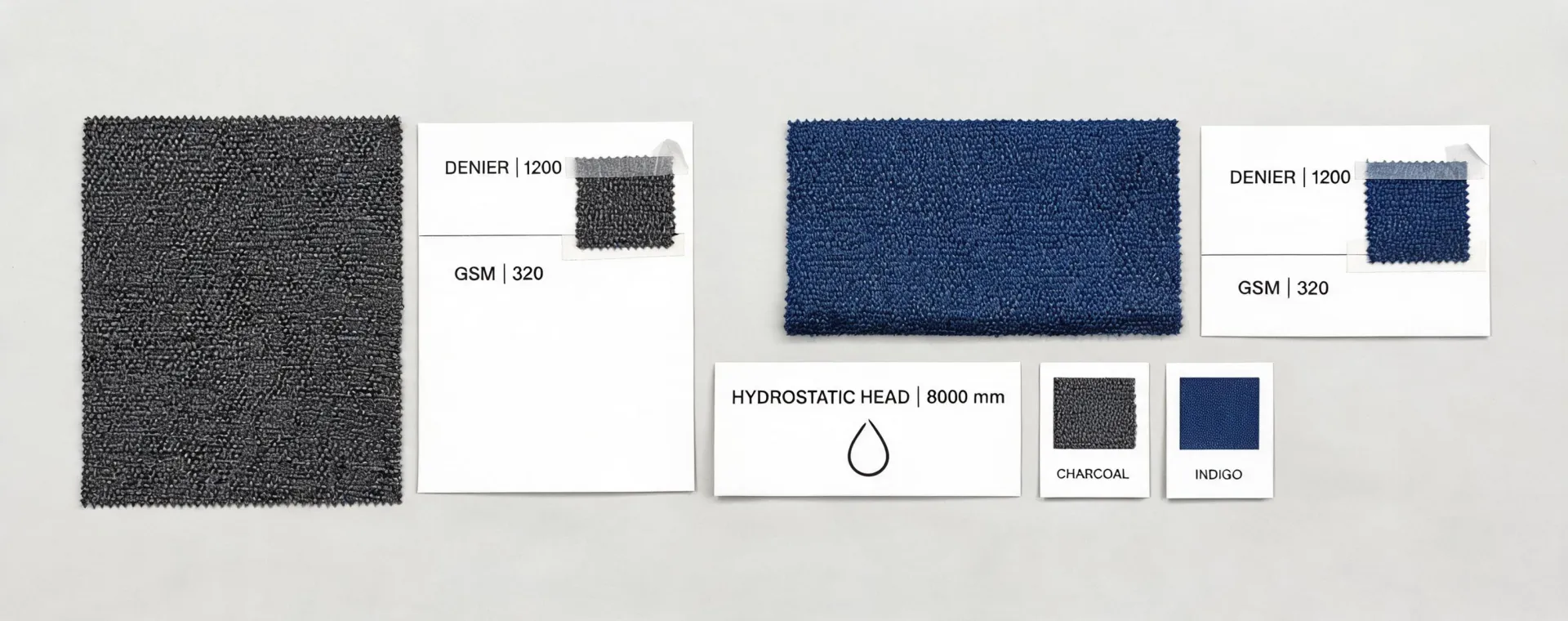
The one thing most buyers skip: order a sample swatch before the full run. It costs about $8 and saves you from a $600 mistake. I learned that one the hard way in 2022, when a "black" that looked right on a monitor came in closer to charcoal in person.
Step 5: Know What You're Actually Buying—Jersey Fabric Isn't One Thing
When I first ordered uniform shirts for warehouse staff, I didn't know what a jersey fabric was. I assumed it was a brand or something specific to sports teams. Turns out "jersey" describes a knit structure—a single-knit fabric—not a specific material or brand. It stretches, it drapes, and it behaves differently from woven fabric in almost every way.
If you're buying fabric for uniforms, ask whether it's single jersey or double jersey, and what the fiber content is (cotton, poly, blend). A poly-cotton jersey will hold up better to industrial washing than 100% cotton, but it may not breathe as well. There's no universal answer—it depends on where the shirts will be worn and how often they'll be washed.
Step 6: Verify Invoicing and Compliance Before You Place the Order
This is the step almost everyone ignores, and it will cost you if you do.
In 2021, I found a great price on cleaning supplies from a new vendor—about $900 cheaper than our regular supplier. Ordered a full quarter's worth. They couldn't provide a proper invoice (handwritten receipt only). Finance rejected the expense report. I ate the cost out of the department budget. So now I verify invoicing capability before placing any order, no matter how good the quote looks.
For any environmental claims (recyclable, eco-friendly, sustainable), remember that the FTC Green Guides require those claims to be substantiated. A product claimed as "recyclable" should be recyclable in areas where at least 60% of consumers have access. If a supplier can't tell you the basis for their claim, don't put it in the purchase request—it's not worth the compliance headache later.
Step 7: Inspect on Delivery Before You Sign Anything
Open at least one unit from every pallet before you sign the delivery receipt. Check the batch numbers against the invoice. Weigh a mattress pad if it feels light (yes, really—one vendor sent us a pad that was about 30% under the stated fill weight).
If something's off, document it with photos immediately. Signing the receipt without noting damage almost always puts you in a back-and-forth that eats two or three weeks.
Common Mistakes I'd Flag
- Don't assume the online price is the commercial price. Call for an account rate.
- Watch minimum order quantities. A vendor quoted us a better per-unit rate on jersey fabric, but the MOQ was 400 yards. We needed 60.
- Check lead times seasonally. What ships in five days in February may take three weeks in August.
- Ask about returns policy in writing. "We'll work it out" is not a policy.
This worked for us, but we're a mid-size company with predictable, small-volume ordering. If you're running a seasonal facility with demand spikes, or you're ordering at a much larger scale, your lead-time math will look different.
Honestly, most of procurement is just asking one more question than the last person did. None of these steps are clever. They're just consistent—and consistency is what keeps your finance team off your back and your facility running.