-
Step 1: Name the job before you name the fabric
-
Step 2: Order samples before you order anything else
-
Step 3: Test the waterproof claim yourself
-
Step 4: Ask for abrasion and lightfastness numbers in writing
-
Step 5: Ask about the minimum order — directly, in writing
-
Step 6: Confirm invoicing and compliance before the order goes out
-
Step 7: Treat environmental and flame-retardant claims as claims, not facts
-
Step 8: Run the total cost, not the per-yard cost
-
A few things that still trip me up
I am not a textile person. I'm the office administrator for a 250-person company, and I manage every purchase that isn't payroll — roughly $180,000 a year across 12 vendors. I report to operations and to finance, which means every order gets looked at twice and questioned at least once.
Two years ago I got handed a project I had no business handling: refitting our reception area and building a photo backdrop for the sales team. That's how I ended up learning the difference between upholstery fabric and a backgrounds textile, and why “PVC fabric waterproof” and “is fabric paint waterproof” are two very different questions.
This is the checklist I built after that project. Eight steps, in the order I actually run them. If you're buying decorative fabric for a commercial space and you're not a designer, start here.
Step 1: Name the job before you name the fabric
Decorative fabric is a category, not a product. Before I talk to any supplier I write down three things: where the fabric goes, what touches it, and how long it needs to look good.
A backgrounds textile for a photo backdrop is not the same purchase as upholstery for a lobby sofa. One gets judged in photographs for six months. The other gets sat on by 200 people a week for five years. Romo group fabric covers a lot of that ground — upholstery, drapery, wallcovering — which is convenient, but “it's all Romo” doesn't help me. I still have to pick the right line.
For our reception sofa I ended up with something from Romo linara fabrics, which reads like linen but holds up better than pure linen does on a seat cushion. For the backdrop I went with a heavier cotton canvas, matte enough that it doesn't bounce flash back at the camera. Two different jobs, two different fabrics.
Step 2: Order samples before you order anything else
Photos lie. Screens lie more. I don't care how good the product page looks — if I haven't held the swatch under our actual lobby lighting, I'm not signing anything.
Sample logistics are where small buyers get stuck. A lot of mills want to send you a full sample card, not one swatch, and some charge for it. Romo's showroom setup makes this easier than most — you can see the range in person, and samples are organized by collection rather than dumped in a box.
Budget for shipping before you're surprised by it. A swatch envelope usually falls under USPS First-Class Mail large envelope rates, which as of January 2025 ran $1.50 for the first ounce plus $0.28 for each additional ounce (usps.com/stamps). That's cheap. What isn't cheap is ordering a full sample card, paying $40 in shipping, and realizing three weeks later that the color is wrong under your lights. Verify current USPS pricing before you assume — rates move, and large-envelope weight limits are strict.
Honestly, I'm not sure why some mills make sampling this hard. My best guess is that assembling a sample card costs them real money and nobody wants to eat that on a nine-yard order.
Step 3: Test the waterproof claim yourself
This is the step everybody skips, and it's the one that matters most for commercial spaces. “Water-resistant” and “waterproof” are not synonyms, and vendors use them loosely.
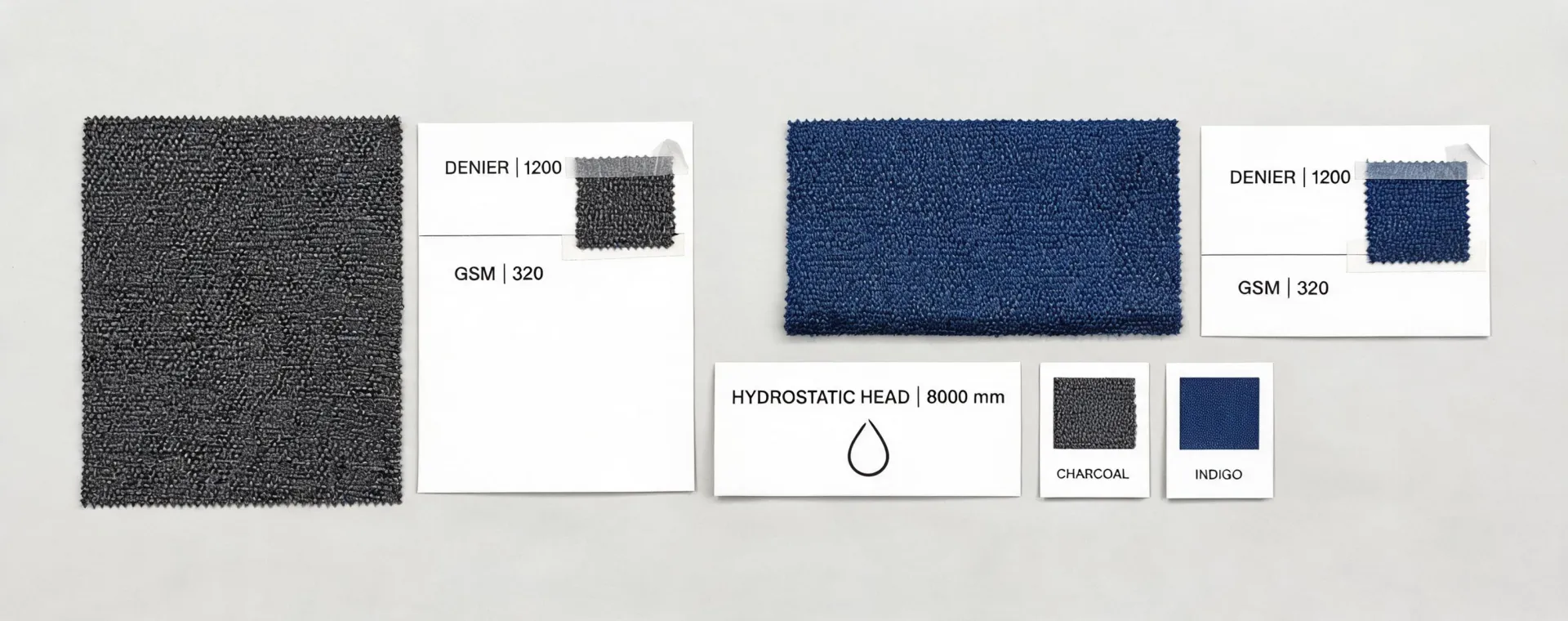
PVC fabric waterproof backing is a real thing — a PVC or polyurethane coating on the back of the fabric creates a barrier water won't pass through. That's what you want for a banquette, a waiting area, or anything near a sink. But not every fabric labeled “PVC” has enough coating weight to matter.
Here's my test: lay the fabric flat, drop a tablespoon of water in the middle, leave it for 30 minutes, then press a paper towel on top. If the towel comes up damp, the coating is too thin or the fabric is only water-repellent, not waterproof. I've sent back two rolls this way.
The idea that you can judge waterproofing by hand feel comes from before coated textiles were common. Today two fabrics with an identical hand can behave completely differently in a spill.
And to answer the question I keep running into: no, fabric paint is not waterproof. Fabric paint is essentially an acrylic medium that cures into a flexible film where you apply it. It doesn't seal the weave around it, and it cracks when the fabric flexes. If someone tells you painting a fabric makes it waterproof, that's a red flag. It makes a decorative surface, not a barrier.
Step 4: Ask for abrasion and lightfastness numbers in writing
Every commercial fabric has two numbers I want: rub count (Martindale or Wyzenbeek) and lightfastness hours. These are measurable. If a supplier can't give them to me, that tells me something.
What I don't want is adjectives. “Durable.” “Long-lasting.” “Premium quality.” Those words cost the supplier nothing, which means they're worth nothing to me.
I'll be blunt: any claim that a fabric will never fade or never wear out is a deal-breaker. Nothing in a sunlit lobby is truly fade-proof. I'd rather see a 40-hour lightfastness rating and know I need to rotate the cushions than hear “it'll last forever” and find out in year three that it won't.
Step 5: Ask about the minimum order — directly, in writing
This is where I have a personal bias, so take it as such. I think small orders deserve the same respect as big ones, and I get annoyed by suppliers who act like a 12-yard order is an insult.
My backdrop project needed 9 yards. Nine. One supplier quoted a 40-yard minimum and then stopped answering emails. Another sent the swatch, quoted a per-yard price with no minimum, and shipped in a week. Guess who's gotten every fabric order since.
To be fair, I get why minimums exist — setup costs on a loom are real, and a mill can't run a custom dye lot for nine yards at a profit. But there's a difference between having a minimum and being rude about it. Ask directly: what's your minimum, is there a cut-yard fee, and can I buy sample yardage before committing? A supplier who answers those three questions clearly is worth keeping.
Step 6: Confirm invoicing and compliance before the order goes out
I learned this one the expensive way. In 2023 I bought 60 yards from a new supplier at roughly 35% under our usual source. Great deal — except the only paperwork they could produce was a handwritten receipt. Finance rejected the expense and I ate $2,400 out of my department budget.
The upside was $2,400 in savings. The risk was ending up with no valid deduction. I only asked myself which one was likelier after finance had already said no.
Now I ask three questions before any purchase order goes out: can you provide an itemized invoice with your tax ID, do you have a W-9 on file, and can you meet our delivery window with tracking? If any answer is fuzzy, I don't order. Saving 35% on fabric is not worth a month of arguing with accounts payable.
Step 7: Treat environmental and flame-retardant claims as claims, not facts
Fabric suppliers love words like eco-friendly, recycled, and sustainable. Some of those claims are real. Some are marketing.
Per the FTC Green Guides (16 CFR Part 260), environmental claims have to be substantiated — an unqualified “recyclable” claim, for example, should mean the product is recyclable where at least 60% of consumers can access recycling. That's a specific bar, and a lot of fabric labels don't clear it. FTC advertising guidelines (ftc.gov) also require claims to be truthful, not misleading, and backed by evidence the supplier actually has on file.
Flame retardancy works the same way. If a fabric is sold as FR-treated, I want the certificate and the test standard — NFPA 701 for drapery, California TB 117 for upholstery, whatever applies. If it's inherently FR, I want the fiber content that makes it so. “It's fire-safe” is not a document.
Step 8: Run the total cost, not the per-yard cost
The sticker price is maybe 60% of what a fabric actually costs me. The rest is freight, cut fees, sample costs when I get it wrong, and the labor to send back something that didn't match the swatch.
I keep a simple sheet: per-yard price plus freight, divided by usable yards after waste, plus a line for reorder friction — how annoying it'll be to get another 10 yards in six months. A supplier who's 10% more expensive but ships in three days and invoices correctly beats a cheaper one who doesn't. The way I see it, reliability is a feature I'm paying for.
A few things that still trip me up
Three mistakes I've made more than once:
- Trusting the photo for color. Every screen renders beige differently. If the swatch and the roll don't match, you own the problem, not the screen.
- Skipping the lightfastness question because the fabric is indoors. South-facing windows are brutal. Indoor is not the same as shaded.
- Assuming a big brand means a simple order. A wide range like Romo's is a strength for choice and a headache for coordination. Know which line you're ordering before you call.
I don't have hard data on how often fabric orders go wrong across the industry — my sample size is one office and a few hundred orders. But anecdotally, the failures I've had were almost never about the fabric itself. They were about what nobody asked before the order went out. Hold the swatch. Test the coating. Ask the boring questions. The rest is just paperwork.