-
Scenario 1: Custom Development — You Need an Engineering Partner, Not Just a Salesperson
-
Scenario 2: Locked Spec and a Fixed Date — What a Waterproof Fabric Distributor Should Show You
-
Scenario 3: Sustaining Programs — Qualifying an Upholstery Fabric Supplier for the Long Haul
-
So Which Scenario Are You In?
I work in quality at Glen Raven Mills, which means I sign off on technical fabric before it leaves the building. On an ordinary month, my team reviews roughly 300 production rolls plus pre-production samples for custom OEM programs. I don't say that to impress you. I say it because I've rejected more than a few first lots, and my notes from Q1 2024 show eight lots held for shade drift, coating issues, or a roll that didn't quite match the approved sample.
That puts me in a useful spot when procurement teams ask, “what should we look for in a fabric supplier?” I'm on the inspected side of the table, so I know which checks are genuinely useful, which ones are mostly theater, and which ones separate a good supplier from a frustrating one.
The honest answer is that there is no universal checklist. A waterproof fabric distributor that works perfectly for one company might be the wrong choice for a brand that's still developing a custom product. The criteria change with your situation. Different scenarios, different red flags.
In my experience, technical fabric buying tends to fall into three scenarios:
- Development. You don't have a locked spec yet. You need a mill that can engineer custom fabric with you—think ripstop fabric oem work or a custom softshell construction.
- Launch. The spec is done, the launch date is not flexible, and you need fabric that is already made or at least already tested. This is where a distributor with real inventory earns its keep.
- Sustaining. You're buying the same styles repeatedly, which is typical when someone is qualifying an upholstery fabric supplier for a furniture program. Consistency over time matters more than any single showroom sample.
A lot of buyers sit in two of these at once. That's normal. It's also a reason to stop asking “which supplier is best?” and start asking “which supplier is best for what I'm trying to do right now?”
Scenario 1: Custom Development — You Need an Engineering Partner, Not Just a Salesperson
How do you know you're in this scenario? Your bill of materials still has question marks in it. You know you want a ripstop nylon or a waterproof breathable fabric, but you haven't locked the denier, the coating, or how the fabric should perform after 20 wash cycles. You need a mill that will help you engineer the product, not just sell you something off a shelf.
This is the moment to look for a supplier that treats “no” as a useful answer. If you share your target spec and the response is an overly smooth “yes, we can do that,” I get cautious. I've watched development projects go sideways because a mill promised more than its finishing line could reliably deliver—particularly with durable water-repellent (DWR) finishes or laminated membranes. The rework cost came out of everyone's pocket, not just the mill's.
The counterintuitive part for buyers: a good custom fabric supplier should push back on your assumptions. They should ask what end use you're targeting, which test standard your industry relies on, and what your acceptable failure rate is. That's not them being difficult. That's them doing quality work before production starts, which is always cheaper than fixing problems after.
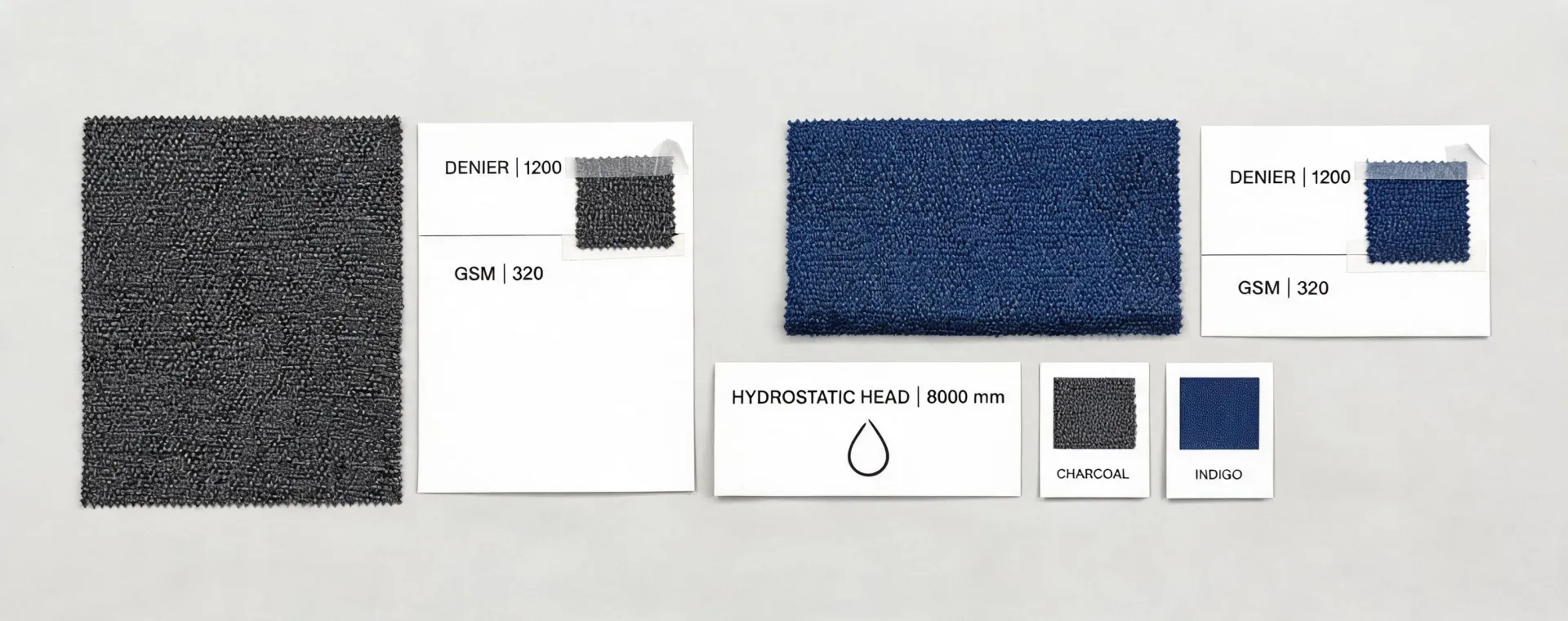
One thing I'd love more buyers to do at this stage is ask for the test method, not just the result. “Waterproof” means very different things depending on the standard. For rainwear, you're probably talking about hydrostatic head, often measured with AATCC 127. For a tent floor, seam integrity might matter more. If a supplier gives you a number but can't tell you which method produced it, the number is close to worthless.
The same logic applies to color. If your brand color is critical, don't accept “we'll match the swatch” without a tolerance. Pantone's own color guidance treats Delta E below 2 as a common benchmark for critical shade matching. A five-minute conversation about tolerances during development is a cheap insurance policy. Five minutes of verification beats five days of correction—that's not a slogan, it's a cost model.
Scenario 2: Locked Spec and a Fixed Date — What a Waterproof Fabric Distributor Should Show You
In the second scenario, the romance is over. The product is designed, tested, and in the catalog. You have a launch date, and the fabric needs to show up in consistent, usable form. If your volume is below a mill's minimum or you need inventory positioned close to production, a waterproof fabric distributor is often the right answer. I'm not going to argue that a direct mill relationship is always better, because it isn't.
The common belief at this stage is that you should pick the supplier with the fastest production. In my experience, speed is rarely the variable that actually sinks a launch. A custom mill can't manufacture its way out of a schedule problem if the fabric doesn't exist yet. Lab dips take time. Finishing trials take time. Testing takes time. If your date is fixed and the spec is frozen, you want stock, not promises.
So what should you look for? Ask a distributor for three things:
- Physical inventory position—not just “we can order it,” but what's actually in the warehouse.
- Lot traceability—can they tie a specific roll to a specific production lot?
- Lot-specific test data—not a generic data sheet, but the actual results for the lot you're buying.
If a distributor says “this style meets the spec” but can't show you a certificate that references the actual lot number, ask why. A good distributor will have that information on hand. A less organized one will treat the question as annoying. That tells you something.
To be fair, some buyers don't need lot-level documentation because their end use isn't that demanding. But if you're buying waterproof fabric for outdoor gear or safety products, the documentation is part of the product. The roll ticket is the fabric's identity. Our own verification protocol, which we implemented in 2022, ties every production roll to its test record. It caught a coating issue that would otherwise have reached a customer's cutting table.
One more piece of advice for this scenario: don't make minimum order quantity your first criterion. It's a reasonable thing to ask about, but a low MOQ means little if the supplier's shade consistency is poor or their record-keeping is weak. A slightly higher MOQ from a supplier that can show you consistent batches is usually the less expensive option.
Scenario 3: Sustaining Programs — Qualifying an Upholstery Fabric Supplier for the Long Haul
Upholstery is where I see the biggest gap between perception and reality. From the outside, two upholstery fabric suppliers look similar: same type of looms, similar finishing equipment, similar certificates on the wall. The reality only shows up when you ask about what happened after the sample was approved.
A physical sample is a promise, not proof. If you're building a furniture line that will reorder the same fabrics for years, you need evidence of consistency across production lots. That means asking about shade bands, dye lot variation, and how often the supplier's own quality team rejects material before it ships.
This is the question that makes people uncomfortable: “Can you show me your internal reject rate?” In my experience the best suppliers don't hide it. They know their numbers because they track them. A supplier that claims they never have defects usually means one of two things—they don't inspect carefully, or they define defects so narrowly that the number is meaningless. Neither is a good sign.
When evaluating upholstery fabric suppliers, look for performance testing that matches the furniture's real use. Abrasion resistance is the obvious one—often tested with ASTM D4157, which you'll hear called Wyzenbeek double rubs. Colorfastness to light matters just as much for a piece of furniture sitting in a sunny room. If your supplier can talk about AATCC 16 and knows which cycle count your contract segment expects, that's a meaningful signal.
I'd also push buyers to set up the inspection plan before the purchase order, not after the first bad shipment. If you're sourcing at scale, an incoming quality agreement—or an AQL-based inspection at the supplier's warehouse—should be a normal part of the conversation. A supplier that reacts badly to that request might be hiding something. A supplier that helps you define it is showing you how they handle problems, which is exactly what you need to know.
So Which Scenario Are You In?
Here's a quick way to decide, in case it isn't obvious:
- If you're still choosing between coatings, weights, or finish options, you're in Scenario 1. You need an engineering conversation, not a quote.
- If your spec is frozen and you need fabric on a hard date, you're in Scenario 2. Prioritize available inventory, lot traceability, and test documentation.
- If you've been ordering the same SKU for several seasons and the real question is whether this supplier will still be reliable next year, you're in Scenario 3. Focus on consistency data, internal reject rates, and audit willingness.
These scenarios shift over time. A brand might start with Glen Raven Custom Fabrics to develop a proprietary ripstop, then move to a stock program once the product proves itself in the market. That transition is natural. What doesn't work is treating one supplier relationship as if it has to serve every stage equally.
From where I sit, the real lesson is that prevention beats rework in every one of these scenarios. The cost of a problem found at pre-production is a fraction of the cost of the same problem found after 50,000 yards are cut. The suppliers worth keeping are the ones that want to have difficult conversations early—about test methods, tolerances, and what happens when something doesn't pass. That's not an annoying supplier. That's a quality supplier, and you'll know it when you find one.