-
Who This Checklist Is For
-
Step 1: Define Your Specs Before You Get a Quote
-
Step 2: Request Physical Swatches, Not Digital Color Cards
-
Step 3: Ask What They Don't Do Well
-
Step 4: Verify Colorfastness With Your Own Testing
-
Step 5: Confirm Stock Depth—Not Just Availability
-
Step 6: Get a Written Rolls-to-Yard Variance
-
Step 7: Lock Acceptance Criteria in the Contract
-
What Usually Goes Wrong
Who This Checklist Is For
If you're sourcing nylon, polyester oxford, or swimwear fabric from a distributor and you've never worked with them before, this is for you. I'm a quality and brand compliance manager at a mid-size OEM. I review every fabric batch before it goes into production—somewhere north of 200 lots a year. In 2024 I rejected 14% of first deliveries. That's down from 22% in 2022, mostly because I stopped trusting spec sheets and started running this checklist instead.
Seven steps. Takes about two weeks if you do it right. Skips a category of problem that costs real money—the kind that shows up six weeks later when 8,000 units are already cut and sewn.
Here's the sequence.
Step 1: Define Your Specs Before You Get a Quote
Most buyers ask for pricing first and figure out specs second. That's backwards. If you don't know your denier, your weight (GSM), your finish (DWR, PU coating, calendered), your colorfastness target, and your shrinkage tolerance before the first quote, you're not comparing fabric—you're comparing numbers that don't mean the same thing.
Put it in writing. One page. Send it with your RFQ.
A distributor who responds with questions is a good sign. A distributor who responds with a price and nothing else—that's a warning. They're either guessing, or they're going to ship you whatever was closest to the dock.
I learned this the hard way in 2022. We needed a lightweight ripstop for a pack line. I sent an RFQ with "210D nylon ripstop, PU coated, ~70 GSM" and got four quotes back in a day. The cheapest one won. Turned out their GSM was measured after coating, ours was measured before. We received fabric that was 18% heavier than spec. That's a real cost on shipping, and it changed the drape of the finished bag. We ate it.
Now every RFQ includes a measurement method. Every time.
Step 2: Request Physical Swatches, Not Digital Color Cards
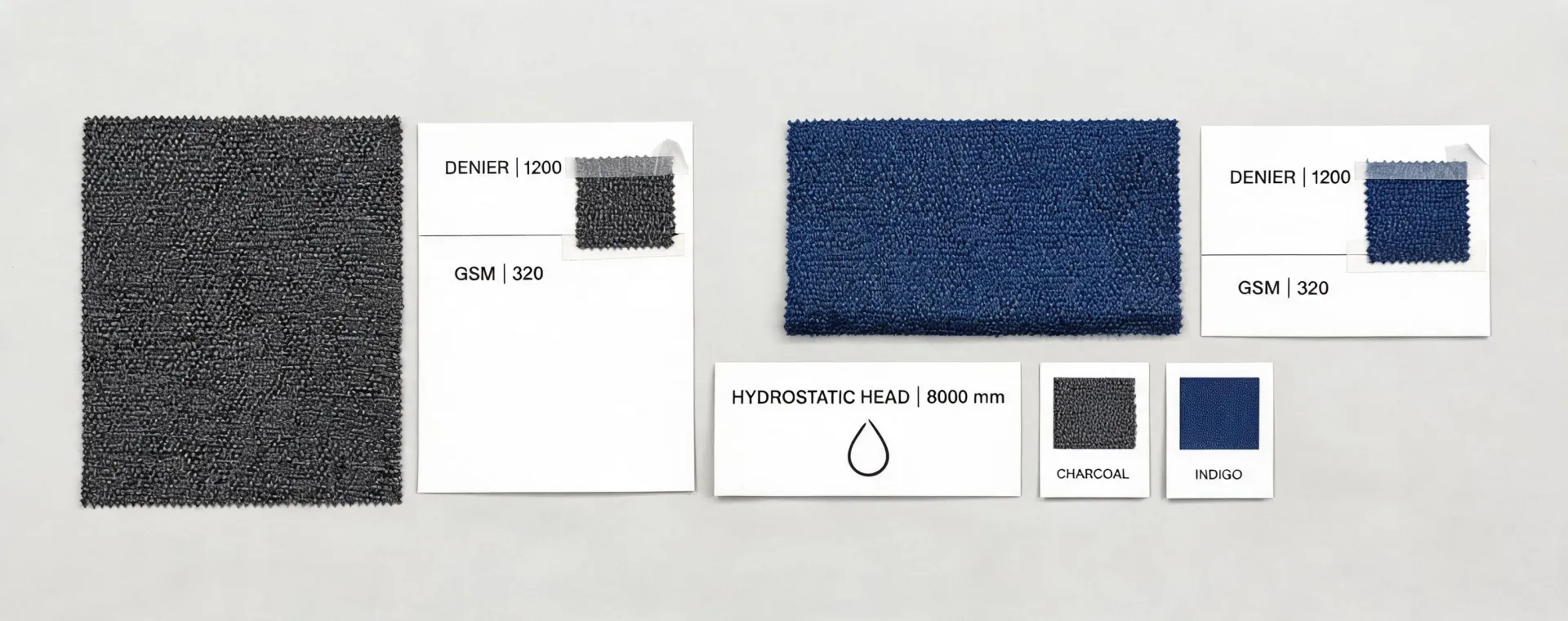
Digital color cards lie. Your monitor lies. Their monitor lies. Hull and lab dips are the only things that tell you the truth, and only if you're holding them under the same light you'll use in manufacturing.
Ask for:
- A swatch of the actual production lot (not a stock card from 2021)
- Enough yardage to test—half a yard minimum
- A sample of the same fabric in the finish you specified (DWR, PU, silicone, whatever)
When a distributor says "we can send you a card," ask if it's from current stock. If they hesitate, that's your answer.
One more thing on this step: if you're sourcing breathable fabric for performance outerwear or swimwear, test the breathability yourself. ASTM E96 or your lab's equivalent. Don't take the spec sheet number. I've seen two mills quote "5,000 g/m²/24hr" on the same construction and get results that were 40% apart. Both were technically telling the truth about their own test. Same fabric, different measurement conditions.
Step 3: Ask What They Don't Do Well
This one sounds odd. Trust me on it.
Every distributor will tell you they handle everything: waterproof, breathable, softshell, hardshell, upholstery, swimwear. Ask one directly—“what's outside your wheelhouse?”—and watch what happens.
The good ones answer. They say things like "we're strong on woven nylon but we source swimwear knit from a partner mill—we don't run it in-house." Or "our color matching is solid but our specialty print capability is limited."
The bad ones say they do it all. Same energy as a contractor who claims to be a plumber, electrician, and roofer. You know how that ends.
I'd rather work with a specialist who knows their limits than a generalist who overpromises. The distributor who told me “this isn't our strength—here's who does it better” earned my trust for everything else.
That's not a soft point. It's a quality signal. It means they know their process well enough to describe its edges.
Step 4: Verify Colorfastness With Your Own Testing
Colorfastness is where most B2B fabric problems start. Not because distributors are lying—because test methods vary and everyone quotes the number that looks best.
Common tests and what they actually cover:
- AATCC 16 (lightfastness): does the color hold up under UV? Critical if the end product lives outdoors.
- AATCC 61 (laundering): does it bleed or shift after repeated washing? Matters for swimwear and apparel.
- AATCC 8 (crocking): does it rub off? Especially on dark dyes against light trim.
Ask what they tested against. Ask for the report. If they can't produce one, run it yourself or walk away. I use a third-party lab for anything going into a line we can't afford to recall.
Budget roughly $150–400 per test depending on method and lab. Cheaper than a product pull, cheaper than a reputation hit.
Step 5: Confirm Stock Depth—Not Just Availability
“In stock” and “available” are not the same word.
Ask:
- How many yards of this specific lot do you physically hold?
- Is that lot from one dye batch or multiple?
- If I reorder in 90 days, will it match the current lot?
Number two is the one buyers miss. A distributor with 40,000 yards spread across three dye lots will ship you fabric that looks consistent on the roll and doesn't in the final product. Dye lot matching is a real thing and it should be written into your PO.
If you need Glen Raven custom fabrics or similar technical constructions, this step matters even more. Consistency is the whole value proposition of a technical fabric. If lot A and lot B don't match, you've paid for a spec you can't use.
Step 6: Get a Written Rolls-to-Yard Variance
You order 1,000 yards. You receive a 40-yard roll that measures 37.2. Over 25 rolls, that's 70 yards missing. That's not shrinkage—that's a payable gap.
Ask for the mill's roll-length tolerance policy in writing. Industry norms sit around ±2–3% on roll length, but that number varies. If the distributor won't put it in writing, they either don't know or don't want to commit.
A buyer I know audited a 12-roll delivery and found a 5% shortfall across the shipment. That's a four-figure credit they had to fight for. Don't skip this step.
Step 7: Lock Acceptance Criteria in the Contract
Everything above leads here. Your PO or supply agreement should state:
- Spec with measurement methods named
- Required test reports (which test, which method, which lab is acceptable)
- Acceptable lot variance (color, weight, roll length)
- What happens if a batch fails—replacement timeline, who pays freight, credit terms
If the distributor pushes back, that's information. The good ones already have this language. They've been burned too.
We didn't have a formal acceptance clause in our contracts until 2023. Cost us when a batch of PU-coated nylon failed crocking and the distributor refused the return—no agreed spec meant no agreed failure. Now every contract has a one-page acceptance annex. Should have done it after the first incident, not the third.
What Usually Goes Wrong
Three mistakes I see most often, including in my own early orders:
Prioritizing price over spec clarity. The cheapest quote is cheapest because something got dropped—a finish, a test, a lot-matching step. Numbers without specs aren't comparable.
Testing samples but not production lots. A sample from the sample room and a production roll are different animals. Test what you'll actually cut.
Skipping the rejection clause. If you don't define what “failed” means and what happens next, every quality issue becomes a negotiation. And you're the one holding inventory you can't use.
I don't have hard data on industry-wide rejection rates, but based on our five years of sourcing, my sense is first-delivery quality issues hit somewhere between 10–20% of orders when specs aren't locked. That number drops to under 5% when steps one through seven are actually followed.
Not perfect. But workable.
The checklist isn't a guarantee. It's a filter. Run it, and the distributors who can't keep up will filter themselves out before you sign anything.