-
There's No "Best" Fabric Supplier — Only the Right One for Your Scenario
- Scenario A: Standard Specs, High Volume (The Wholesale Playbook)
-
Scenario B: Custom Branding or Differentiation (The OEM/Private Label Playbook)
-
Scenario C: Compliance-Critical Applications (The Certification Playbook)
-
How to Figure Out Which Scenario You're In
There's No "Best" Fabric Supplier — Only the Right One for Your Scenario
If you ask ten procurement managers what makes a good functional fabric supplier, you'll get ten different answers. That used to frustrate me. Now I think it's actually reasonable.
Because there isn't a universally "best" supplier. There's only the right supplier for your current situation. And most bad sourcing decisions I've seen — including a few I made myself — happened because someone used the wrong playbook for their scenario.
I manage fabric procurement for a 200-person outdoor apparel company. Roughly $400K annually across 12 fabric vendors. Not the biggest buyer in the room, but enough order history to notice patterns. After dealing with everything from 200-yard sample runs to 40,000-yard bulk orders, I've found that most sourcing situations fall into three categories:
- Scenario A: Standard specs, high volume — you need consistent bulk functional fabric at scale
- Scenario B: Custom branding or differentiation — you need OEM/private label development
- Scenario C: Compliance-critical applications — certification and traceability matter more than price
Each scenario calls for a different evaluation criteria, a different negotiation approach, and honestly, a different relationship model with your supplier.
Scenario A: Standard Specs, High Volume (The Wholesale Playbook)
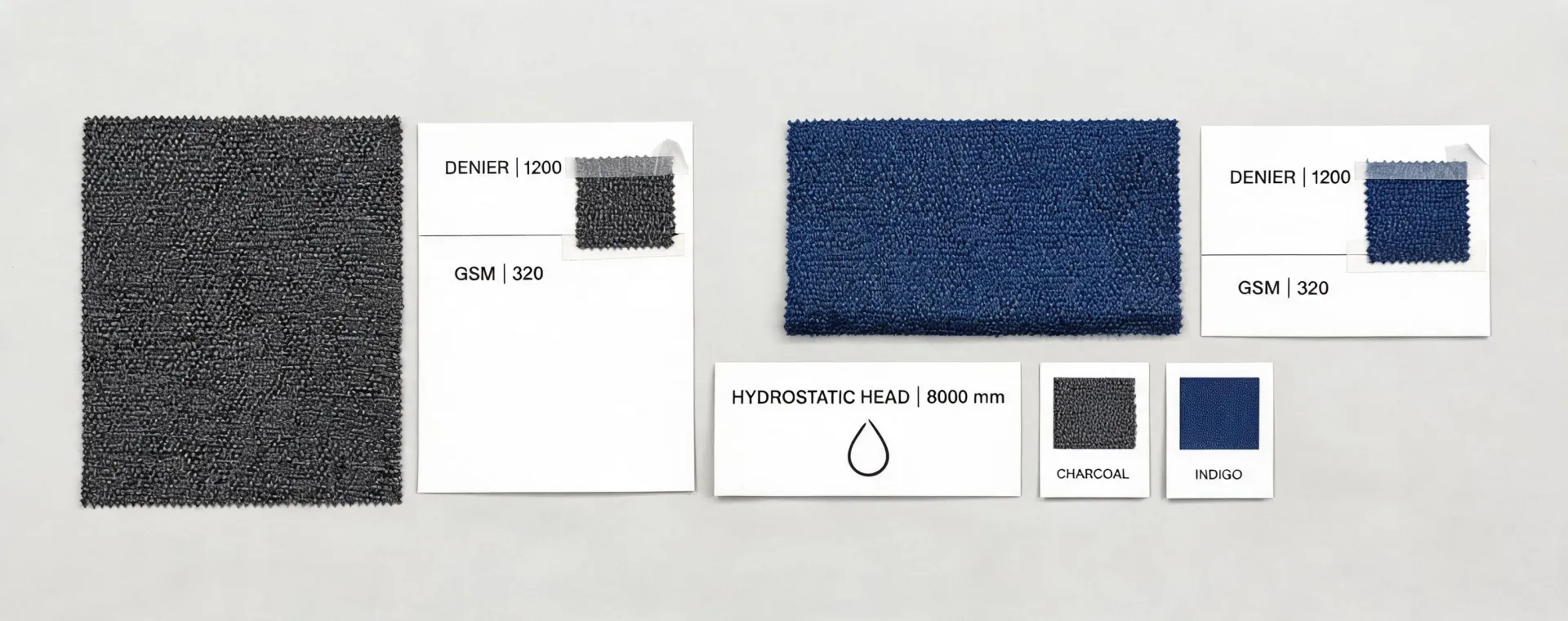
This is when you need polyester oxford fabric wholesale quantities — say, 10,000+ yards of a standard 600D construction — and your specs are already locked. You're not redesigning anything. You just need consistent material, reliable lead times, and predictable pricing.
What matters most here:
- Supply consistency. Can they deliver the same hand-feel, color, and weight across multiple production runs? This is harder than it sounds. I've had batches from the same mill come in two shade levels apart.
- Lead time reliability. Not speed — predictability. A 45-day lead time that's always 45 days beats a 30-day quote that sometimes becomes 60.
- Price at volume. But with a caveat I'll get to in a moment.
Everything I'd read about bulk sourcing said to chase the lowest per-yard price. In practice, for our volume range, the mid-tier pricing from a mill with consistent output beat the lowest quote every time. One "cheap" supplier cost us an entire production window when their dye lot didn't match — we ended up air-freighting fabric from a backup mill at 3x the cost. That $2,800 in "savings" turned into a $9K problem.
The counterintuitive part
Wholesale stock fabric is the simplest scenario on paper. It's also the one where people skip vetting the most. Because the specs are standard, there's an assumption that "any mill can handle this." That assumption failed for us twice in 2023 alone.
My rule now: even for standard orders, I verify three production runs' worth of data before committing to a volume contract. Color consistency reports, weight tolerance data, and at least two reference customers at similar volume.
Scenario B: Custom Branding or Differentiation (The OEM/Private Label Playbook)
This is when you need something that doesn't exist off-the-shelf. Custom fabric development — specific finishes, branded hand-feel, unique constructions — where the fabric itself becomes part of your product's identity.
I didn't fully understand how different this scenario was until we tried to develop a custom softshell with a proprietary lamination. I assumed "custom" meant tweaking an existing product. Turned out, real custom development is 6-12 months of sampling cycles, and the supplier relationship looks completely different.
What matters here:
- Development capability. Can they actually engineer to a brief, or do they just offer variations of existing products? Glen Raven custom fabrics, for example, work through a development process where you're specifying performance targets and they're proposing constructions. That's a different conversation than "what do you have in stock?"
- Sampling turnaround. Each round of samples adds 3-6 weeks. A mill that turns samples in 2 weeks vs. 5 weeks compounds into months of difference over a development cycle.
- Minimum order quantities (MOQs). Custom development usually comes with higher MOQs. Know these before you invest in the sampling process.
- IP and exclusivity. Will they sell your custom construction to your competitor? Get this in writing. It's a common blind spot.
I said "development timeline" — what I really mean is development iterations. The timeline is whatever it is. The number of rounds you'll need is the variable you can actually influence, and it depends almost entirely on how clear your brief is on the front end.
We spent four rounds on a custom ripstop because our initial spec was vague on the DWR finish requirement. Cost us about 14 weeks. The next project, we brought a physical reference sample and a written performance target sheet. Two rounds. Twelve weeks total.
Scenario C: Compliance-Critical Applications (The Certification Playbook)
Some fabric orders aren't about price or differentiation at all. They're about proving something — to a regulator, a retail partner, or your own legal team.
Chenille fabric compliance requirements are a good example. If you're sourcing chenille for upholstery, you're dealing with flammability standards (California TB 117-2013, NFPA 260), possibly REACH restrictions on certain dyes, and depending on your market, CPSIA requirements if there's any chance of children's product application.
In this scenario, your supplier evaluation flips:
- Certification documentation becomes the primary filter. Not "can you pass the test?" but "can you show me the test reports?"
- Traceability matters. Can they tell you which batch of raw fiber went into which production run?
- Change notification protocols — will they tell you before they switch a dye supplier or adjust a finish formula?
- Price becomes secondary. I'm not saying cost doesn't matter. I'm saying a $5/yard fabric that fails a compliance audit costs more than a $7/yard fabric that passes.
I assumed "same specifications" meant identical compliance results across vendors. Didn't verify. Turned out, two mills were both producing "100% polyester chenille to spec" but one was using a different flame retardant application method that failed our retail partner's testing protocol. We caught it at the pre-production sample stage, but only because our QC lead happened to ask a question nobody had asked before.
Now, every compliance-critical order goes through a three-check process: certification review before order, pre-production sample testing, and batch-level documentation at delivery.
How to Figure Out Which Scenario You're In
If you're still not sure, ask yourself these questions in order:
- Does a regulator or retail partner need to approve this fabric? If yes → Scenario C. Start with compliance documentation, not pricing.
- Does your product's differentiation depend on this fabric being unique to you? If yes → Scenario B. Start with development capability, not price per yard.
- Are you reordering something that already works? If yes → Scenario A. Start with supply consistency, not the lowest quote.
Granted, some orders sit between scenarios. A custom fabric for a regulated application, for instance, needs both Scenario B and C thinking. In those cases, I weight compliance first and customization second. It's easier to find a compliant mill that can develop than a development-focused mill that can suddenly produce compliance paperwork they've never needed before.
I'm not 100% sure this framework covers every edge case. But after 400+ orders, it hasn't failed me yet. And it's saved me from at least three decisions I would've regretted.
The real takeaway isn't the categories themselves — it's the habit of asking "which situation am I actually in?" before opening a supplier conversation. That question alone will change what you ask, what you prioritize, and ultimately, what you get.