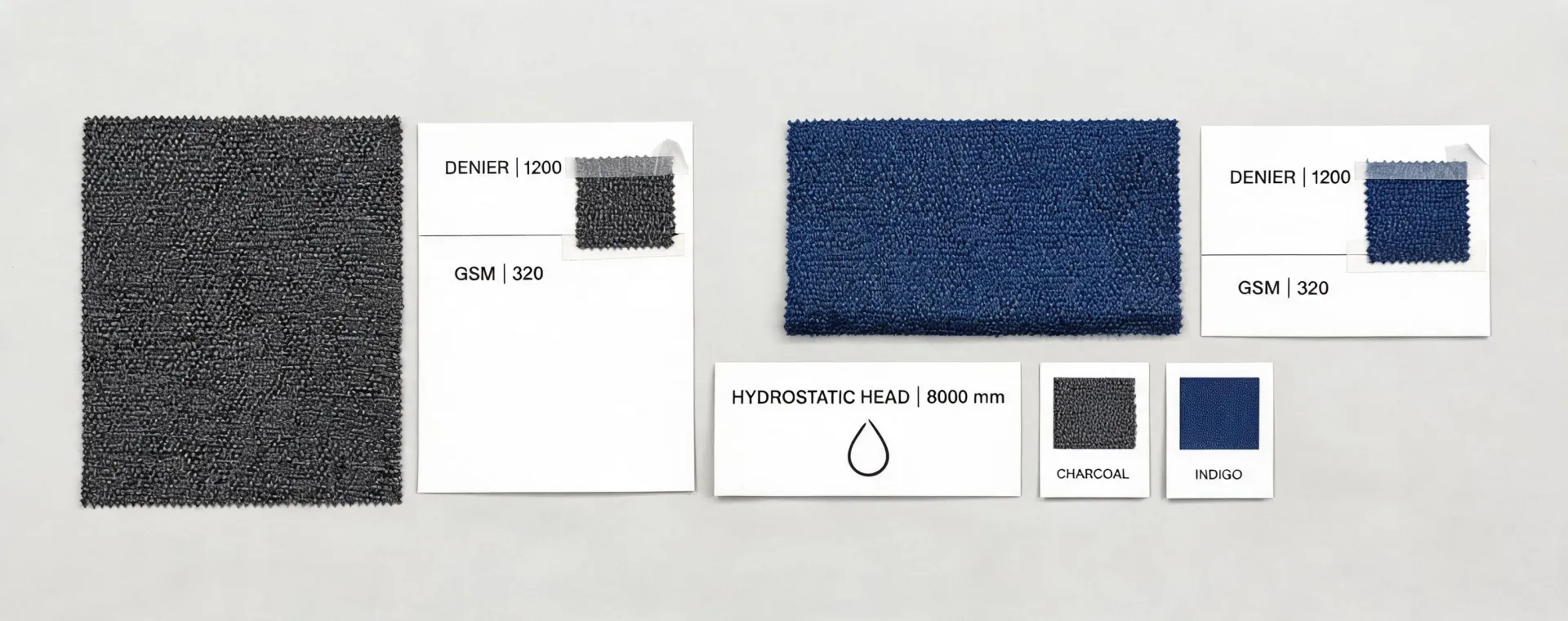
It was February 2024, roughly 6:40 PM on a Thursday, and I was still at my desk when the email came through. Our production partner in Vietnam had just told us the mill they'd subcontracted couldn't finish our hardshell fabric order. Eighty percent of the yardage was still unproduced. We needed 8,000 yards, DWR-finished, in three weeks — or the container was going to miss its sailing window and our client's winter softshell line would land on shelves two months late.
I've been coordinating fabric procurement for a mid-size OEM and private label operation for about eight years now. I've handled maybe 200+ rush orders across nylon, polyester, ripstop, and various laminates. But this one was different. This wasn't "we need it a week early." This was "we need it or the contract dies."
Here's what I learned — and why I now budget differently for situations like this.
The First Instinct Was Wrong
My initial reaction was to chase the cheapest quotes fast. Classic mistake. I fired off RFQs to five suppliers — two overseas mills, two domestic distributors, and one broker I'd worked with before. Within 48 hours, three came back.
The cheapest quote was about 22% below what we'd normally pay. The broker promised "7–10 business days" for delivery. The second-lowest was similar. Both had vague answers when I asked about production status — which, looking back, should have been the first red flag.
I almost went with the cheapest one. The math looked fine on paper: 8,000 yards at a discount meant roughly $3,200 in savings. Why wouldn't I take that?
Then I called our logistics lead and ran the numbers on what a missed deadline actually costs. Late container fees. Air freight rerouting. Client penalty clauses. Potential loss of the account — which was worth about $180,000 annually. Suddenly that $3,200 "savings" looked absurd.
Uncertain cheap is more expensive than confirmed not-cheap. Every time.
The Turning Point
I had about two hours to make a call before our client's PM needed an answer on whether we could still hit the window. Normally I'd want at least three days for due diligence — verify mill capacity, confirm fiber specs, check references on the DWR finish. There was no time for that.
So I went with a different logic: who has actual inventory or confirmed production slots right now, and can prove it?
That narrowed it down fast. Glen Raven — the North Carolina textile manufacturer — came up in a conversation with a contact at another brand. They had capacity through their custom fabrics division and a reputation for consistent delivery on technical fabric orders. I'd never worked with them directly before, but their name kept surfacing whenever I asked about reliable turnaround on performance fabrics.
Was the price the lowest? No. Not even close. It was roughly 15% above the broker's quote. But here's the difference: they gave me a specific production start date, a specific finish date, and a named contact who I could actually call. No "approximately," no "should be."
I said yes.
What Actually Happened
The order went into production two days later. There were still hiccups — a spec clarification on the DWR finish took an extra 24 hours, and one roll showed a dye-lot variance we had to inspect manually. But we shipped on day five. Not day ten. Not day seven. Five.
The container made its sailing window with about 36 hours to spare.
Looking back, I should have started the process with a call to known reliable mills instead of a mass RFQ to the cheapest options. But given what I knew then — and how many past orders had gone fine with budget suppliers — I understand why I didn't.
Here's the thing nobody tells you about rush fabric orders: the expensive part isn't the fabric. It's the uncertainty. Every day you wait on a vague "should be ready by Friday" promise is a day you can't plan around. And in B2B apparel production, planning is everything.
What I Do Differently Now
After that order, I changed how we handle time-sensitive fabric sourcing:
- I ask for production dates, not lead times. "Lead time is 10 days" means nothing. "Your fabric goes on the loom Tuesday and finishes Friday" means everything.
- I pay for certainty. When a deadline is real, I'm not shopping for the best price. I'm shopping for the supplier who can commit — in writing — to a delivery date.
- I keep a short list of mills with proven track records. Glen Raven is on it. So are two others. I don't need 20 options. I need three I trust.
- I stopped treating rush fees as waste. They're insurance. The premium you pay is a fraction of what missing the deadline costs.
My experience is based on mid-volume orders — generally 2,000 to 15,000 yards. If you're working with small sample runs or massive 100K+ yard contracts, your leverage and your calculus will look different. I can't speak to those scenarios with the same confidence.
But for the in-between space where most OEM and private label programs live? The principle holds. When time is the constraint that matters most, buy the certainty. The cheaper option will still be there next season.
Your client might not be.