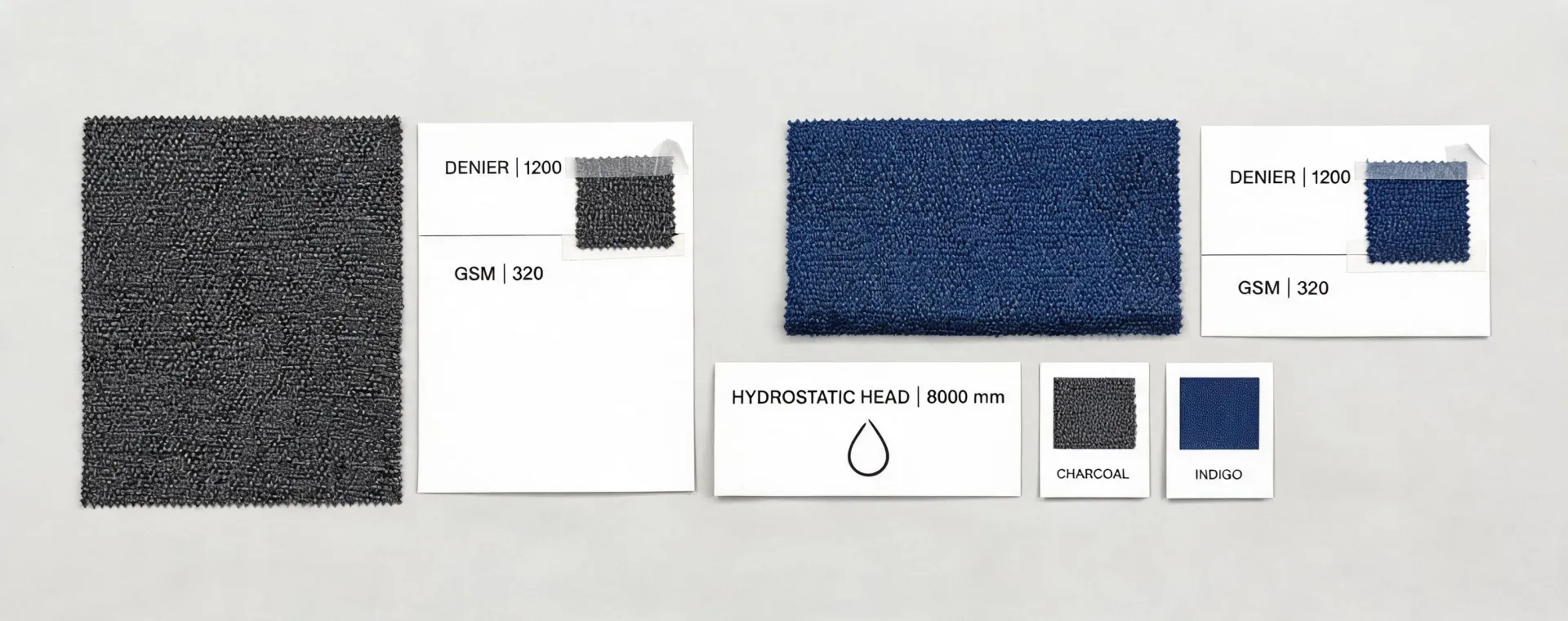
When I first moved into spec review, I assumed custom-developed fabric was always the better buy. Better control, better margins, a better story to tell your customers. Three years of rejected first articles later, I learned that custom programs also blow up over MOQ commitments, ten-week lead times, and dye lots nobody signed off on — while a plain stock 600D oxford quietly kept an entire product line shipping. That's the part that doesn't make it onto a spec sheet.
So here's the comparison I actually use when a buyer asks me which route to take. Stock program on one side, custom development on the other, same five dimensions applied to both.
What I'm Comparing (and Why These Five Dimensions)
Two options. Five dimensions. Minimums, spec control, lead time, total cost, and consistency at scale. In that order — because that's roughly the order in which they kill projects.
One thing before we start: "custom" here means a construction or colorway developed for you, typically under OEM or private-label terms. "Stock" means an existing construction and colorway you buy from inventory. Everything below applies whether you're sourcing bulk oxford fabric, a breathable laminate for outerwear, or upholstery for a furniture line.
Dimension 1: Minimums and Setup Commitment
Stock: Minimums are usually in the hundreds of meters, sometimes lower for sampling. No development fee. You take what's on the shelf, and the shelf may change next quarter.
Custom: Expect minimums in the low thousands of meters per colorway and construction. There's a sampling phase — lab dips, handloom or pilot runs, first articles — and that phase costs money whether or not you proceed.
Verdict: If you can't commit to a dye lot, stay stock. This is the dimension where custom loses most often, and it loses fast. I've watched a brand commit to 6,000 meters of a custom colorway to save $0.40/meter, then sit on 2,800 meters of it for two seasons. That's not a sourcing win; that's a warehouse problem.
Dimension 2: Spec Control
This is where custom earns its keep. And it starts with a hard truth: "breathable" is not a specification. Numbers are.
When you buy a breathable fabric off a stock list, you're often buying a marketing adjective. When you develop one, you can write a real spec — MVTR per ASTM E96 (in g/m²/24h), or RET per ISO 11092, plus a hydrostatic head figure per ISO 811 or AATCC 127. Those two numbers tell you different things, and you need both. A fabric with a 10,000 mm hydrostatic head and a mediocre MVTR is waterproof and clammy. A fabric with a great MVTR and 800 mm hydrostatic head isn't waterproof at all — it's a windbreaker.
Rough reference points for RET: under 6 is very breathable, 6–13 is what most people mean by breathable, and above 20 you've basically built a tarp. Ask which test method and which condition set the number came from, because they don't translate cleanly.
Upholstery has the same trap. Wyzenbeek (ASTM D4157) and Martindale (ISO 12947) are different test methods that don't convert 1:1, so a 30,000-double-rub Wyzenbeek result is not equivalent to 30,000 Martindale cycles. The contract-industry baseline most specifiers work from is 15,000 double rubs minimum for general contract use. If a supplier hands you a single number with no method attached, that number is decoration.
Verdict: Custom wins, but not for the reason most people think. The advantage isn't a better fabric — a good mill can produce identical performance either way. The advantage is a documented fabric. Two mills can hit the same numbers; only one will hand you lot-by-lot test reports when your retail customer audits you.
Dimension 3: Lead Time and Change Risk
Stock: Days to two or three weeks, depending on whether it ships from a domestic warehouse or a container.
Custom: Six to twelve weeks on the production side, plus three to five weeks of development and sampling up front. First run is often slower than subsequent runs, but not by as much as people hope.
The risk nobody prices in is change orders. Once greige is dyed, a color change is not a change order — it's a write-off. I still kick myself over one in 2022: we approved a shade adjustment verbally after dyeing because a customer asked for it, and the resulting lot was within our tolerance band but outside theirs. Twelve hundred meters went to scrap, and we ate it.
Verdict: If your launch calendar has no slack in it, that's not a pro/con question. Stock wins by default.
Dimension 4: Total Cost (Not Unit Price)
Unit price is the worst way to compare these two. Here's what actually lands on the ledger for a custom program:
- Development and sample fees (lab dips, pilot yardage, first articles)
- Small-lot dye premiums
- Testing costs — third-party abrasion, colorfastness, and hydrostatic testing runs roughly $150–$500 per test per lot, and good buyers run more than one
- Inventory carry on the minimum you had to commit to
- Write-off on unused meterage
Stock has a higher unit price and almost none of that. On a 1,500-meter-per-year program, stock frequently wins on total cost even at a 25% price premium per meter. On a 20,000-meter program with a brand-critical color, custom usually wins — but only after the development costs are amortized across at least two or three production runs.
Verdict: Do the math on landed cost, not quoted price. And note that the lowest quote in the room is rarely attached to the most useful documentation.
Dimension 5: Consistency at Scale — The Surprise
The surprise wasn't the price gap. It was where defects actually come from.
In 2024 we rejected close to 9% of first-article submissions. When I traced the root causes, most of them pointed at us, not the mill. Spec language like "soft hand," "matte finish," or "premium feel" is not measurable, so it gets interpreted — and interpretation drifts. Once we rewrote specs around measurable criteria (weight in g/m² at ±5%, width at ±3%, color at Delta E < 2 against an approved standard, minimum rub counts by named test method), first-article rejections dropped by more than half.
For color specifically, the tolerance bands matter. Delta E under 2 is generally considered imperceptible for brand-critical colors; 2–4 is noticeable to a trained eye; above 4 is visible to most people under normal lighting. Reference your color to a physical standard (Pantone TCX/TPG for textiles) and state the tolerance in writing — otherwise "close enough" becomes an argument you can't win.
Verdict: Consistency is a specification problem before it's a manufacturing problem. This is true for custom and stock alike, but custom is the only route where you can fix it.
How to Decide
Choose stock if: you're under roughly 2,000–3,000 meters per construction per year; you're using standard colorways; your calendar is tight; you're test-marketing a product; or you don't have the QC bandwidth to run a development program properly.
Choose custom if: you're above roughly 5,000 meters per year on a single construction; your color is brand-critical and needs continuity across seasons; your retail or contract customers require documented test reports; or the construction you need simply doesn't exist off the shelf (a 300D ripstop with a specific laminate, for instance).
Or do both. This is the hybrid most brands I work with actually run: stock for the first production run to validate demand, then custom once volume is real. It costs a little more in the first year and saves a lot in the second.
This is also where it helps to work with a mill that runs both under one roof. Glen Raven's roots as Glen Raven Mills go back to 1880 in North Carolina, and Glen Raven custom fabrics programs sit alongside their stock capability — which sounds like a brochure line until your stock colorway gets discontinued and you need a custom match with continuity behind it. That's the moment the two-option comparison stops being theoretical.
And the Honest Answer
If you're buying 800 meters of black 600D oxford four times a year, custom development is the wrong answer for you. Full stop. It'll cost you more, take longer, and you'll spend the development fee on a construction that already exists.
No option wins this comparison outright — the dimensions don't point the same direction, and pretending otherwise would just be sales copy. Figure out which dimensions your business can't compromise on, and the choice usually makes itself.