-
Who This Checklist Is For
-
Step 1: Define the Performance Spec Before You Ask for Pricing
-
Step 2: Ask for Test Methods, Not Just Marketing Words
-
Step 3: Decide OEM vs Private Label Before Sampling
-
Step 4: Test the MOQ With a Small Trial Order
-
Step 5: Request Lab Dips and Check Color Tolerance
-
Step 6: Verify Documentation and Invoicing Before Bulk
-
Step 7: Build a Backup Supplier (The Step Most People Skip)
-
Common Mistakes and Things I Wish I’d Tracked
-
A Note on Glen Raven, Glen Raven Mills, and Glen Raven Custom Fabrics
-
The Short Version
I’m an office administrator for a 45-person outdoor accessories company. I manage fabric sourcing—roughly $180,000 a year across six vendors. I report to operations and finance, which means I get it from both sides if a fabric order goes wrong. This checklist is for small-to-mid procurement teams, founders, and ops folks who need to vet a water-resistant fabric wholesale supplier without wasting three months on samples. There are seven steps. None are complicated. Most people skip two of them.
Who This Checklist Is For
Use this when you’re sourcing bulk polyester oxford fabric, softshell, ripstop, or another technical fabric for an OEM or private label program. It works whether you’re buying 300 yards for a pilot run or 30,000 yards for a seasonal launch. It’s not for buying craft fabric on a marketplace. The stakes are different.
One thing I’ll say upfront: small orders shouldn’t get treated like a nuisance. When I started in 2020, our first fabric order was 120 yards. The vendors who took that seriously are the ones I still call today for 12,000-yard orders. Small doesn’t mean unimportant—it means potential.
Step 1: Define the Performance Spec Before You Ask for Pricing
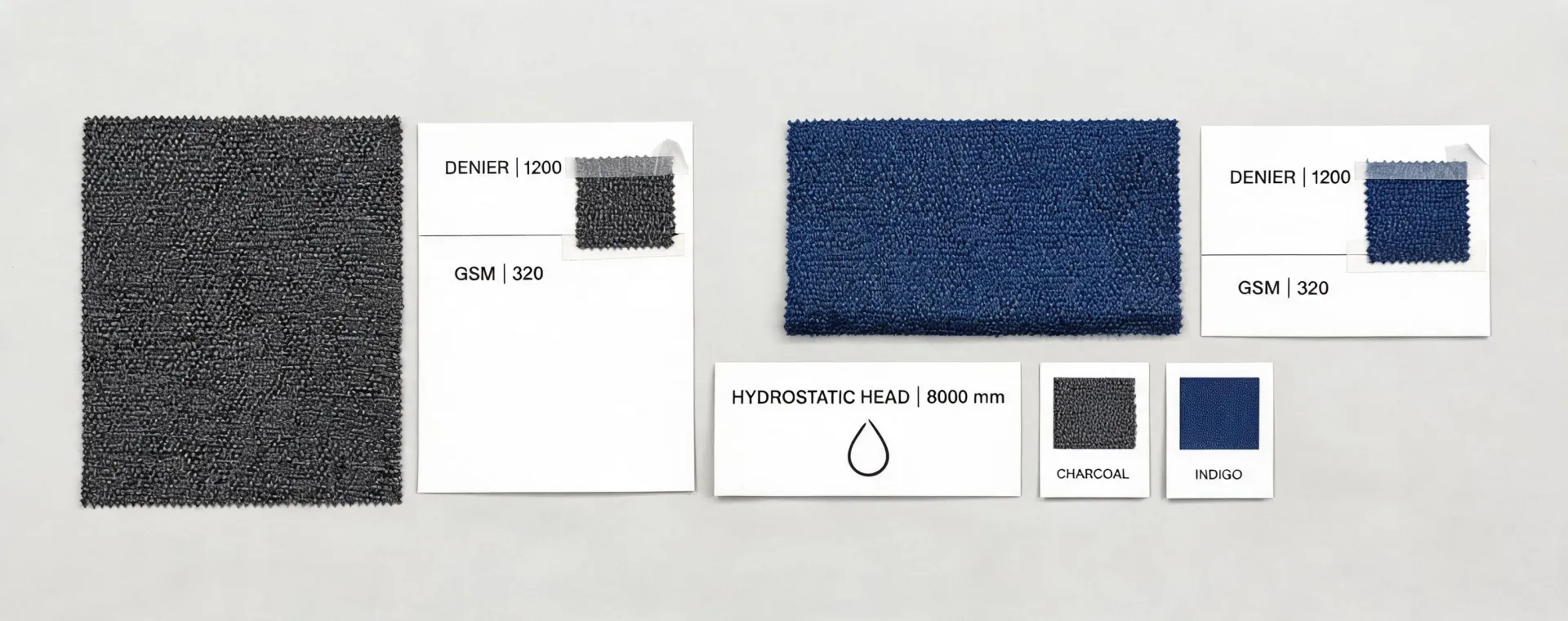
Don’t send “waterproof fabric” in a quote request. That phrase means different things to different mills. Write down the end use: backpack, jacket, pet bed, awning, upholstery, whatever. Then list the specs that matter:
- Weight and construction (denier, yarn count, weave)
- Water resistance target and test method
- Breathability, if relevant
- Abrasion and tear strength
- Colorfastness to light and washing
- Coating or finish (PU, PVC, acrylic, DWR, etc.)
This is the step where I learned to slow down. If you don’t define the spec, every quote comes back with a different fabric. You can’t compare them. I don’t have hard data on how often this causes rework, but based on our own orders, I’d guess it’s the single biggest reason first-round quotes are useless.
Step 2: Ask for Test Methods, Not Just Marketing Words
“Water resistant” and “waterproof” aren’t interchangeable. Ask which standard the mill uses and what the actual result is. If they can’t name the test method, that’s a red flag. You want a spec sheet with test methods, not a brochure with adjectives.
Also ask whether the test was run on the greige fabric, the finished fabric, or a lab sample. The answer changes what you’re actually buying. I went back and forth between two suppliers on this for a week. One had a beautiful marketing deck. The other had a boring PDF with test methods and tolerance ranges. I chose boring. The deck supplier couldn’t tell me whether the coating was on one side or both.
Step 3: Decide OEM vs Private Label Before Sampling
This is where a lot of fabric procurement gets messy. Waterproof fabric OEM vs private label is not just a labeling question.
In simple terms: OEM usually means the fabric is built to your specification—construction, finish, color, maybe exclusivity. Private label usually means you’re buying a mill’s existing fabric and putting your brand on the final product or packaging. Both can work. They have different minimums, lead times, and ownership terms.
Ask four questions before you pay for a sample:
- Who owns the fabric construction if we develop it together?
- Can we buy the same base fabric later if we need a reorder?
- What’s the MOQ for OEM vs private label?
- Is there any exclusivity window, and what does it cost?
I didn’t ask the ownership question on our first custom color run. Nothing bad happened, but I spent two weeks nervous that our “custom” green was going to show up in someone else’s catalog. Now I ask. It’s a five-minute conversation that saves a lot of stress.
Step 4: Test the MOQ With a Small Trial Order
MOQs are real. A mill can’t always run 50 yards efficiently. But a good supplier will find a path for a serious buyer—stock yardage, a pilot run, a sample roll, or a higher per-yard price for low volume. That’s fair. What isn’t fair is getting ignored because your first order is small.
When I took over purchasing in 2020, I had a vendor laugh at our 200-yard request. Another vendor sent a stock list, quoted a reasonable pilot price, and shipped in nine days. Guess who got our next three orders? The small-order-friendly supplier. Not because they were cheap—because they were easy to work with.
If a supplier won’t do a trial order, ask what they can do. If the answer is “nothing,” move on. There are too many mills in the water resistant fabric wholesale market to beg for attention.
Step 5: Request Lab Dips and Check Color Tolerance
Color is where small fabric orders go to die. Screens lie. Lighting lies. Your memory lies. Get a physical lab dip.
Ask for the color target in Pantone or another accepted system, and ask what Delta E tolerance they can hold. Industry standard color tolerance is Delta E < 2 for brand-critical colors. Delta E of 2–4 is noticeable to trained observers; above 4 is visible to most people. Reference: Pantone Color Matching System guidelines.
Then check the dip under the light you’ll actually use. Retail floor, outdoor daylight, warehouse fluorescent—it matters. I approved a “close enough” dip in our office under warm light. Outside, it looked yellow. We ate the rework. Now I keep a daylight lamp and a gray card on my desk. It sounds fussy until it saves you $4,000 in rejects.
Step 6: Verify Documentation and Invoicing Before Bulk
This is the least glamorous step. Do it anyway. Before you place a bulk order, confirm:
- Commercial invoice format and required fields
- HS codes and country of origin
- Shipping terms (Incoterms)
- Test reports or certificates you’ll need for customs or retail
- Packaging and labeling requirements
- Payment terms and currency
I once found a great price on a small fabric lot—$1,200 cheaper than our regular supplier. The vendor couldn’t provide a proper invoice, just a handwritten receipt. Finance rejected the expense. I ate the cost out of our department budget. Now I verify invoicing capability before I even request a sample. A cheap fabric isn’t cheap if you can’t book it.
Step 7: Build a Backup Supplier (The Step Most People Skip)
Everyone says they’ll do this. Few do. You need a second source for anything that touches a launch date. Not a full duplicate program—just a backup. Maybe it’s a stock fabric that’s close enough. Maybe it’s a mill that can run a smaller order quickly. Maybe it’s a distributor with yardage on the floor.
Had two days to decide on a replacement fabric before a trade show in 2023. Normally I’d run three quotes and a lab dip. There was no time. Went with our backup supplier based on trust and a previous order. It wasn’t the perfect color. It was close enough. We shipped on time. In hindsight, I should have built that backup list six months earlier.
Common Mistakes and Things I Wish I’d Tracked
I wish I had tracked more data from the start—defect rates, on-time delivery, color rejections. What I can say anecdotally is that the first bulk order from a new supplier is where most problems show up. Not because suppliers are bad, but because specs get misunderstood.
Other mistakes I see:
- Treating “water resistant” and “waterproof” as the same thing.
- Assuming OEM and private label have the same MOQ and ownership rules.
- Skipping the lab dip because the digital proof looked fine.
- Chasing the lowest per-yard price and ignoring freight, duties, and rework.
- Not asking whether pricing is current. Pricing accessed in January 2025 may not hold by Q2. Always ask for a validity window.
A Note on Glen Raven, Glen Raven Mills, and Glen Raven Custom Fabrics
If you’re searching water resistant fabric wholesale and bulk polyester oxford fabric, Glen Raven comes up. You’ll see it written as glen-raven, Glen Raven Mills, or Glen Raven custom fabrics. If your program needs technical fabrics and a custom or private label path, it’s a name worth shortlisting alongside other mills.
But don’t let the brand name replace the checklist. Ask the same questions: test methods, MOQ, OEM vs private label terms, lab dip tolerance, documentation, and backup supply. A good mill will welcome those questions. A bad one will dodge them.
The Short Version
Define the spec. Ask for test methods. Decide OEM vs private label early. Test the MOQ with a small order. Get a lab dip. Verify invoices before bulk. Build a backup. Do those seven things and you’ll avoid most of the expensive surprises I’ve already paid for.