The Problem Everyone Blames First
Let me start with a scene that gets me called in way too often. A buyer ordered 5,000 yards of awning fabric. The price was right. The sample was approved. Then the production batch arrived, and the color didn't match. One roll measured 58 inches wide. Another measured 60. The coating had a strange texture under a loupe. And the install team is standing in a parking lot, waiting.
From the outside, this looks like a supplier mistake. The reality is more uncomfortable: most of these failures are baked in before the PO ever goes out.
In my role as a sourcing manager at a technical textiles supplier, I've spent years at the unglamorous end of textiles—rush orders, failed inspections, last-minute substitutions. Based on our internal data from 200+ rush jobs, about 80% of delays trace back to a sourcing decision made weeks earlier. The actual production mix-up is rare. The real enemy is a misaligned sourcing model.
The OEM vs. Private Label Confusion
People assume OEM and private label are just two ways to say 'put my brand on a roll of fabric.' What they don't see is the production model underneath.
OEM means the mill manufactures to your specification. Yarn type, denier, weave, finish, coating, color, testing. You are buying a technical package, not a SKU. Private label means the mill owns the spec. You choose from their standard fabric range, maybe adjust a color, and they add your brand. Both can be sold as bulk outdoor fabric. Neither is inherently better. But they create different lead times, different costs, and different risk profiles.
This is what people really mean by the 'awning fabric OEM vs private label' question. It is not about which label is on the box. It is about who controls the technical spec.
A mill like Glen Raven sits firmly on the OEM side when it offers custom fabrics. When you order Glen Raven custom fabrics, the entire construction—from yarn to finish—is defined around your application. That distinction matters more than the marketing language around it.
Bulk Nylon Fabric Is a Search Term, Not a Specification
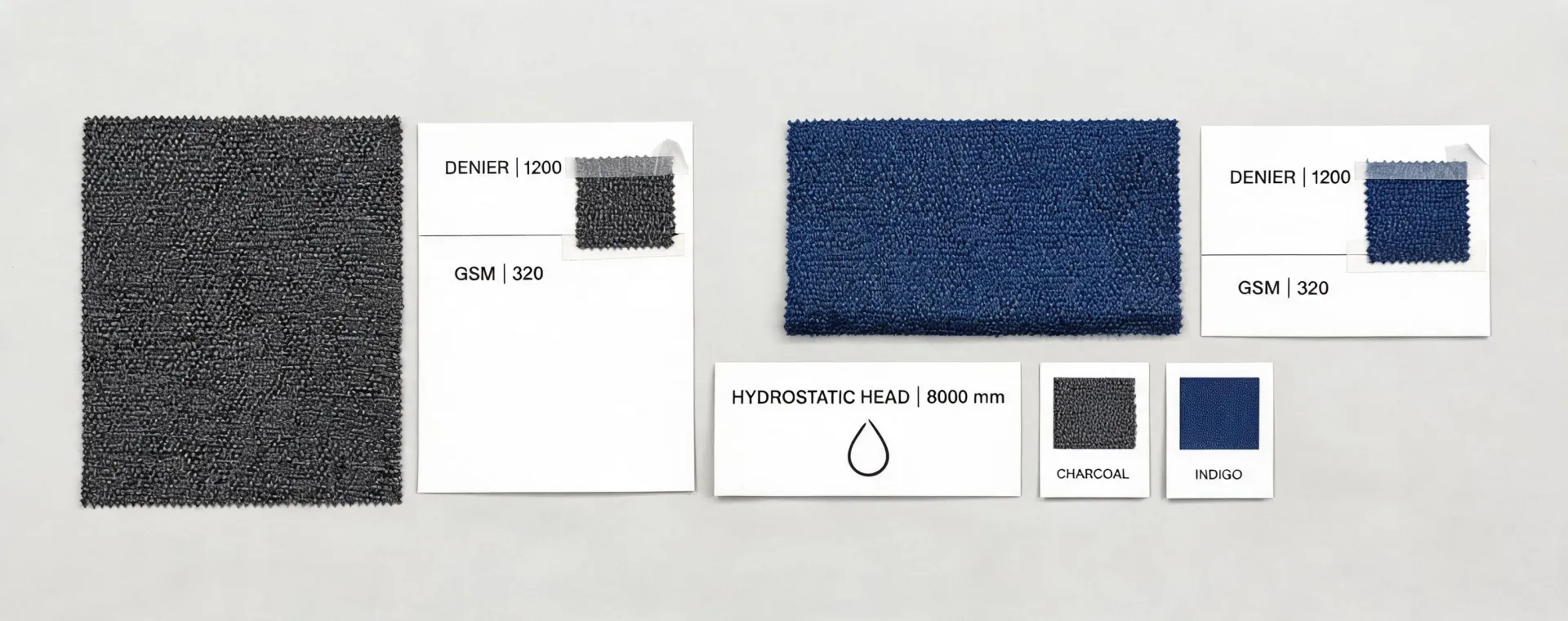
Let's talk about bulk nylon fabric for a second. It sounds like a commodity. But 'nylon' covers a huge range: nylon 6 and nylon 6,6; 70D, 200D, 500D, 1000D; woven and knitted construction; PU coating, PA coating, silicone coating; C0 or C6 DWR; FR treatments; UV stabilizer packages. Two fabrics that both get called bulk nylon fabric can perform completely differently after three months of direct sun.
Most buyers focus on per-yard price and roll width. They completely miss the specifications behind the quote. The question everyone asks is, 'What is your best price for bulk nylon fabric?' The question that actually protects you is, 'What is the exact specification behind that price?' If a supplier can't answer in one sentence—yarn denier, construction, finish, coating, width—you don't have a quote yet. You have a guess.
Mills Are Not Fast-Fashion Warehouses
Here's the thing I wish more buyers understood: fabric mills plan production in waves, not on demand. Ordering custom fabric from an integrated textile mill means your order is inserted into a schedule that started months ago. The dye kitchen plans dye lots around machine capacity. The finishing line has its own queue. The testing lab needs time for wash trials, lightfastness tests, and physical performance checks.
If you've ever tried to rush a custom fabric order, you know the warning: you can't compress chemistry. Rush fees move your order up in the admin queue. They don't speed up a polymer curing or a dye strike. When you push a mill to go faster than the process allows, you are asking for compromise. Color lots may drift. Coatings may not cure evenly. Then you end up with a bigger delay than the one you were trying to avoid.
What These Mistakes Actually Cost
Let me give you a real example. In June 2023, a client was contracting 4,200 yards of awning fabric for a hotel renovation. Their purchasing team had bought from a broker who assured them a standard private-label fabric would work fine. The price saved them about $0.29 per yard. Then the hydrostatic head test failed the specified minimum. The trailer was already 60% sewn.
They called us on a Thursday. We sourced a replacement custom fabric, paid for expedited freight, and got the first 1,000 yards to the cut-and-sew shop by Tuesday. Total extra cost? More than $40,000. The initial savings on that order had been about $1,200.
That math never makes it into the initial comparison. But it is the math that decides whether a project survives. That experience is why we now require a technical spec sheet before any bulk fabric PO goes out. It sounds bureaucratic. It saves projects.
When Custom Fabric Is Worth It (And When It Isn't)
Now for the honest part. Not every order needs Glen Raven custom fabrics. If you need a quick run of standard material for a temporary installation, private label stock fabric is probably the better choice. Custom OEM programs come with color development, testing, minimums, and longer lead times. If your volume is small, that weight will crush you. That is not a failure. It is a mismatch.
I'm not saying private label is bad. I'm saying it's a risk decision, not a cost decision. If your product lives outdoors for years, carries a warranty, or depends on consistent color across seasons, the private-label model starts to get risky. You need control over the specification. You need a mill that will stand behind a technical package. This is where an integrated supplier like Glen Raven Mills earns its keep.
Ask yourself one question: Are you buying a spec, or a SKU? If you can hand a supplier a full technical package and say 'this is my fabric,' you are in OEM territory. If you are browsing bulk outdoor fabric and picking a color, you are in private label territory. Both can work. Mixing them is where the trouble starts.
What to Ask Before You Commit
If you are about to place a large awning fabric order, slow down. Ask for the full specification in writing. Ask about the nylon type, yarn denier, coating chemistry, UV stabilizer package, and testing standards—ASTM D5034 for tensile strength, AATCC 16 for colorfastness to light, and the relevant hydrostatic head test method for water resistance. Ask about dye lot tolerance. If the supplier can't define a measurable limit, expect trouble.
And find out who owns the spec. When I'm triaging a rush order, the first thing I ask is: who wrote it? If the answer comes back vague, the risk just moved to you. A mill with its own production—like Glen Raven—can usually give a much clearer answer. That clarity is worth more than the last $0.20 per yard.
Final Thought
The real problem with bulk outdoor fabric is not lead times. It is not even price. It is a mismatch between the sourcing model and the business need. When an awning fabric order blows up, the cause is usually not the mill. It's the moment someone chose a SKU standard when they needed a spec.
Make that decision before you send the PO, not after the trailer arrives.