-
Where this checklist fits
-
1. Define the failure mode before you define the fabric
-
2. Turn failure modes into measurable requirements
-
3. Give construction details, not fabric category names
-
4. Choose the coating or lamination route before you approve color
-
5. Put compliance and claim evidence into the spec sheet
-
6. Build a first article approval into the schedule
-
Final Notes: avoid these common errors
If you've ever tried to push a custom fabric order through quickly, you already know the formula: an incomplete specification is the fastest way to miss a launch date. I coordinate custom fabric programs at Glen Raven, and when I'm triaging a rush order, I don't start with color names or hand-feel samples. I start with a checklist.
If you're speccing Glen Raven custom fabrics for an OEM or private label product, this is the process I would walk through with you. It works for technical shells, waterproof outerwear, functional packs, swimwear, and contract upholstery. If you came looking for an upholstery fabric specification guide, the same steps apply; just change the critical tests from waterproofing to abrasion, seam slippage, cleaning, and UV resistance.
The checklist has six steps. Most of the delayed projects I work on trace back to one of them: unclear failure modes, vague test methods, missing construction details, an unproven coating or membrane, incomplete compliance requests, or skipping a first article review before bulk.
Where this checklist fits
Use this when you're still at the specification stage. If you need an existing stock item and a standard color, you do not need custom development. Custom development is for products where the fabric has to do something specific, and your brand depends on it.
If you've ever had a bulk roll show up looking different from the approved hand sample, you know how quickly that conversation becomes expensive. This checklist is built to prevent that conversation.
1. Define the failure mode before you define the fabric
It sounds basic, but it is the step I watch sourcing teams rush past. When someone says 'I need waterproof fabric,' the useful question is: what happens if it fails? A rain jacket that leaks makes a customer angry. A tent floor that leaks makes a camping trip miserable. A swimsuit that loses its stretch gets returned. All three products might use a nylon or polyester base, but they need different constructions, finishes, and test targets.
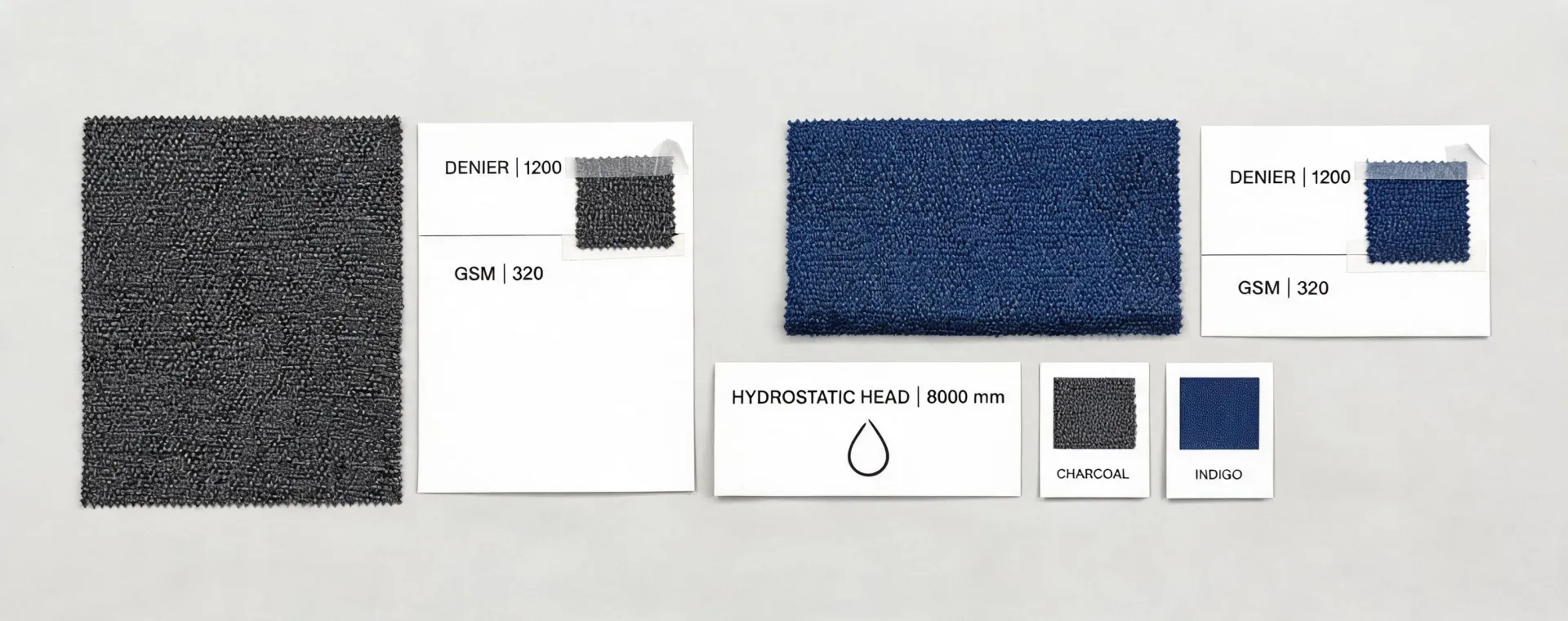
For a waterproof fabric private label program, ask your design and quality teams to rank the likely failure modes. Write them down before you look at Glen Raven's custom fabric range. A customer does not buy 10,000 millimeters of hydrostatic head. They buy a dry jacket. But your spec sheet has to protect the jacket from an actual rainstorm, not just from a lab test.
For upholstery, the same logic means ranking abrasion, seam slippage, crocking, cleaning, and light exposure. Whatever is at the top of the list should drive the next step.
2. Turn failure modes into measurable requirements
Once the failure modes are ranked, assign a test method and a minimum target. For waterproof shells, common measures include hydrostatic head and moisture vapor transmission rate. For pack and tent fabrics, tear strength matters. For softshell, stretch and recovery matter. For upholstery, abrasion and seam slippage matter. But do not list every possible test; list the tests that predict the failure modes from step one.
State the test method as well as the number. Abrasion can be measured with Wyzenbeek or Martindale, and the results are not always comparable. A hydrostatic head number means little if you do not know whether it came from AATCC 127 or ISO 811. In my opinion, vague spec values are worse than no spec values because they create the illusion of agreement.
No blog post can give you the one right number for every product. Your cleaning process, storage, garment construction, and warranty period all influence the target. That's why this is a checklist, not a formula.
3. Give construction details, not fabric category names
'Softshell' is not a construction. It can be a woven face with a laminated membrane or a knit face with a brushed backer. 'Nylon' is not a construction, either. A 30 denier taffeta, a 70 denier ripstop, and a 420 denier oxford all perform differently. If you want a custom run, give the mill enough detail to build the correct base fabric.
Earlier in my career, I made the rookie mistake of assuming that specifying a fabric name was enough. I wrote 'softshell' on a product spec and did not define stretch recovery. The fabric looked correct at the sample stage, but the finished garment did not snap back after a day of wear. It was a classic assumption failure, and fixing it cost us time and credibility.
When you brief a Glen Raven technical fabric specialist, include the end use, the desired weight range, the fiber direction and stretch requirements, and any seam taping or lamination plans. You can still ask for the mill's recommendation, but your brief should be specific enough to be challenged.
4. Choose the coating or lamination route before you approve color
The big fork in functional fabrics is often coating versus lamination. Coatings can be a good fit for many industrial and outdoor products. Laminates tend to provide more breathability possibilities in apparel. Both can be part of Glen Raven custom fabrics. The problem comes when a buyer treats waterproof and breathable as if those words alone tell the mill what to do.
For a waterproof fabric private label program, ask how the finished product will be seam sealed. Fabric with a membrane is only one part of the weatherproof system. If the seams leak, your customer will not care that the face fabric passed a water column test. This is the part of the product that often gets the least attention because it is not visible in a photo.
Personally, I would rather answer basic questions about coating compatibility early than explain a return rate later. There is no no-brainer coating choice for every brand; there is only the coating or membrane that matches your product's cost, hand, and performance targets.
Also, finishes can change the hand feel and the final color. If you approve a dyed strike-off before the coating is applied, expect that the finished roll may look slightly different. Plan for that.
5. Put compliance and claim evidence into the spec sheet
Most custom fabric programs are not just about meeting your own quality standard. They also have to support labels and claims. In the United States, the Federal Trade Commission requires advertising claims to be truthful, not misleading, and substantiated. That applies to words like waterproof, UV resistant, and recyclable. If a supplier says 'passes all certifications,' I would ask exactly which certifications and which test versions. No material passes everything.
For a functional fabric OEM project, include a column for regulatory requirements. Flame retardancy, restricted substances, Proposition 65, REACH, Oeko-Tex, and PFAS-related restrictions can all change what is available. These requirements are not an answer; they are a starting point for the discussion.
Ask for test reports from the finished fabric, not from a generic material sample. The final coating, dye, and finish can influence the test result. Save those reports for your own brand's claim file. In other words, document the quality before you put a hang tag on it.
6. Build a first article approval into the schedule
This is the step that disappears when a deadline moves up. I know why: first articles add days. But the alternative can be a bulk order with an unexpected matte coating, a slightly different hand, or a color that only works in one lighting condition.
Last quarter, I worked with a customer who approved a small color chip and a hand sample, then asked to move straight to bulk because their launch date moved. The product was not ruined, but the coating finish was different enough from the hand sample that they had to revise their styling notes. That coordination took more time than a first article check would have taken.
By first article, I mean a small run of finished fabric made with the same construction, dye, coating, and finishing steps intended for bulk. A lab dip is not the same thing. A lab dip checks color on a small swatch; a first article checks the whole manufacturing system.
I have mixed feelings about custom development. On one hand, custom fabric gives your product a point of difference. On the other hand, every custom step adds risk. The fix is not to avoid custom work. The fix is to freeze the specification after the first article is approved and resist changes during bulk production.
Final Notes: avoid these common errors
If you are tight on time, don't skip the small quality checks. Here are the habits I see causing re-runs:
- Approving color under one light source. Use a lightbox and check the fabric under daylight, store light, and UV or fluorescent light.
- Assuming that standard test data on a similar fabric is enough for your custom version. Ask for results on the actual coating and finish.
- For waterproof goods, testing the shell fabric while ignoring the sewn seam. Seams and tape are the usual weak points.
- For upholstery, ignoring cleanability. A contract fabric can pass an abrasion test and still be difficult to clean, which affects how the end client perceives the brand.
Bottom line: quality is a brand decision, not just a purchasing detail. The customer may never know your hydrostatic head rating or your abrasion test method. They will know how the product feels the first time they touch it, how it looks under the light, and how it performs after cleaning or washing. That is why the fabric spec needs to protect the brand, not just the purchase order.
If you're starting a Glen Raven Mills custom project, ask the spec team what can change between sample and bulk, how they handle first articles, and which tests they recommend for the actual end use. A mill that gives you a straight answer is easier to build a brand with than one that promises a perfect fabric and leaves the risk hidden.