-
1. Write the technical spec before you ask for a quote
-
2. Compare total cost of ownership, not per-yard quotes
-
3. Normalize every price into one usable measure
-
4. Don't let a leather fabric wholesale cost guide oversimplify your decision
-
5. Put claims and compliance documentation in the RFQ
-
6. Test samples like you will sell the production fabric
-
7. Add freight, duties, terms, and currency risk before you celebrate
-
8. Price the three failure scenarios before you issue the PO
-
The last step is not a step
The first thing to know about this guide: I cannot give you one honest price for a leather fabric wholesale cost guide, because one honest price does not exist. I have been managing fabric procurement for six years, tracking every order in our cost system, and comparing technical mills, converters, and overseas suppliers. The process I keep coming back to is an eight-step checklist. It works for custom waterproof fabric OEM work, for an oxford fabric supplier quote, and even for expensive-looking leather-look textiles. Step away from the unit price, and this checklist will save you more than any single negotiation trick.
Glen Raven Mills has been a familiar name in textiles for a long time. These days, you will usually see the company as Glen Raven, Inc. and its custom fabrics division, Glen Raven Custom Fabrics. But brand familiarity is not a cost model. You need a process. Here is mine.
1. Write the technical spec before you ask for a quote
If you ask three suppliers for waterproof fabric OEM pricing without specifying the intended construction, you will get three different products. One may quote a 2-layer nylon laminate. Another quotes a coated polyester. The third quotes a breathable hardshell with a film from a different supplier.
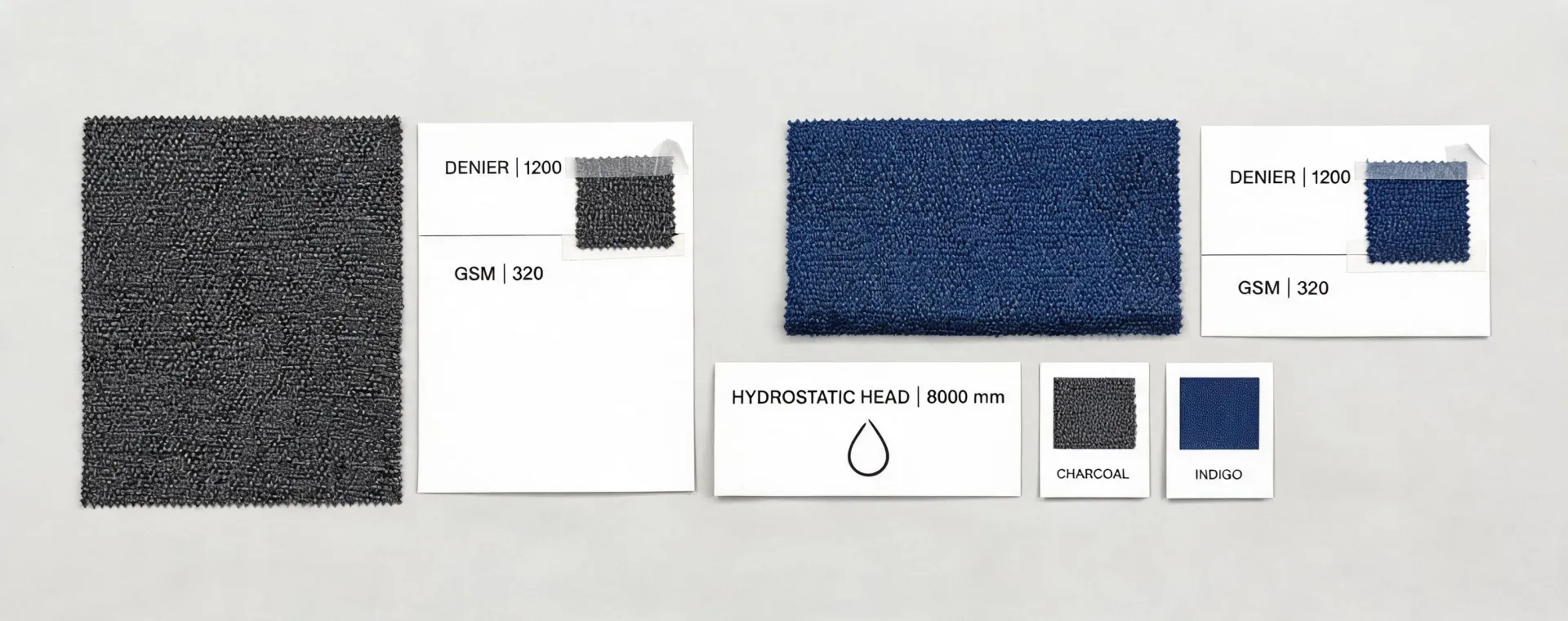
Start with end use. Is this for rainwear, outdoor furniture, tactical bags, or pool cushions? Then list mandatory performance points: hydrostatic head, moisture vapor transmission rate, coating or lamination type, denier, weight, width, and expected seam sealing method. For an OEM waterproof fabric program, ask the supplier to state its test method too. There is no point comparing two hydrostatic numbers if one lab uses a different protocol.
Checkpoint: If you cannot write the product specification without a brochure phrase, another week of product development will be cheaper than another emergency order.
2. Compare total cost of ownership, not per-yard quotes
The assumption in many RFQs is that a high quote means better quality and a low quote means a bargain. Actually, a quote is the result of a supplier's operating model. Some mills quote higher because they include testing, defect allowances, and responsive customer service. Some low quotes are simple because the sample is a stock roll. Neither is automatically better until you compare total ownership cost.
In 2024 I audited our own spending and found that almost 20 percent of our budget overruns were not in the quoted yard price. I do not remember the exact percentage; it could be 17 or 22 percent, but the pattern was obvious. Extra costs came from freight, expedited sample couriers, duplicate testing, rejected dye lots, and delayed decisions. When we switched to a different waterproof fabric OEM quote because of a lower per-yard number, the hidden extras made the real cost higher than staying with a supplier we already understood.
Checkpoint: Build a one-page cost estimate that includes sample charges, minimums, lead time, quality risk, compliance documentation, freight, and potential inventory loss before you tell finance the unit price.
3. Normalize every price into one usable measure
If you have ever compared an oxford fabric supplier, you already know the pain. One quote is per yard at 58 inches. Another is per meter at 150 centimeters. A third is per kilogram. A fourth hides the weight by quoting only per roll. You can spend an afternoon discovering that two prices that look identical are not close.
For polyester oxford, the first thing to compare is the final fabric weight in grams per square meter and the finished width. Then convert everything to cost per usable square meter or square yard. If your factory cuts panels in a specific way, cost per usable square foot matters even more. Let me rephrase that: one supplier can be ten percent higher on a linear-yard price and still be cheaper for your pattern because the usable width and cutting yield are better.
Checkpoint: Your spreadsheet needs one single unit. If you do not know the finished width, you are not comparing a price; you are guessing.
4. Don't let a leather fabric wholesale cost guide oversimplify your decision
I have never fully understood why the market groups so many materials under the label of leather fabric. My best guess is that the term follows a visual look rather than a construction. In one category, you can find PU-coated knit, microfiber suede, woven polyester with an embossed film, and coated oxford. Each one has a different cost structure, different flex behavior, and different supplier risk.
This is why I will not give you a simple leather fabric wholesale cost guide with a neat table. A table would be fake. Instead, use the checklist to force the supplier to name the base substrate, coating type, backing fabric weight, abrasion test method, and lightfastness. If the term is too broad, the quote will be too broad, and the hidden cost will show up in returns.
Checkpoint: Ask the supplier what the material is made of before you ask what it costs. If you have to guess the construction, you have already added risk to the order.
5. Put claims and compliance documentation in the RFQ
According to FTC guidance at ftc.gov, environmental and performance claims have to be substantiated before you put them in front of a customer. That includes recycled polyester content, eco-friendly finishes, water repellency, and flame-resistance descriptors. If a material is called recyclable, your supplier has to tell you what collection system or recycling process exists.
In practice, this changes how you compare Glen Raven Custom Fabrics to another mill. Ask for the actual test report. Ask for material declarations. Ask which certification standard applies. Do not accept the phrase everything is certified, because that sentence cannot be true without a standard. If a supplier cannot document dye lots and finish history, you are buying a commodity roll with a story attached.
Same logic applies to waterproof language. A supplier can test one coating under one method, but your final product will include seams, zippers, and flaps. Performance is a system, not a fabric. Put another way: claim documents are part of the material cost.
Checkpoint: If your marketing team plans to make a green or waterproof claim, bring them into the review before you select a supplier, not after the fabric is woven.
6. Test samples like you will sell the production fabric
You cannot skip samples, but a sample rack can mislead. A four-inch swatch does not show how a roll runs through a cutting table. It does not show dye lot variation or coating coverage at the roll ends. It tells you very little about lamination strength over time.
Once, we had a candidate supplier with excellent lab data and a nice hand feel. The numbers said a pilot order was unnecessary. My gut said try a pilot anyway. The pilot roll revealed a lamination tension problem that made the fabric curl along one edge. That edge would have consumed three percent of our cutting yield. I have never fully understood why the sample panel looked so good, but production tension made the difference visible. My best guess is the supplier produced swatches on a shorter, controlled line.
Checkpoint: For a custom waterproof fabric OEM project, request a pilot roll from the actual production line. It is easier to resell a small custom pilot as a reject than to explain to sales why the spring launch is late.
7. Add freight, duties, terms, and currency risk before you celebrate
Every fabric cost guide should include the cost of getting the fabric to your factory. Manufacturer quotes are normally FOB or EXW. Broker and importer quotes are often DDP. DDP is convenient, but you are paying for the vendor's hedging and freight assumptions. FOB is transparent, but you carry the risk. Both can be correct. The mistake is comparing them without adding customs, port handling, inland freight, insurance, and currency conversion.
This is especially important when you compare a domestic oxford fabric supplier with an overseas option. A 40-foot container looks economical until it sits at a port for two weeks because the paperwork was incomplete. In Q2 2023, we lost a full production week to that exact problem. Maybe the delay was not entirely the fabric supplier's fault, but it was still our cost.
Checkpoint: Ask what is included and what is not included. If the supplier cannot answer in one sentence, the quote is incomplete.
8. Price the three failure scenarios before you issue the PO
Experienced cost controllers do not look only at successful delivery. First, ask what happens if the fabric arrives late. If an oxford fabric supplier delivers eight weeks late, the material itself may still be fine, but your customer's product line misses the window. The price was cheap, but the program can still fail.
Second, think about dead inventory. Custom dyed or custom waterproof fabric cannot be sold to the next customer when the program does not sell through. The raw material cost is only part of that loss. Third, consider supplier concentration. If you have only one source for a custom backing, you have no negotiating power when capacity tightens. In 2025, that risk is bigger than it was in 2020.
Checkpoint: For each supplier, note the realistic cost of one late week, one rejected lot, and one unsold roll.
The last step is not a step
People ask me which fabric supplier is the best. I usually answer with another question: what can go wrong if you choose wrong? That is not evasive; it is cost control. A textile source such as Glen Raven Custom Fabrics has a strong reputation, and Glen Raven Mills has history. Either could be right. But a supplier with a good name is not automatically right for every waterproof fabric OEM order, every oxford fabric supplier comparison, or every leather-look program. The lower price is not automatically better either. Use the checklist, write down the assumptions, and let the total cost speak.