If you're sourcing custom nylon fabric with a tight deadline, here's the truth I share with every buyer: Glen Raven isn't the bottleneck—your specifications and compliance paperwork are. Honestly, in my 7 years coordinating rush orders with Glen Raven custom fabrics, I've seen more projects derailed by vague specs than by mill lead times. Based on roughly 200 rush orders I've triaged, most delays trace back to something that could have been written down before the purchase order.
If you're looking for a nylon fabric manufacturer, Glen Raven has the capability. But capability isn't the same as clarity. Here's what you need to know.
Why I'm the person asking you annoying questions
I coordinate custom fabric orders at a technical textiles company in Burlington, N.C. That has put me in the middle of enough last-minute catastrophes to make me allergic to vague emails. In March 2024, a client called at 4 p.m. on a Thursday needing a lightweight ripstop nylon for a city contract that had to ship Monday. Normal lead time for that coated nylon was 18 days. We got it out in three, but only because every spec was already locked: denier, weave, coating, color standard, and compliance package. If any of those had been missing, the deadline would have slipped.
That's basically the pattern. It took me a few years and roughly 160 rush orders to understand that the bottleneck is rarely the mill. It's the gap between what the buyer means and what the mill needs. When I'm triaging a rush order, I spend more time untangling 'we just need nylon' than actually finding fabric. The fabric is rarely the issue. Nylon fabric sourcing is full of words that sound clear until they aren't.
What Glen Raven custom fabrics can and can't do
Glen Raven Mills started in 1880, and the company now works with a broad range of technical and performance fabrics. For this discussion, think of Glen Raven custom fabrics as a capability. It's nylon, polyester, and blends. It's OEM and private label work, custom finishing, and bulk supply. But 'custom' doesn't mean 'infinite.' It means the mill can build a fabric around an end-use—if you define the end-use.
1. Denier and weave
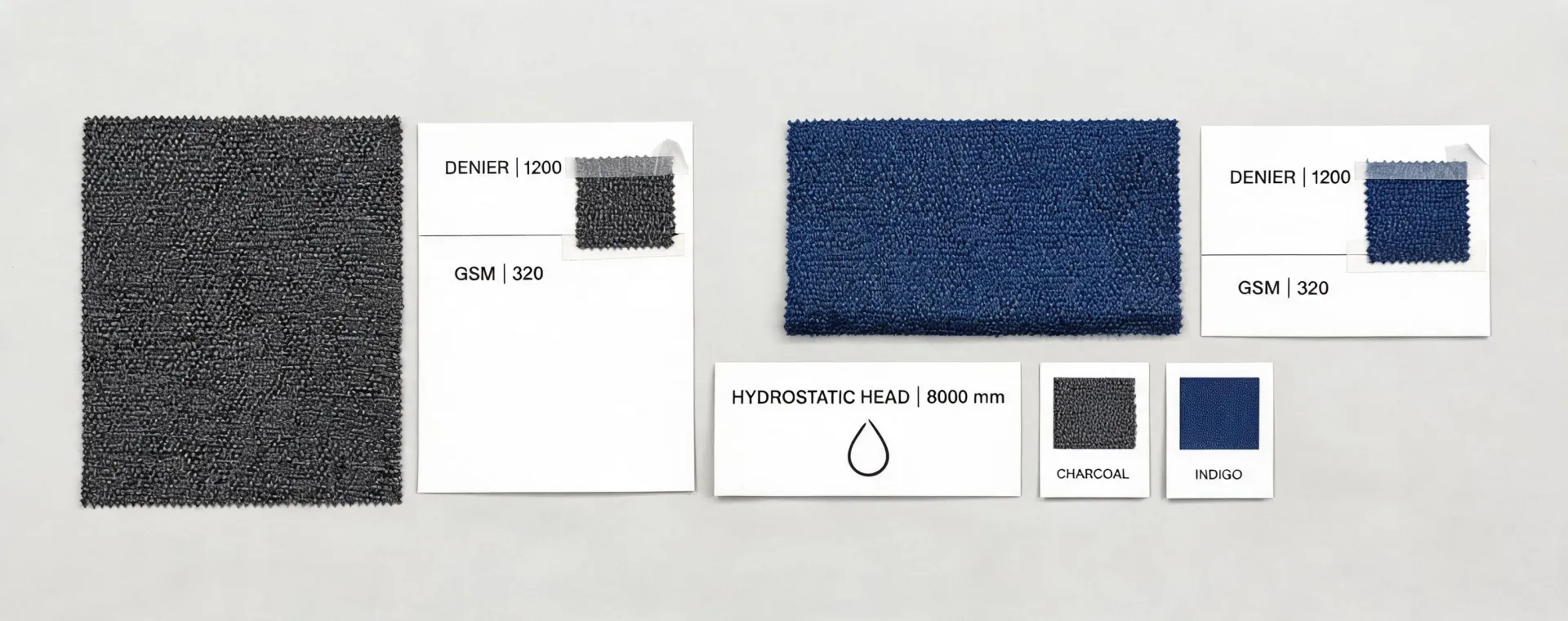
Nylon isn't one material. A 30-denier ripstop behaves differently from a 210-denier oxford. If you ask for 'nylon,' you're asking me to guess. Denier (the thickness of the yarn) and weave (ripstop, plain, twill, oxford) change tear strength, drape, and cost. Pick them carefully.
2. Finish and coating
This is where I've seen more mistakes than anywhere. Nylon can be coated with PU, PVC, silicone, or a dozen other options. It can be treated for water resistance, UV stability, antimicrobial performance, or flame resistance. Saying 'waterproof' isn't a spec. Saying '2,000 mm hydrostatic head after PU coating' is closer. I'm not going to make absolute performance promises, but I can tell you that the more specific the finish, the easier it is to pull off.
3. Color and color consistency
Color might be the most overlooked part of a custom fabric order. A screenshot of a hex code is not a dye spec. Use a Pantone reference when possible. Industry color tolerance is Delta E < 2 for brand-critical colors; Delta E of 2–4 is noticeable to trained observers; above 4 is visible to most people. Reference: Pantone Color Matching System guidelines. In fabric, dye lots will always have some variance, so establish the tolerance before production, not after.
Nylon fabric compliance requirements: the paperwork that decides your deadline
Let's be blunt: compliance is the least glamorous part of sourcing, and it's usually the one that kills a rushed order. A lot of buyers ask 'is it compliant?' The better question is 'what is it compliant with?'
- For the EU, be ready to document REACH and any SVHC restrictions.
- For California, Prop 65 can matter, especially for dyes, finishes, or add-on materials.
- For children's goods, CPSIA testing may apply.
- For general consumer textiles, OEKO-TEX certification is a common baseline.
I'm not a lawyer and I'm not 100% sure of every current threshold in every market. That's exactly the point. Ask for batch-specific test reports, not a generic brochure. If a nylon fabric manufacturer says 'we are compliant' without naming the requirements, that's a red flag. If you can't get the test report before you issue the purchase order, treat it as a deal-breaker.
I only started checking compliance documents on every order after a rush shipment got held at customs because the destination country required a test report we had assumed was fine. It was supposed to save a week by skipping the paperwork. It cost three. Now our team won't schedule a mill until we've done a 48-hour documentation review.
The counterintuitive part: rush orders need more documentation, not less
It sounds backwards, but the way to make a fast turnaround work is to slow down the definition stage. A 30-minute call to lock down specs is worth more than a week of expediting. If I have to choose between a mill that can ship tomorrow and a clear specification, I'll take the clear spec. Speed is a side effect of clarity, not urgency.
I said 'coated nylon' to a client once, and they heard 'PU coated nylon.' The coating was wrong, the rolls came in, and we had to re-run the order. We were using the same word but meaning different fabrics. Now every custom fabric order includes a written glossary and a sample approval.
At the end of the day, the fabric you put into a product is the product. In my opinion, saving a few cents per yard on a spec gamble is a bad trade if it means inconsistent color, failed coating, or missed compliance. A quality mismatch is rarely invisible. Your client feels it, and then the brand feels it.
When Glen Raven isn't the right call
I'm not going to tell you Glen Raven is right for every nylon project. If you need 1,000 yards of commodity 70D nylon for simple tote bags and you don't care about color matching, a fabric distributor with stock goods is probably faster and more cost-effective. Glen Raven is built for technical work, custom finishes, and performance requirements. If that's not what you need, you don't need the extra overhead.
This approach also assumes you can define the end-use. I can only speak to our process and what I've seen in U.S.-based orders. If you're sourcing internationally, there are probably requirements I'm not aware of. Your mileage may vary.
Bottom line: if the fabric underperforms in the field, your client will notice. If you're on the fence about whether to go custom, ask yourself what happens when it fails. Spend the time on specs. The fabric is the brand they feel.