I'm the office administrator for a 135-person outdoor brand in Colorado. I handle all fabric ordering—roughly $1.1 million a year across six vendors—and I report to both operations and finance. When I took over purchasing in 2020, I had a simple assumption: if you want breathable technical fabric, buy through a fabric supplier. It seemed easier, faster, more flexible.
Three years later, I had a different view. The more orders I placed, the more I kept comparing two categories of suppliers: an integrated performance fabric manufacturer like Glen Raven Mills, and a functional fabric supplier who buys from multiple mills and resells rolls to brands like ours. They solve the same problem in different ways. Which one is right depends on what you're making—and how much you really know about your own fabric needs.
I'm going to compare them across three dimensions: custom fabric capability, testing and documentation, and how they treat a buyer who isn't ordering 50,000 yards per color. I'll give you my conclusions, but the answers will depend on your situation.
The Two Supplier Types I Keep Comparing
For this article, I'm comparing two distinct supplier types:
- Performance fabric manufacturer / integrated mill—A company that controls weaving, dyeing, finishing, and often testing. Glen Raven is an established example. They're a family-owned textile manufacturer based in North Carolina, and their custom fabrics group works with OEM and private-label brands. You bring them a spec, and they engineer it.
- Functional fabric supplier / converter—A company that sources rolls from multiple mills, occasionally applies a finish, and sells shorter runs. They're often excellent for sampling, color options, and quick turnaround. You bring them a request, and they find you something close.
Both are legitimate. I have spent money with both. The question is where breathable fabric sits on your priority list.
Dimension 1: Custom Fabric Capability
This is the dimension where an integrated manufacturer usually wins, but not for the reason I first assumed. I used to think 'custom' meant expensive and exclusive. It does mean a different process. A mill can create a construction from scratch: a 50-denier nylon face, a polyurethane membrane, a tricot backer. It can adjust the ripstop grid, the hand-feel, the matte finish, the color. That is not something a converter can do easily.
In our 2024 vendor consolidation project, we asked a functional fabric supplier to match the drape and moisture vapor transmission rate of our existing shell fabric. They sent three near-matches that all felt different. Then we sent the same spec to Glen Raven Custom Fabrics. Their first sample was not perfect, but it was built to our spec rather than assembled from stock.
The functional fabric supplier, to be fair, is faster. Need a breathable four-way stretch in three colors for a quick capsule? They can often ship within a week. That has value. But if you need a proprietary product that differentiates you, you need a performance fabric manufacturer.
One lesson from this dimension: say what you mean. We once told a supplier we needed 'breathable' fabric. They heard 'waterproof breathable,' and the samples came with a PU laminate. Our design team laughed. We were using the same word for different products. I'm less careless now.
Conclusion: Choose a manufacturer when the fabric is part of your product design. Choose a supplier when you need a working fabric quickly.
Dimension 2: Testing and Documentation
This is where I almost got burned. In 2023, I switched a breathable lining order to a lower-cost supplier and saved about $900 on a 5,000-yard order. Then eight rolls failed the moisture vapor transmission tests that our certification lab required. We spent $3,400 on rush replacement, testing, and air freight. I looked bad to my VP. The original savings disappeared.
The issue was not necessarily the supplier's product. It was that they could not document it. They gave us a spec sheet with one line: 'breathable 5000.' No test method, no conditions, no measured permeability. 5000 what? I asked. They did not know.
A good breathable fabric supplier, whether a mill or converter, should ask how you test. For breathable fabrics, the standards I rely on are:
- ISO 11092 for evaporative heat transfer resistance (RET). A lower RET generally means more breathable; under 6 is often considered very good, though it depends on the garment.
- ASTM E96 for moisture vapor transmission rate (MVTR). A huge caveat: Method A (inverted) and Method B (upright) produce different numbers. A '10,000 MVTR' claim means little without the method.
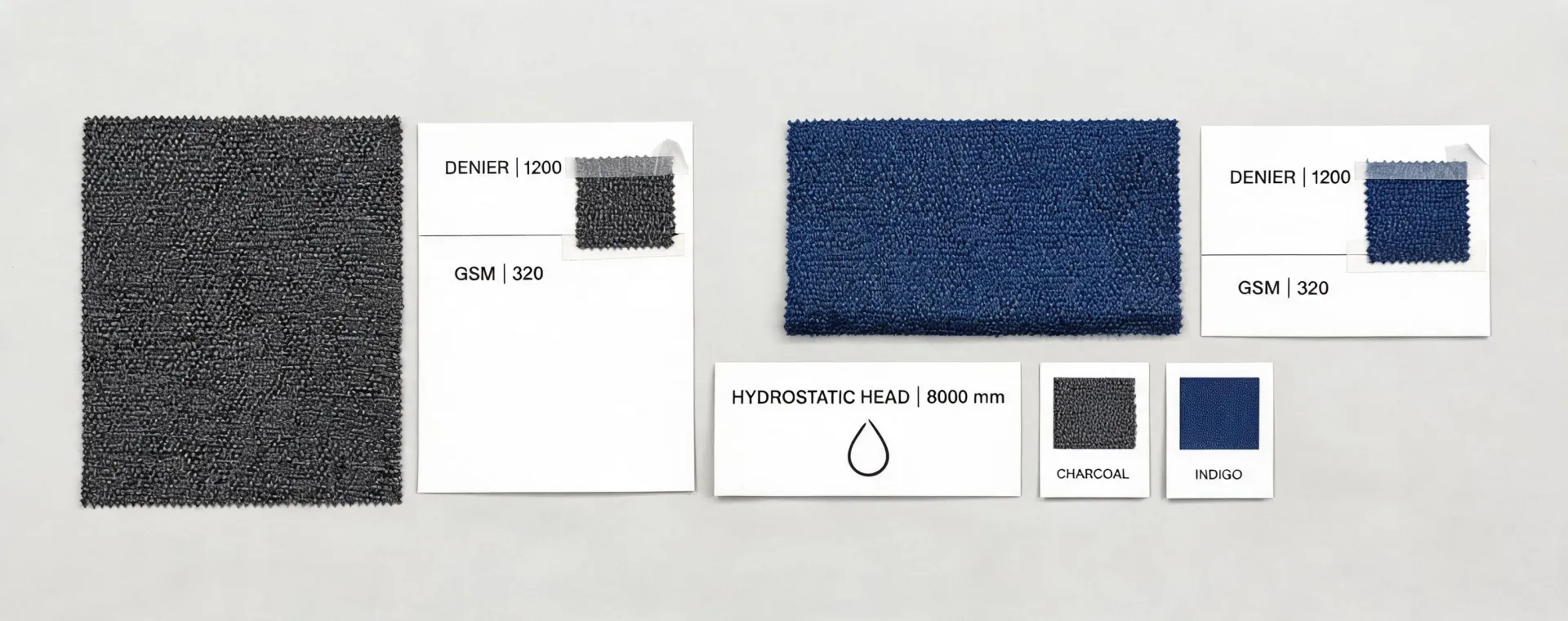
- Hydrostatic head for water resistance, usually mm H2O (Source: ASTM D751 / ISO 811).
When we sourced Glen Raven Custom Fabrics for a small batch of shell fabric last year, they came back with RET data and ASTM E96 results before we had to ask twice. That is the level of documentation I expect from a performance fabric manufacturer. It does not make them perfect, but it makes the conversation easier.
Conclusion: For technical fabrics, testing transparency matters as much as price. I would rather buy a fabric from someone who can explain why it breathes than from someone who just says it does.
Dimension 3: Minimums, Lead Times, and Small-Customer Treatment
I expected this dimension to go entirely to the functional fabric supplier. Their whole model is short runs, split rolls, and fast turnaround. Small companies like us are their bread and butter. An integrated mill, I assumed, would not want a 500-yard trial order. This is where my assumption got adjusted.
During the 2024 vendor consolidation project, we contacted three manufacturers for breathable shell fabrics. One of them was Glen Raven. I was hesitant to ask for a small initial run. The person I spoke with—I might be misremembering her title—was fine with it. She explained their process for trial orders: we buy the finished rolls at a set price, pay for testing samples, and then scale up if the numbers pass. No 20,000-yard demand, no 'come back when you're bigger.'
(That alone surprised me. I had always assumed big mills treat small customers like noise.)
The functional fabric supplier still wins on raw flexibility. If I need 100 yards of something today, they are the solution. But for consistent, repeatable breathable fabric, the mill's minimum was actually easier to work with because they do not run out of the same production lot. The converter might get a different batch from a different mill next time. That creates re-testing headaches.
If you are a small brand, don't self-disqualify when talking to a performance fabric manufacturer. Ask about their trial order program. Some of my best vendor relationships started with a $1,200 test order, not a container.
What to Look for in a Breathable Fabric Supplier
If I had to condense what to look for into a short checklist—and please verify current specs with any supplier—it would be:
- Test method clarity. They should quote ISO 11092 RET, ASTM E96 method, or air permeability, not just 'breathable.'
- Lot-level documentation. Can they trace a roll back to the production batch? Finance hates invoices without lot numbers.
- Failure response. Ask: 'If a roll fails testing, what happens?' You want a process, not a shrug.
- Color matching. For private-label work, ask about Delta E tolerance. Pantone's standard for brand-critical colors is roughly Delta E under 2 (Source: Pantone Color Matching System). If a supplier won't commit to a tolerance, be careful.
- Invoicing and compliance. Handwritten receipts or vague packing slips cost us $2,400 in rejected expenses once.
This list applies whether you're talking to a manufacturer like Glen Raven or a small converter. The size of the supplier is less important than how they answer these questions.
Which Should You Choose?
Here's the practical version. Choose an integrated performance fabric manufacturer like Glen Raven if:
- You need a custom construction, a proprietary color, or a new-material finish.
- Your product has certification requirements, and you need documented test results.
- You care about lot-to-lot consistency for a core product.
- You are willing to plan around a slightly longer lead time.
Choose a functional fabric supplier if:
- You need short-run samples, inventory flexibility, or a wide variety of fabrics.
- Your product is not tied to a specific fabric innovation.
- You want to test a market before committing to production volume.
For us, the answer was not either/or. We use Glen Raven Custom Fabrics for our main breathable shell fabric—the one with our brand colors and our own spec. We use a converter for test colors, small bags, and the occasional rush order when a sample has to ship tomorrow.
And one more thing from a buyer who has made mistakes: do not assume a bigger manufacturer won't take you seriously. Small orders are not automatically treated poorly. Good suppliers know that today's 300-yard sample can turn into next year's 10,000-yard production run. That is not a sales line. It is how we started with two of our current vendors.
The best breathable fabric supplier is the one that can show you the numbers, explain what those numbers mean, and support you when something goes wrong. That might be a giant mill. It might be a nimble converter. In our case, it is both.