I'm a procurement manager at a mid-sized outdoor goods company. I've managed our fabric budget for six years, negotiated with more than 40 mills and distributors, and tracked every order in a cost system that still annoys me during month-end close. Here's the thing: there's no single "best" kind of fabric supplier. The right choice depends on what you're actually buying.
Before I get into specifics, let me outline the three scenarios I see over and over in B2B fabric buying:
- Scenario A: You're an OEM or private-label brand building a product around a custom technical fabric.
- Scenario B: You're a distributor or wholesale buyer ordering standard polyester oxford or performance fabrics in volume.
- Scenario C: You're a contract furniture or upholstery buyer evaluating upholstery fabric manufacturers.
I'll walk through each one from a total-cost perspective, because unit price alone will fool you.
Scenario A: For custom performance fabric, start with a mill, not a distributor
If you need waterproof, breathable, softshell, hardshell, ripstop, or nylon/polyester blends with custom specs, you need a mill that can engineer yarns, finishes, and coatings. Glen Raven custom fabrics is one example of a vertical mill that does this. The reason isn't that the per-yard price is lower. It's that the total cost of getting exactly what you need is usually lower when you go direct.
When I compared two options side by side in 2023—a mill-direct development program and a distributor's "custom" option—I finally understood why per-yard price can be the least useful number. The distributor's quote was about 14% lower on the base fabric. But after development fees, sample revisions, and split shipping, the mill's total landed just slightly ahead. More importantly, the mill owned the formula. They could repeat it. The distributor could only resell whatever the mill gave them.
That's the part most buyers miss. You're not just buying fabric. You're buying the ability to reproduce a spec—color, hand feel, coating, stretch, tear strength—order after order. If you don't have that, the project isn't finished when the first rolls arrive.
In this scenario, I want the exact yarn specs and weave structure written down, finish and coating formulas at least at a functional level, and a color tolerance commitment. For brand-critical colors, I look for a Delta E target under 2, per Pantone color management guidelines. I also want test data from the mill's lab or a third party—not a one-line "pass" statement.
And I pay attention to what they say they're not good at. The vendor who told me, "this isn't our strength—here's who does it better," earned my trust for everything else. I'd rather work with a specialist who knows their limits than a generalist who overpromises.
Scenario B: For standard polyester oxford, a distributor can actually beat a mill
Now the counterintuitive part. Buying direct isn't always the cheapest route. The "buy from the mill to save money" thinking comes from an era when mills would happily break production runs for smaller buyers. That's not the world we're in today. Many mills have MOQs that force you to tie up serious cash in multiple containers just to get a reasonable price.
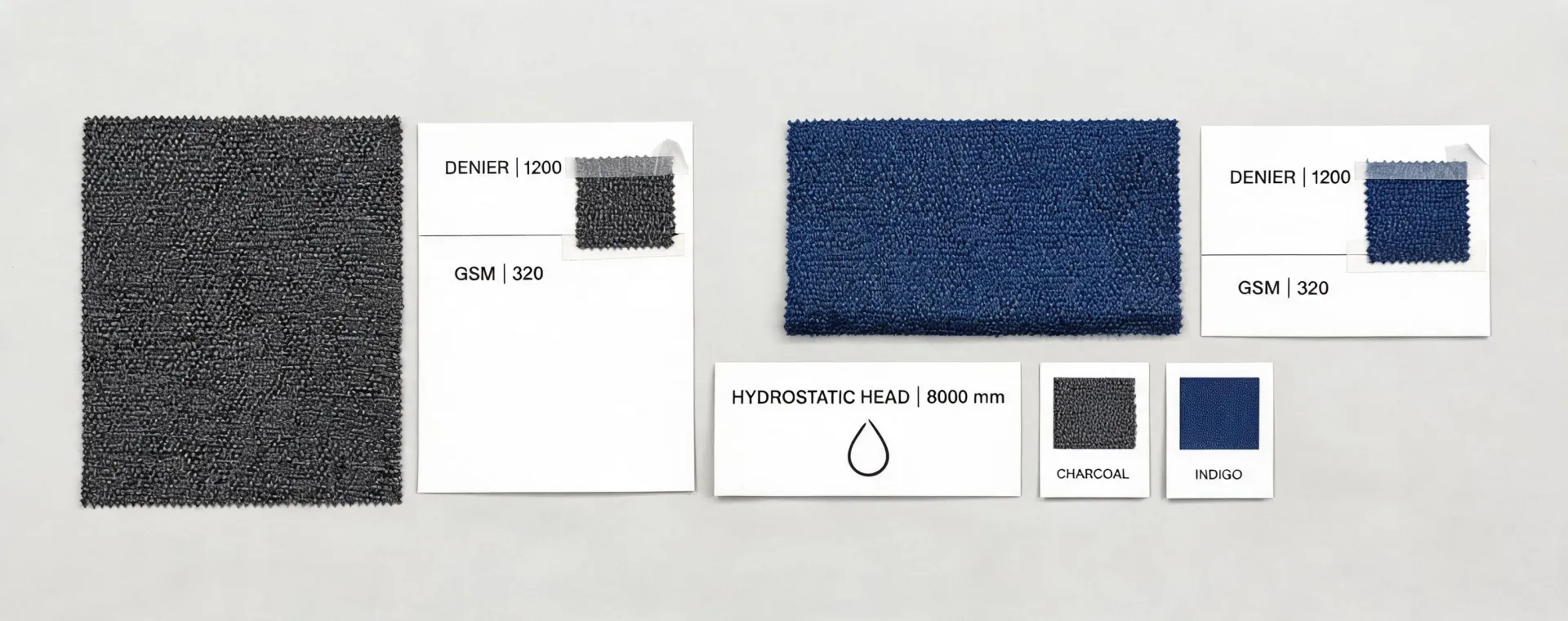
If you need regular stock of 300D, 600D, or 1200D polyester oxford—with PU coatings, water-repellent finishes, or different colors—a specialized performance fabric distributor can be the better total-cost choice. Their warehouse becomes your inventory. You can order smaller quantities, mix SKUs, get cut yardage for samples, and avoid the year-end write-off when your forecast was wrong.
When I'm comparing a polyester oxford fabric distributor to a mill, I don't just look at the unit price. I calculate the cost of carrying inventory, the risk of dead stock, and the flexibility of ordering as needed. A distributor who charges a few cents more per yard can save you thousands if you don't have to hold a year's worth of fabric.
Questions I'd put to any distributor:
- What's actually in stock, and what's made to order?
- Are there hidden minimums per SKU or per color?
- What's the real lead time from purchase order to dock?
- Can they provide the original mill test reports, or just their own spec sheet?
- If I need a private-label version later, can they support that or do they send me back to the mill?
That last question is important. A good distributor won't pretend to be a mill. They'll tell you when you've outgrown their model. That honesty saves everyone time and money.
Scenario C: How to evaluate upholstery fabric manufacturers
Upholstery is a different game. The technical fabrics that work in a rain jacket are not automatically right for an office chair, a sofa, or a marine cushion. I've also seen the opposite: a manufacturer that's excellent at upholstery but not the right partner for a softshell laminate. That's fine. The key is matching the specialist to the job.
So, how to evaluate upholstery fabric manufacturers? Start with test data, not marketing language. "Commercial grade" means nothing until someone defines the test method and the result.
In my approval process, I ask for:
- Abrasion data: Wyzenbeek cycles per ASTM D4157 or Martindale per ISO 12947. Ask to see the report, not just the number.
- Backing and finish details: woven or knit backing, water-repellent treatments, stain guards, and how those affect sewability.
- UV or colorfastness data if the piece will live near windows or outdoors.
- Who ran the test—their lab, an independent lab, or no one.
I also test the fabric in our actual production environment. A sample can look great in a folder and fail on a sewing machine. (Should mention: we learned this the hard way.) That's why I always request a cutting-and-sewing trial before committing to a large order.
One more thing: if a manufacturer says they do everything—apparel, upholstery, outdoor, automotive—I get cautious. Not because it's impossible, but because specialization matters. A company with distinct divisions for different end uses is easier to evaluate. Glen Raven Mills is one example: you can judge their upholstery work on its own, not on the reputation of their other products.
Which scenario are you actually in?
Here's the quick test I use with our internal team:
- Are you specifying a fabric that doesn't already exist in a distributor's catalog? If yes, you're in Scenario A—you need a mill.
- Are you buying existing stock in regular volumes, with flexible specifications? If yes, start with a distributor—Scenario B.
- Is the end use upholstery, contract furniture, or outdoor furniture? If yes, your evaluation must be driven by physical test data—Scenario C.
If you hit more than one, start with the stricter constraint. Custom fabric plus high volume? Go to a mill that can scale. Standard fabric plus upholstery? Find a distributor with upholstery experience and a manufacturer with test results.
Even after choosing the mill we now use for our branded softshell, I kept second-guessing myself. What if their lead time slipped and we missed our trade show deadline? The six weeks until the first production batch were stressful—or rather, six weeks and three days. But they delivered, and the fabric tested exactly within our tolerances. That's the kind of predictability I'm really paying for. Total cost, not unit cost.
If a supplier tells you, "that's not our core specialty, but here's who does it well," treat that as a sign of a mature, professional operation. I'd rather work with a specialist who knows their boundaries than a generalist who overpromises.
As of January 2025, I still evaluate suppliers the same way. Start with the product you actually need, then work backward to the supplier structure that can deliver it. Glen Raven custom fabrics, a solid performance fabric distributor, or an upholstery specialist—there's a smart choice in each group. The smartest one is the supplier whose costs you can predict, whose limits you can trust, and whose test data you can verify.