-
Step 1: Put your spec on paper, and define every term
-
Step 2: Ask for batch-level test data, not a recycled datasheet
-
Step 3: Verify consistency across batches before you commit
-
Step 4: Decide OEM vs. private label before you start negotiating
-
Step 5: Get lead time in writing—and pay for certainty when the deadline is real
-
Step 6: Read the reject and claim policy before you order
-
Two notes before you finalize that order
For the past four years, I've been a quality and compliance manager at a textile product manufacturer. The job title sounds broad, but it really comes down to one thing: I review every bulk fabric order we receive before it goes into production. That's roughly 50 to 60 orders a year, and in 2024 I rejected about 12% of first deliveries for out-of-spec materials, inconsistent color, or missing documentation.
This checklist is for anyone involved in performance fabric sourcing—OEM and private label brands, distributors, and wholesale procurement teams. If you're about to place a bulk performance fabric order, whether with Glen Raven Mills or a mill you've never worked with, these are the six things I check before I sign off. It's the practical version of what I wish someone had handed me in my first year.
Step 1: Put your spec on paper, and define every term
The classic mistake I made as a beginner was assuming "standard" meant the same thing to every mill.
In my first year, I specified "standard ripstop nylon" for a batch of 8,000 yards. What arrived was a 70-denier fabric with a 200-denier ripstop grid—visibly different from the sample we had approved. The mill said it was "within industry standard." We rejected the batch and they redid it at their cost, but the disruption still set us back $22,000 in rework and overtime, and pushed our launch back three weeks.
Now every contract I touch includes measurable specs: weight (gsm or oz/yd²), yarn count, weave or knit construction, coating type and thickness, finish (like DWR), and color tolerance (ΔE under 1.0 for critical shades). If a mill can't give you a written spec sheet with numbers, that's a red flag.
I also reference common industry test methods directly in the purchase order—ASTM D5034 for breaking strength, ASTM D4966 for abrasion resistance, AATCC 16 for colorfastness to light. You don't need to be able to run these tests yourself, but naming the method in writing stops the mill from testing against their own idea of "good enough."
Step 2: Ask for batch-level test data, not a recycled datasheet
A datasheet is a marketing document. A batch-level test report is evidence.
This is where a lot of bulk performance fabric sourcing goes sideways. When you ask a supplier for test results, you want the report for the specific lot they're going to produce and ship to you—not the mill's standard brochure. This applies to Glen Raven custom fabrics or any other supplier.
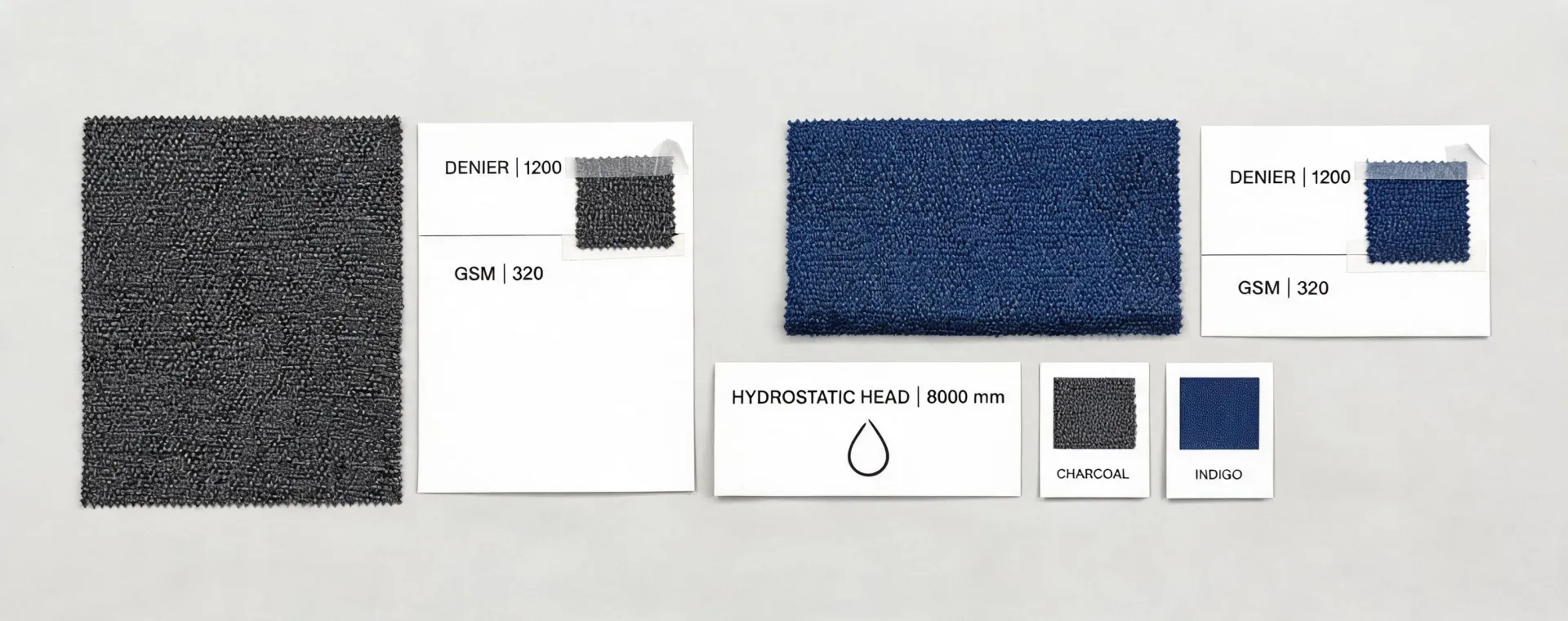
Watch for vague words like "waterproof" without a test method or a pressure rating. "Waterproof" and "water-resistant" get used interchangeably in sales conversations, but in production they're very different products. If you're buying a coated fabric for outdoor use, you want a hydrostatic head number from a recognized method (AATCC 127, for example, where a reading of 1,500 mm is a very different product from 10,000 mm). Same with "passes all certifications"—which certification, which report, issued by which lab?
A few years back, a supplier told us their coated fabric met a flame-resistance spec. I asked for the lot-specific test certificate. They sent a generic PDF from two years earlier. After three rounds of emails, they admitted the new batch hadn't been tested yet. We bought elsewhere. That verification cost about an hour of email time and saved us from shipping a product that could have failed a compliance audit.
Step 3: Verify consistency across batches before you commit
A good sample proves one thing: the sample is good. It tells you nothing about the next batch, or the batch after that.
Consistency is the whole game in bulk fabric. So when I evaluate a mill, I ask for samples from two different production runs of the same fabric and compare them side by side—measurements, hand feel, coating adhesion, weight. For color, I check them under the same light source against the approved standard, and if the shade is critical I compare the ΔE readings.
I once ran a blind test with our product team. Same material, same color, two different production runs. Without knowing which was which, the team consistently described the newer batch as "slightly off" and "less expensive-looking." The cost difference between the two runs was a few cents per yard. On a 25,000-yard order, that's maybe $1,200 for measurably better consistency. No-brainer. As much as possible, make your buying decision on a set of samples from multiple runs, not a single swatch.
Step 4: Decide OEM vs. private label before you start negotiating
Early in the sourcing process, ask the mill whether they do OEM, private label, or both. This question changes the whole conversation, so it's worth getting the terminology clear.
This is the leather fabric OEM vs private label question—and it's the same logic whether you're sourcing leather fabric for upholstery, a performance knit for activewear, or a coated nylon for outdoor gear. Basically:
- OEM means you bring the spec, the mill builds to that spec, and you take the product to market under your own brand.
- Private label means the mill holds more of the design and development responsibility. They may customize an existing base fabric—changing colors, backings, widths, or finishes—that you then sell under your brand.
A textile company like Glen Raven Mills, for example, has a custom fabrics division that does both. They manufacture their own performance fabrics (including the well-known Sunbrella line) and customize those materials for brands that want something specific without starting from scratch. For a private label buyer, that's attractive because the base material is already proven. For an OEM buyer, it's more about nailing down the spec and making sure the mill doesn't substitute materials during production.
My advice: define which direction you're taking, in the contract. If you try to negotiate a private-label deal but keep changing the base construction, you'll end up with change orders, cost overruns, and missed launch dates.
Step 5: Get lead time in writing—and pay for certainty when the deadline is real
I've learned this one the hard way, twice.
Mills usually quote a "standard" lead time—often 6-8 weeks for bulk performance fabric—and some will produce faster for a premium. In March 2024, we paid $400 extra for a rush production slot because the alternative was missing a $15,000 event where the fabric had to be in hand. The $400 felt annoying at the time. Missing the event would have cost us the relationship, plus the $15,000. When I look at it that way, the rush fee was cheap insurance.
The phrase that gets me now is "probably on time." I've been burned by "probably" twice: once in 2022 and again in early 2024. The second time, the mill's standard delivery slipped by a week, and we had to air-freight the finished goods to make our own customer deadline. That "budget-friendly" quote ended up costing about $3,800 extra in freight and rushed labor. Bottom line: uncertain and cheap is more expensive than certain and pricier.
So when you're sourcing, ask for a specific ship date, not a range. Ask what happens if they miss it. Ask what rush production costs before you need it. And for anything tied to a hard deadline, budget for guaranteed delivery even if it costs a bit more.
Step 6: Read the reject and claim policy before you order
This is the step most people skip, and it's the one that's bitten me hardest.
I skipped it once, on a shipment of 5,000 yards that arrived with a coating defect. The mill's response was "fine, send it back." Three months later, we still had neither a replacement nor a refund. We had to reorder from another supplier at a higher price to keep our commitments. That was the last time I skipped this step.
What I look for now:
- A written quality complaint process
- What evidence they require (photos, lab results, third-party inspection reports)
- A stated timeline for decisions
- Clear remedies—replacement, credit, or refund
- Which side pays for return freight
A mill that's confident in their product usually has a straightforward policy written down. If you hear "don't worry, we'll take care of you" but there's nothing in writing, treat that as a risk. The cheapest quote in the world is still expensive if the claim process is a dead end.
This is also where I learned my lesson about small expedite fees: I once saved about $80 by not expediting a sample order, then spent $400 on a rush reorder when standard delivery missed our deadline. In fabric sourcing, saving a little at the wrong moment can cost you a lot.
Two notes before you finalize that order
One: my experience is based on roughly 40-60 bulk orders a year for outdoor, marine, and performance apparel. If you're sourcing for automotive, medical, or heavy industrial applications, the standards and certifications are different. The same checklist applies, but make sure you're working with the right test methods and expectations for your industry.
Two: pricing figures are a snapshot. The numbers in this article were accurate as of Q1 2025, but performance fabric pricing moves with crude oil, supply chain conditions, and currency swings. Verify current lead times and quotes before you budget.
The six checks again:
- Define every spec in writing, with measurable numbers.
- Get batch-level test data, not a datasheet.
- Compare samples from multiple production runs.
- Define OEM vs. private label in contract language.
- Get lead time in writing, and pay for certainty when the deadline matters.
- Read and vet the claim policy before you order.
If you're doing performance fabric sourcing and you're wondering whether a mill will actually follow through, run these six checks. They'll tell you more than any sales conversation—and they've saved me from repeating the nastiest mistakes I made early on.