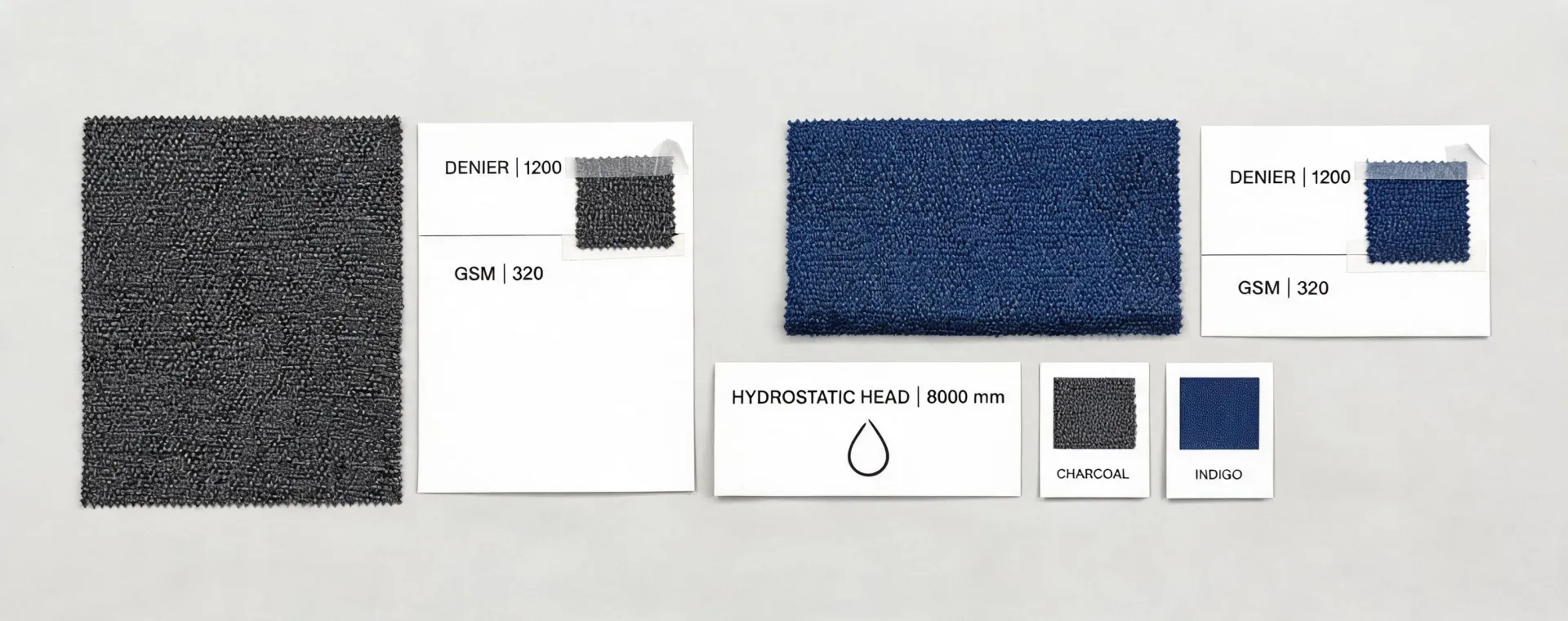
At Glen Raven Mills in Burlington, NC, I'm the person who signs off on technical fabric before it goes out the door. On a normal week, that means reviewing 150+ rolls of woven nylon, polyester, and coated materials. On a bad week, it means rejecting one of those rolls and explaining again why a spec sheet doesn't tell the whole story.
If you're an awning fabric distributor, or if you're building a nylon fabric OEM program, you've probably been on the receiving end of a frustrating conversation: the material looks right on paper, sews well, maybe even looks great in a sample. Then the production order behaves differently. The coating peels. The shade drifts. The fabric stretches after installation. And the supplier keeps repeating, 'It meets the spec.'
It probably does meet the spec. That's the problem.
The Spec Sheet Is an Abstract, Not the Fabric
It's tempting to think two fabrics with the same numbers are the same fabric. A 600D polyester oxford from one mill and a 600D polyester oxford from another mill can look identical on the quote and act completely different on a cutting table.
Here's why. The label 'polyester' is just the polymer family. Within that family, you can have drawn filament, textured yarn, high-tenacity yarn, staple yarn, or recycled polymer. Each one changes dye uptake, tensile strength, hand feel, UV stability, and price. 'Nylon' is even broader. Nylon 6 and nylon 6,6 are not interchangeable in demanding outdoor applications, but both can be called nylon on a datasheet.
Then comes construction. Thread count, warp tension, pick count, weave pattern, and especially heat-setting after dyeing. Two looms can start with the same yarn and produce different fabrics if the finishing line isn't calibrated. I've unrolled incoming fabric where the selvedge was tighter than the center, causing the roll to curl and sew poorly, even though the mill's data sheet showed the right yarn and weave.
And finally, the finishing system. On an awning fabric, water resistance rarely comes from the base cloth itself. It comes from a fluorochemical finish, an acrylic coating, or a laminate. That coating can be applied at different weights and cured at different temperatures. If the base fabric went into the finish line with residual impurities, the coating can fail adhesion later, sometimes much later, after the product is installed.
The Real Problem: Buyers Price a Product but Get a Process
People sometimes think premium mills are expensive because of their brand. Actually, the causation runs the other way: a mill that invests in process controls can charge more because it delivers consistency. The price is the result of reliability, not the cause of it.
This matters more in custom fabrics than almost any other purchase. When you order a nylon fabric OEM project, you're not buying a polymer; you're buying a repeatable process. The same is true for a polyester oxford fabric private label program. The question shouldn't be 'what's the unit price?' It should be 'what is the probability that this mill ships the same product ten times in a row?'
I remember one audit in 2022, and don't quote me on the exact year, where a mill had replaced a finishing chemical with a cheaper equivalent. The data sheet didn't change. The price quote didn't change. The fabric looked the same at a glance. After three months of UV exposure, it turned noticeably gray and lost tear strength. The original cost saving was invisible in the unit price (until the warranty claims showed up).
Another thing that gets missed: sample orders are made under near-perfect conditions. The sample run gets extra operator attention, the finishing line is cleaner, and the tests are done on a fresh swatch. In production, speed matters. If the mill's process controls are weak, the finished roll can drift from the approved sample even though the spec sheet hasn't changed.
What Awning Fabric Buyers Should Actually Test
If you're putting together an awning fabric distributor buying guide, the usual criteria are denier, color, tensile strength, and price. Those are only the opening act. For outdoor products, you need to understand how the fabric behaves after it is cut, sewn, tensioned, and left in the sun.
That means focusing on the variables most datasheets ignore:
- Dimensional stability. Does the fabric shrink, stretch, or sag after wetting and drying or after heat exposure?
- Coating adhesion after aging. A coating can pass a lab test on day one and fail after seasonal temperature swings.
- Colorfastness to UV. The relevant method is usually AATCC 16.3 under a xenon arc, not a workroom lightbox.
- Tear and seam strength after exposure. Initial strength is useful, but awning seams live under wind load. Test after accelerated weathering.
- Dye lot consistency. If you sell through distributors, shade differences from roll to roll become warranty claims.
For coated fabrics, ASTM D751 is a common reference for coated fabric strength, adhesion, and water penetration. ISO 811 covers hydrostatic head. ASTM G155 covers xenon arc weathering. These are not the only standards that matter, but if a supplier can't tell you which method they used, the numbers on their datasheet are almost impossible to compare.
The Price of Ignoring Total Cost
Here's where I get accused of being a quality nerd. Fine. I'd rather be called that than be the person who explains why 8,000 yards of custom fabric need to be restitched.
I've seen a coating adhesion issue turn a $6,000 fabric order into an $18,000 field problem. By the time the fabric was replaced, the awning was resewn, the installer went back, and the customer had been compensated, the original 'cheap' quote was the most expensive decision that buyer made that year. Not because the fabric failed—everything can fail—but because nobody had defined what success looked like before the order was placed.
Total cost of ownership is not a buzzword. It's:
Base price per yard + freight + inspection time + rejects + rework + replacement shipping + project delay + warranty claims, divided by usable yards.
Let's say one fabric costs $2.40 per yard and another costs $2.70 per yard. The 30-cent difference looks easy. But if the cheaper fabric has a 10% defect rate, you're really paying $2.67 per usable yard before you spend an hour sorting, measuring, or returning it. If a better-controlled fabric has a 2% defect rate, the effective price is $2.75 per yard. Suddenly the 'expensive' option is the same or cheaper, and it didn't burn your team's time.
Budget mills can be the right choice for some commodity products. That's not what custom nylon OEM usually is. When a product is expected to perform outdoors for years, the unit price is the least interesting number on the spreadsheet.
What the Right Vendor Does Differently
At Glen Raven Custom Fabrics, we don't claim any material is perfect. Anyone who promises a fabric will 'never fade' or 'never peel' is selling a fantasy. What we do differently is design the fabric around your specific end use and then put the quality controls around that same end use.
For a nylon fabric OEM program, we want to know your seaming method, your expected loads, your exposure environment, and your warranty expectations. For a polyester oxford fabric private label project, we want to know whether the fabric will be laminated, coated, printed, or used in an uncoated form. Then we set production tolerances that match those conditions, not a generic catalog page.
Even after choosing a new supplier for our own private label contract a few years ago, I kept second-guessing. What if the sample that passed early testing was a lucky roll? The two weeks before the production roll came back, or rather the eleven business days if I'm counting the weekend, were not calm. It passed. But I didn't relax until we saw the full-width inspection data.
And yes, I still kick myself for times early in my career when I accepted a hand sample and a dry data sheet without asking for a production trial. If I'd asked for a 200-yard trial roll and tested it the way our customer would test it, we'd have caught the problem in Week 2, not Quarter 2. Now every contract I touch includes lot tracing, full-width inspection, and an AQL sampling plan.
If a mill can't tell you how it checks roll-to-roll consistency, you're not buying custom fabric; you're buying hope. Distributors are caught in the middle of that risk. You don't control the manufacturing line, but you do control which mill gets a seat at the table.
At the end of the day, fabric is a material, but your supplier relationship is a system. Buy the system. The right fabric will follow.