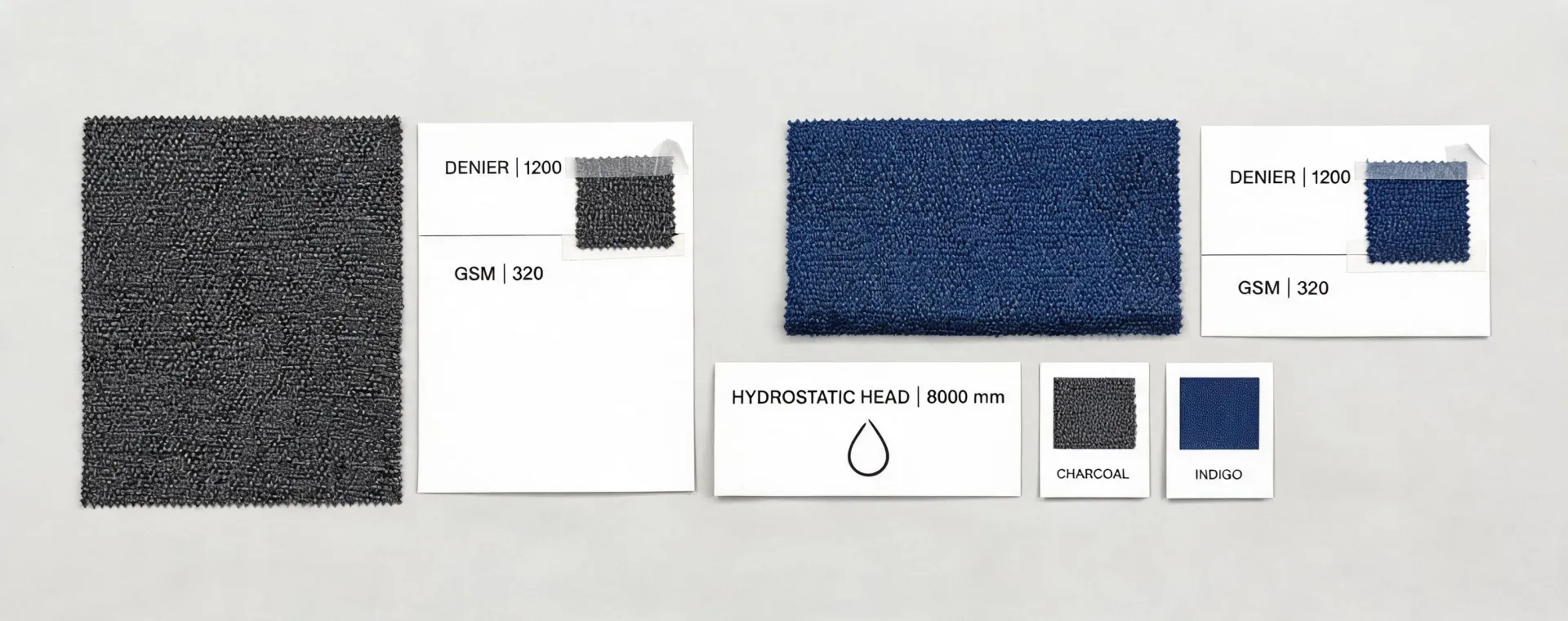
Around this time last year, I was sitting in my office with two fabric samples that looked identical. Same color, same hand feel, same weight. One came from a swimwear fabric distributor we'd used for years. The other was from a new supplier quoting 14% less. My boss wanted to switch. I wasn't so sure.
That moment didn't come out of nowhere. I've been managing procurement for a mid-sized swimwear company for six years now—our fabric budget runs about $480,000 annually, and I've tracked every order, every sample, and every supplier interaction in a cost spreadsheet that has saved us more times than I can count. When people ask me what to look for in a nylon fabric supplier, they usually expect me to talk about price per yard. But that's not where the real costs hide.
Where the Search Started
Our company makes performance swimwear for a handful of private label brands. We're not the biggest operation, but we're big enough that a bad fabric decision can hurt. In early 2024, we were at capacity with our existing fabric mill. Lead times were stretching, and we needed a backup source for our core nylon fabric—a 78% nylon / 22% spandex blend with a UPF rating, used in most of our products.
The search was straightforward at first. I reached out to a few distributors, compared quotes, and narrowed it down to two candidates. This is the part where I have to admit something: I almost went with the cheaper option without doing the full math. The surface quote was attractive—14% less per yard than what we were paying. From the outside, it looked like the obvious money-saving move. The reality was more complicated (isn't it always?).
The TCO Mistake I Almost Made
I've seen this pattern before. People assume the lowest quote means the vendor is more efficient. What they don't see is which costs are being hidden or deferred. In this case, I caught it because our procurement policy requires quotes from at least three vendors. The third quote made me look more carefully at the details.
Here's what I found when I dug into the cheaper bid:
- Minimum order quantities. The cheaper supplier required a 3,000-yard minimum per color. Our current supplier's minimum was 1,000 yards. Since we typically order 1,500 to 2,000 yards per color, that suddenly meant either more inventory than we needed or custom color matching fees.
- Dye lot consistency. They guaranteed consistency within a single lot, but not across lots. For our multi-panel swimwear designs, that's a problem—panels cut from different lots can show slight color differences that customers absolutely notice.
- A "quality adjustment" clause. Buried in their terms, it allowed them to adjust the invoice if their raw material costs went up before production. That's a risk I wasn't willing to absorb.
I almost went with them. The quote looked that good. But when I calculated the total cost—including the higher MOQ, warehousing the extra fabric, and the risk of dye lot issues—the cheaper option was actually about 9% more expensive per usable yard. That's the kind of math that doesn't show up in a simple price comparison. (Mental note: I really should write up our TCO template and share it. I keep saying that.)
How We Vetted Glen Raven as a Supplier
We didn't start with Glen Raven as our top choice. They're a well-known fabric manufacturer—Glen Raven Mills, based in Burlington, NC, has been around for over 140 years—but I've learned that a big name doesn't automatically mean a good fit. So I treated them like any other candidate and put them through the same process.
The first thing that stood out was their willingness to talk specifications. Some suppliers treat a phone call with a procurement manager as an inconvenience. The Glen Raven team answered technical questions about yarn denier, stretch recovery, and UPF testing without making me feel like I was wasting their time. That matters more than people think.
We then went through what I call the "sample gauntlet." I've been burned before by beautiful samples that didn't hold up in production, so now I always ask for:
- A production-run sample (not a hand-made lab dip) in our exact color spec
- Stretch and recovery data on the specific fabric construction, not generic test results
- References from other swimwear brands or manufacturers using the same fabric
- Clear documentation on dye lots, batch traceability, and what happens if a lot is out of tolerance
Glen Raven passed all four. The production sample matched our approved color within acceptable tolerance. Their test data was specific to our fabric—78% nylon, 22% spandex, 230 gsm with a matte finish—and not just a generic data sheet. And the references we talked to had been ordering from them for years, which said something about consistency.
Here's where the story takes a turn, though. The first production order almost went wrong.
The Delivery That Almost Broke Us
We placed our first order in June 2024: 3,000 yards across two colors, scheduled to arrive in eight weeks. The fabric was meant for a fall swimwear capsule collection with a hard launch date. I won't name the logistics company, but the shipment sat at a transload facility for nine extra days due to a "system error" (their words).
The frustrating part: the fabric was fine. The supplier did their job. But we were staring at a delivery delay that would push our production schedule to the edge, and our line was already booked at the factory. You'd think written delivery dates would prevent this sort of thing, but in reality, once the freight carrier has the shipment, the mill's control ends.
We had a buffer of about five days built into the schedule—barely enough. The containers finally arrived at our warehouse on a Thursday morning. Our cut-and-sew partner agreed to run a weekend shift to get us back on track. It cost us overtime, but it saved the launch date.
After the third late delivery from other vendors over the years, I've learned to build in buffer time rather than trusting estimates. That habit is the only reason we made it. I mentioned this to our Glen Raven account manager during a follow-up call. Without me asking, she offered to adjust future order lead times by a week to account for freight variability. It was a small gesture, but it told me they understood how B2B supply chains actually work.
What the Numbers Say After Six Years
Over the past six years, I've analyzed over $180,000 in cumulative fabric spending and tracked every invoice in our cost tracking system. (I'm a little obsessive about it, honestly.) The data has shown me some patterns worth sharing:
Price per yard is the least reliable indicator of total cost. In our experience, suppliers with the lowest unit price tend to have higher rates of shade variation, more frequent quality claims, and less scheduling flexibility. That doesn't mean expensive is always better—but it does mean you need to look at the whole picture.
Communication speed correlates with order success. Vendors who reply to technical questions within one business day have a significantly lower rate of production issues in our records. It's not a guarantee, but it's a useful proxy for how they handle problems when they come up.
Consistency beats innovation for core fabrics. We use the same Glen Raven performance nylon construction for about 60% of our swimwear line. It's not the most cutting-edge fabric on the market, but it's predictable—same hand feel, same drape, same dye uptake, order after order. For a swimwear brand, that consistency is worth a lot. Customers feel it when a new batch of fabric changes the fit of a style they bought last season.
The Hidden Cost of Switching Suppliers
One thing I didn't account for in my early years: the cost of switching itself. Every new supplier has a learning curve. And I'm not just talking about their learning curve—ours too.
We need to learn their quality tolerance levels, their communication style, their production calendar. Our pattern makers need to see how the fabric behaves on the cutting table. The sewing team needs to know if it sits differently in the machine. For swimwear, fabric stretch and recovery are everything—a slightly different stretch percentage can change the fit of an entire size run.
When we compared the actual cost of switching from our previous mill to Glen Raven, including samples, testing, extra production trials, and the time spent on qualification, it came to about $6,500. That's not huge in the grand scheme, but it's real. And it's the reason I recommend that buyers don't switch suppliers just to save 5% on the unit price. The savings disappear fast when you account for qualification time, learning curve, and risk.
Glen Raven has been worth the investment so far. Their custom fabric program means we can order our exact spec—the 78/22 nylon-spandex with a UPF finish—without having to compromise on a stock fabric that's close enough. For a brand that cares about fit and color consistency, that's not a nice-to-have. It's the difference between a swimsuit that stays true to size after ten wears and one that doesn't.
Per FTC guidelines (ftc.gov), advertising claims for UV protection need to be substantiated. That's why we always ask for the actual UPF test report for each production lot, not just a mention in the fabric's marketing materials. Good suppliers are used to this. If a fabric distributor pushes back when you ask for test documentation, that's a red flag (and honestly, a deal-breaker for us).
What I'd Tell Someone Starting a Swimwear Line
If you're sourcing swimwear fabric for the first time, or even if you've been doing it for a couple of years, here's the advice I'd give from my own experience:
Start with the end use. What are you actually making? A competition swimsuit needs a very different fabric than a resort cover-up. Both might be "nylon," but the performance requirements are miles apart. A swimwear fabric specification guide will tell you to look at denier, stretch percentage, recovery, and chlorine resistance—but you need to know which of those actually matter for your product line before you start asking questions.
Ask for the test data, always. If a supplier can't or won't provide third-party test results for the specific fabric you're buying, walk away. The swimwear market has enough problems with quality claims that fall apart after a few swims. Don't add yourself to that list.
Get references, and actually call them. We've had suppliers give us references that seemed great—until we called and discovered the "reference" was a one-time customer from three years ago. What you want is someone who's ordered multiple times, over an extended period, and is still happy. That's the strongest signal you can get.
Build a TCO calculator early. I built one after getting burned on hidden fees twice (ironically, both times with suppliers that seemed "cheap"). Now every quote goes into the same spreadsheet: unit price, MOQ, lead time, freight, inspection costs, payment terms, and a risk factor for the supplier's track record. It takes about an hour per quote. It has saved us tens of thousands of dollars.
The Bottom Line
So, is Glen Raven the right nylon fabric supplier for every swimwear brand? Probably not. If you're making a limited run of custom swimwear, a smaller specialty mill might be a better fit. If your biggest concern is speed over quality, a distributor with stock fabrics might get you to market faster. And if you're purely chasing the lowest price per yard, Glen Raven will lose that comparison.
But for a mid-sized company like ours—one that needs a consistent technical fabric at a reasonable total cost, with a supplier that treats custom specs seriously—they've been a solid choice. The fabric quality has stayed consistent across every order we've placed. The account management is responsive. And the production samples have been accurate enough that we've never had to re-do a color approval since we switched.
At the end of the day, fabric sourcing is about managing risk, not just finding the lowest price. The cheapest option often isn't, once you calculate the true cost. The best supplier isn't the one with the flashiest marketing or the slickest sales pitch. It's the one that delivers what they promise, consistently, order after order.
And in this industry, that's worth a lot more than a 14% discount.