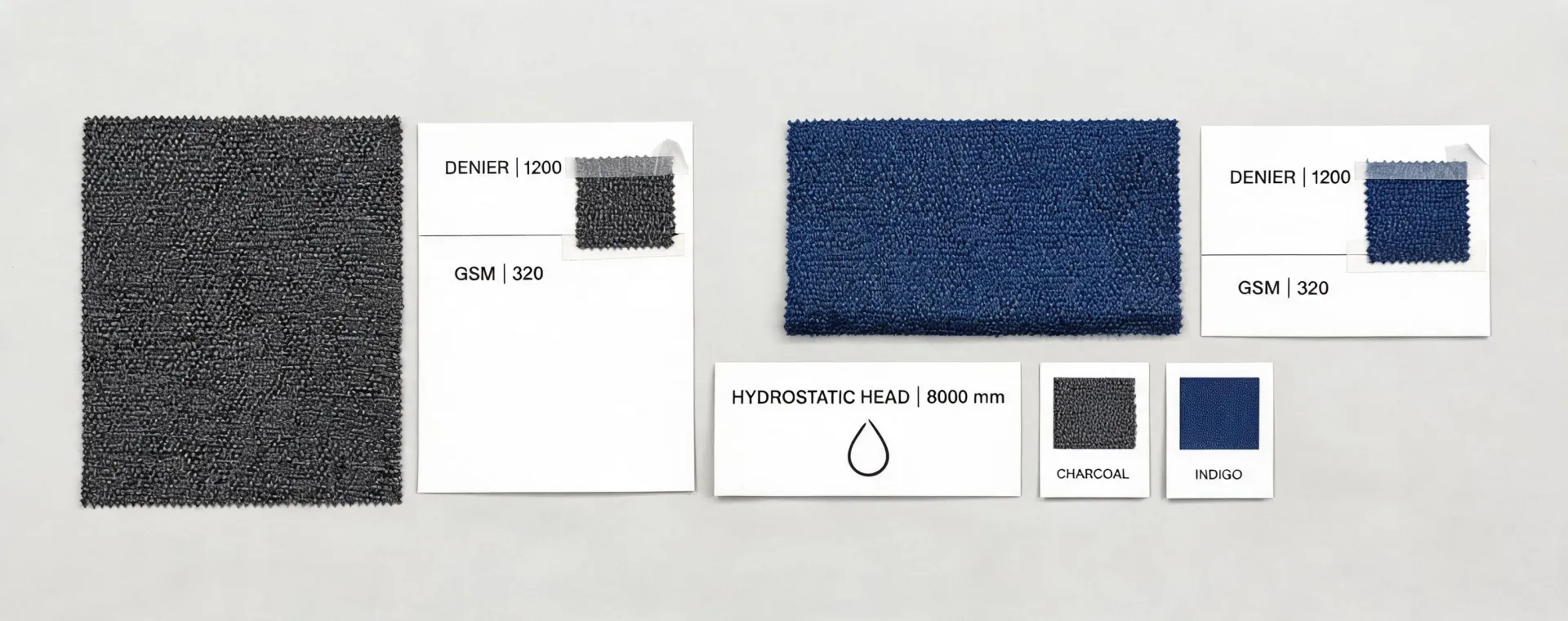
Last spring, I sat in a conference room with a stack of fabric swatches and a spreadsheet I'd been avoiding. We were launching a new line of softshell jackets for field crews. The spec said 'water resistant, breathable, stretch.' Three vague words. That's it.
I'm the procurement manager at a 45-person outdoor apparel company. I've managed our materials budget—roughly $850,000 a year—for six years. I've negotiated with dozens of mills and distributors. This project almost went off the rails. Not because the fabric was bad. Because I almost optimized for the wrong number.
The Cheap Quote That Wasn't
At first, the search looked easy. We had three quotes: one from an overseas mill, one from a regional distributor, one from Glen Raven Custom Fabrics. The first was lowest by a mile. I almost sent the PO. Then I started adding columns.
Look, I'm not saying the low quote was fraudulent. It wasn't. But the unit price didn't include freight minimums, special reel charges, or a 'sample approval fee' that became a setup charge if we ordered. When I calculated total cost for 30,000 yards, the supposed 'cheap' option was 11% higher than the Glen Raven quote. That's a $4,200 difference hidden in fine print.
Why does this matter? Because a low meter price can hide more cost than the yardage savings. After that, I built a cost calculator. Every fabric candidate now gets a TCO line: unit price, freight, MOQ, testing cost, lead time, color matching, cut loss. It takes ten minutes and it has saved us more than once.
Breathable Is a Category, Not a Spec
Turn one: Glen Raven's rep asked me two questions I couldn't answer. 'What hydrostatic head rating do you need? What MVTR target?' I told her 'breathable' and she smiled politely. 'Breathable is a category, not a spec. Let's define it.'
What I learned: water resistance is measured by hydrostatic head—how much water pressure a fabric handles before leaking. For a softshell, 5,000 mm is a common entry point; a hardshell often goes 10,000 mm or higher. Breathability is measured by moisture vapor transmission rate (MVTR), usually grams of moisture per square meter in 24 hours. A 5,000 MVTR fabric will feel less stuffy than a 1,500 one, but it's not a free ride. Don't hold me to those numbers universally—they're starting points, not laws. But if a supplier can't tell you what standard they test to, walk away.
I said 'breathable.' They heard 'we need a waterproof-breathable membrane.' I meant 'the fabric can't be a sweat trap.' We discovered this when the first sample came back with a taped-seam membrane that made the jacket heavier and twice as expensive. Good thing we had the conversation before ordering.
At the same time, we were evaluating a water resistant fabric distributor who could supply a DWR-treated polyester oxford. That option looked fine until we realized we needed a softshell with mechanical stretch, not just a coated shell.
The Glen Raven Custom Fabrics team didn't push us toward the most expensive route. They laid out two options: a laminated softshell and a woven stretch softshell with a DWR finish. For our use—high-abrasion workwear, not alpine expeditions—the woven version made more sense. It saved us about 18% per yard.
The Color Check That Almost Didn't Happen
One detail almost slipped: color. We chose a deep navy. The sample looked right under the fluorescent lights in our office. Then someone carried it to a window. It looked different. Mismatched.
Sample yardage took about two weeks—or rather, closer to three when you count a FedEx delay. That was fine, but it reminded me to build extra time into every development calendar.
That's when I learned what Glen Raven does on color. They check the approved standard with a spectrophotometer. They quoted a Delta E tolerance below 2, which is the Pantone Color Matching System guideline for brand-critical colors. For reference, Delta E of 2-4 is noticeable to trained observers; above 4 is visible to most people. If you're creating a Glen Raven custom fabric with a branded color, put that tolerance in your spec.
Dodged a bullet when I asked for the color report. We were one signature away from ordering 30,000 yards of slightly green navy. On the sample it was subtle. On a production run it would have been a disaster.
Honestly, I'm not sure why some colors shift so much between light sources. My best guess is metamerism—different dye formulations reflect light differently. If someone has insight, I'd love to hear it.
What I'd Tell Another Buyer
After that project, we put Glen Raven in our spec book for future softshell and performance fabric projects. Not because they're the only performance fabric supplier in the market. Because they answered the questions, respected the budget, and didn't make me feel stupid for asking basics. An informed customer asks better questions and makes faster decisions.
If you're at the beginning of this process, start with three numbers:
- Water resistance: hydrostatic head in mm, not 'water resistant'
- Breathability: MVTR in g/m²/24h, not 'breathable'
- Color tolerance: Delta E below 2, per Pantone guidelines
Call this my breathable fabric specification guide, if you want. It's not exhaustive. But it's enough to avoid the mistake I almost made.
Don't let a low sample price fool you. Calculate total cost. Ask what the supplier actually tests. And don't be afraid to say 'I don't know'—a good performance fabric supplier will see that as a starting point, not a weakness.
I also made mistakes. I nearly let a lower per-yard quote steer the project, and I nearly approved a color without a measurement. Over the past six years, probably 60% of our material cost problems came from those two things: hidden costs and vague specs. Maybe 55%, I'd have to dig into the system. But it's more than enough to change the way we buy.
Could we find a cheaper price next year? Probably. But the point isn't finding the cheapest supplier. It's finding a performance fabric supplier who makes the total cost predictable.
Glen Raven Mills has been weaving technical fabrics for a long time. That alone doesn't make them the right fit for every project. What made them right for ours was the same thing I look for in any vendor: they helped us spec the right fabric, caught our mistakes, and priced the whole thing honestly.
That's the real cost lesson. It's not about picking the big name. It's about picking the supplier who makes your total cost predictable. Everything else is just fabric.