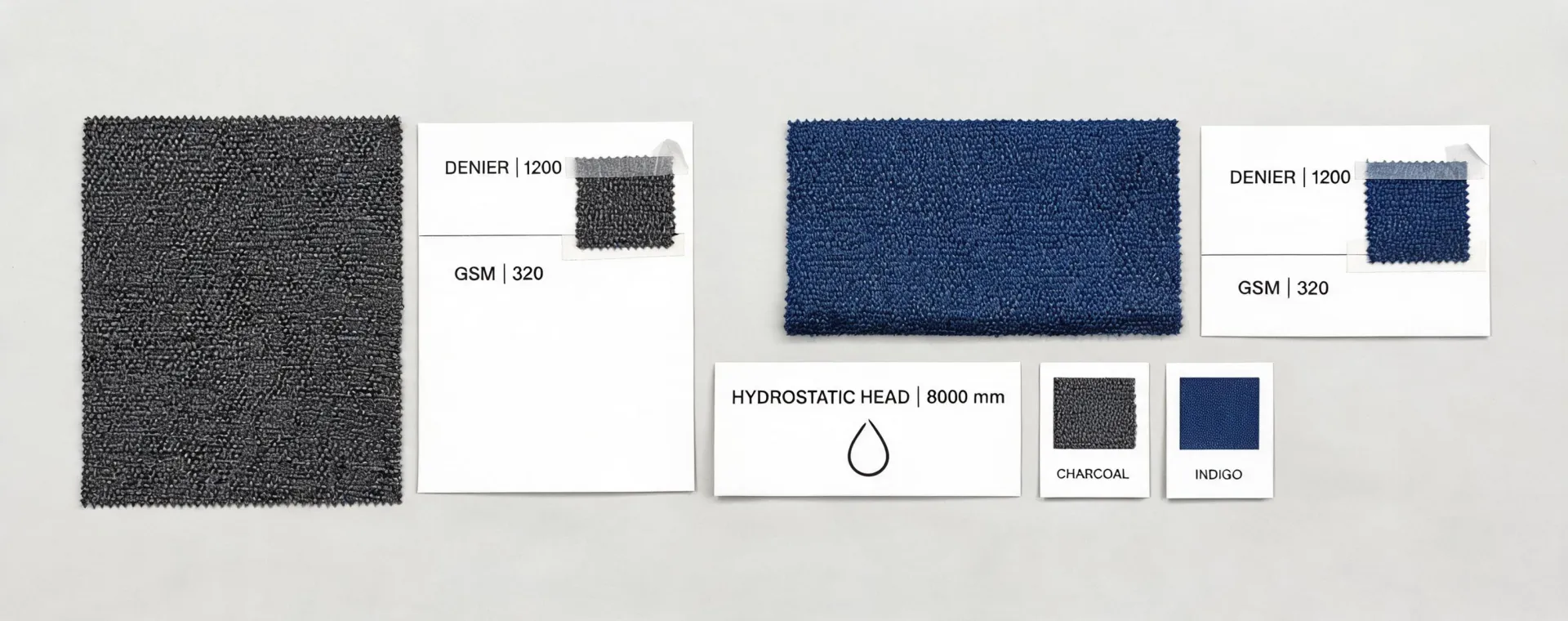
I've spent the better part of the last six years managing fabric procurement for a mid-sized distributor. We move roughly $420,000 in fabric annually across about 40 active SKUs. In that time, I've learned that "how to choose fabric for wholesale" is the wrong question. The right question is: what kind of buyer are you right now?
Because the answer changes depending on which scenario you're in. I've watched buyers overpay for specs they never needed, and I've watched them save $0.30 per meter only to eat a $4,000 rework bill three months later. Neither outcome was inevitable. It came down to whether they understood their own buying context.
Below are the three scenarios I see most often in wholesale fabric procurement, and what I'd do differently in each one.
Scenario A: You're buying performance fabric for an outdoor or technical brand
This is the world of waterproof/breathable membranes, ripstop nylon, softshell laminates, and DWR finishes. If your end customer is a hiking brand, a ski label, or a tactical-gear OEM, this is probably you.
What actually matters
Don't chase the highest numbers on the spec sheet. A 20K/20K waterproof-breathable rating sounds impressive, but unless you're selling into alpine mountaineering, a 10K/10K fabric will handle rain jackets for urban commuters fine. In 2023 I watched a buyer pay a 40% premium for 20K membranes on a product line that never saw weather worse than a Portland drizzle.
What does matter:
- Finish durability — not the initial DWR rating. Spray-test the fabric after 20 home launderings. Some finishes wash out after 10.
- Seam-seal compatibility — if the mill can't tell you which seam tape works with their laminate, that's a red flag.
- Colour consistency — Delta E tolerances above 2.0 will show on production runs. Ask for the mill's standard before you commit.
Where the hidden costs live
Here's something vendors won't put on the quote: minimum order quantities are often more negotiable than the head price. A mill might hold firm on $4.20/meter (spring 2024 pricing, at least) but flex on MOQ from 3,000 down to 1,500 meters if you're a returning customer. That flexibility is worth more than a 5% price cut on a small first order.
If you're sourcing through an outdoor fabric distributor rather than direct from the mill, expect a 15–25% markup but shorter lead times and smaller MOQs. Whether that's worth it depends entirely on your cash-flow tolerance for inventory.
Scenario B: You're buying velvet or upholstery fabric for wholesale
This is where things get strange, because velvet is one of the hardest fabrics to source consistently at scale. The "how to choose velvet fabric for wholesale" conversation is really a conversation about batch consistency, and most first-time buyers don't realise it until their third order looks different from their first.
What actually matters
Martindale rub count, not pile height. A 3mm pile feels luxurious in a sample book, but if the fabric is rated for 15,000 Martindale cycles, it's residential-only. Commercial hospitality projects need 30,000+. Heavy contract (hotels, restaurants, offices) wants 40,000+.
Colour fastness to light (ISO 105-B02). Velvet's deep pile catches light differently than flat fabrics, so fading is more visible. A rating of 4 or above on the blue wool scale is your floor for anything that will sit in daylight.
Dye lot control. Ask your supplier: "will my repeat order come from the same dye lot?" If the answer is "probably," plan for visible seams when you reorder.
Where the hidden costs live
I went back and forth between two velvet suppliers for about two weeks in early 2024. The first quoted $8.40/meter with a 500-meter MOQ and included FR finishing. The second quoted $6.90/meter — but the FR treatment was a $1.80/meter add-on, and their MOQ was 1,200 meters. Cheaper on paper. Put another way: more expensive in reality, since we only needed 600 meters.
Even after choosing the first supplier, I kept second-guessing. What if their dye consistency wasn't as good as the sample swatch? We didn't relax until the third reorder came back matching the original.
Scenario C: You're running a private-label or OEM program
This is the highest-stakes scenario and the least forgiving of mistakes. If you're putting your brand name on the fabric — or on the finished product made from it — you're not buying a commodity. You're buying a piece of your reputation.
What actually matters
Development capability, not catalog access. Any mill can sell you their existing line. The question is whether they'll develop something that's genuinely yours — your hand-feel, your colour, your finish recipe. Functional fabric private label programs live or die on this.
Recipe ownership. If you're paying for custom development, get it in writing who owns the formulation. I've seen brands spend $12,000 on development only to discover the mill was free to sell the same construction to a competitor.
QC process transparency. Ask for their AQL sampling standard (mental note: if you don't know what AQL is, that's your homework tonight). If they don't have one, that's not a minor gap — it's a warning.
Where the hidden costs live
Development costs aren't the issue. The issue is iteration costs. Most first-round custom samples miss the target. Budget for three rounds instead of one, and you'll avoid the panic of a missed production window.
This is also the scenario where working with an established mill — someone like Glen Raven Mills, whose custom fabrics division has been doing this for decades — tends to pay off despite a higher per-meter price. Their OEM and private-label work is built around exactly this: bespoke constructions, documented development processes, and longer-term supplier relationships rather than off-the-shelf options rebranded as "custom."
So which scenario are you actually in?
Before your next supplier meeting, answer these three questions honestly:
- Who is your end customer? If it's a consumer brand that puts their name on the product, you're in Scenario C whether you like it or not.
- What's your realistic order volume? If you're under 1,000 meters per SKU, direct-from-mill relationships (Scenarios A and B) will strain under MOQ pressure. A distributor or wholesale aggregator may be the smarter path — at least until your volumes justify going direct.
- Are you buying inventory or developing a product? Inventory purchases optimise for price and lead time. Product development optimises for consistency, documentation, and long-term partnership. Don't confuse the two.
Most buyers don't fit neatly into one box. But knowing which weight dominates your decision is the difference between a good purchase and a lesson learned the expensive way.