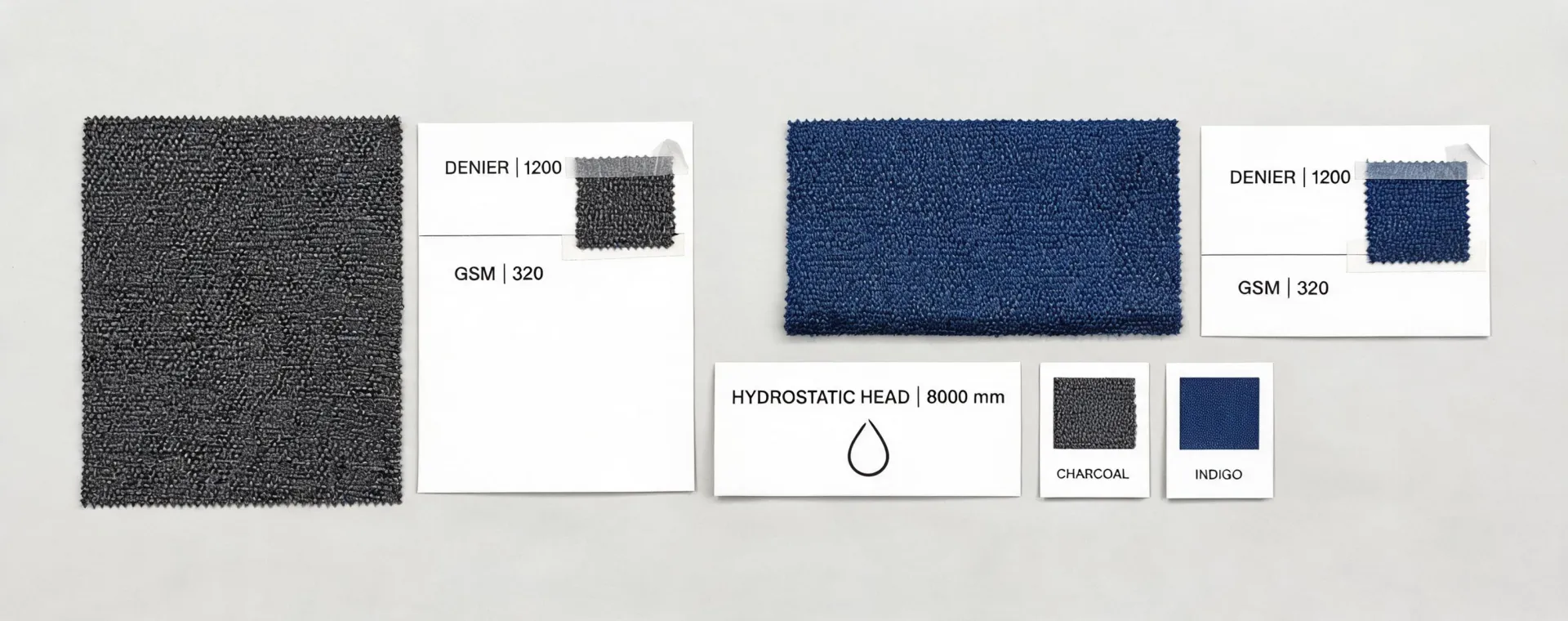
When I took over fabric procurement for our outdoor gear division in 2021, I had a spreadsheet with 23 vendors and no real framework for choosing between them. About half were selling stock technical fabrics—catalog items I could pull from a warehouse in days. The other half, including Glen Raven, offered what the industry calls OEM custom fabrics: you bring the spec, they weave or knit to it.
I've now placed roughly $1.2M worth of fabric orders across both models over four years. Here's the thing I wish someone had told me earlier: the OEM vs. stock decision isn't about which is "better." It's about which trade-offs you can absorb given your volume, timeline, and how tight your product spec actually needs to be.
So this is going to be a straight comparison across four dimensions that mattered most to our team—specification fit, cost structure, batch consistency, and compliance documentation. I'll tell you where each model wins and where it doesn't.
Specification Fit: How Close Does "Close Enough" Actually Get You?
With stock fabrics, you're working backward. You find a 3-layer softshell with a 10K/10K waterproof-breathable rating, a 4-way stretch, and the hand-feel your design team wants—and then you adjust your product around whatever the mill already produces. Maybe the DWR finish isn't quite what you were targeting. Maybe the color range tops out at six options. You make it work.
OEM functional fabric flips that. You hand over a spec sheet—weight (GSM), weave structure, stretch percentage, finish type, colorfastness requirements—and the mill produces to it. Glen Raven Custom Fabrics, for example, does this across softshell, hardshell, ripstop, and performance nylon and polyester programs.
The catch is iteration time. Our first OEM softshell run went through three rounds of hand-feel revisions before sign-off. That added about five weeks to the timeline—or rather, closer to seven once you count the lab dip approvals for color.
Where stock wins: Speed to first sample. If you need something in hand for a trade show or a quick-turn customer pitch, stock catalog fabric gets you there in 5-10 business days.
Where OEM wins: Everything after the first order. Once the spec is locked, you're not compromising on stretch recovery, DWR durability, or color consistency just because that's what the warehouse had.
I'd rather spend 10 minutes explaining a spec sheet to a mill than spend six months explaining to my VP why our "waterproof" jacket wasn't actually waterproof in the field test.
The MOQ Math: Where OEM Actually Starts Saving You Money
This is where procurement people get tripped up. Stock fabric has low MOQs—sometimes 500 yards, sometimes less. OEM custom fabric usually starts at 3,000-5,000 yards per colorway, depending on the mill and the construction complexity.
So on small runs, stock is cheaper. That's obvious.
But here's the part that surprised me. Once you cross roughly 8,000-10,000 yards annually in a given fabric, the unit economics flip. Our landed cost on a custom 2-layer bonded softshell was about 18% lower than the equivalent stock fabric at our annual volume—because we weren't paying the stock mill's margin on top of an already-marked-up catalog price, and we weren't absorbing the waste from cutting around specs that didn't quite match what we needed.
I want to say that savings hit around $40K annually across our softshell and ripstop programs, but don't quote me on the exact figure—our volumes shifted a lot between 2023 and 2024.
The real cost trap isn't the per-yard price though. It's the cost of getting the spec wrong on a low-MOQ stock order, then re-ordering. I watched a colleague save $1,800 by going with a cheaper stock nylon oxford. The DWR coating failed on a customer's 50-unit production run after four months of field use. The rework and replacement order cost over $12,000, not to mention the relationship damage.
The practical rule I use now: If annual volume on a given fabric is under 5,000 yards, stock is fine—though I should note that assumes your spec tolerance is genuinely loose. Above 8,000 yards, get OEM quotes before you default to catalog.
Batch Consistency: The Dimension That Surprised Me Most
Conventional wisdom says stock fabrics are more consistent because they're standardized. That's not quite right.
Stock fabric consistency depends on whether you're sourcing from the same production run. If your order spans two dye lots—and it often does—you'll see shade variation. We had a situation in early 2023 where our stock supplier shipped us a 2,000-yard order split across three lots. The navy was noticeably different between lots two and three. We had to segregate the cut panels by lot number.
OEM flips this too. Because your spec is locked and the mill produces specifically for you, batch-to-batch variation tends to be tighter—assuming you're working with a mill that has genuine process control. Glen Raven Mills has been running production in Burlington, North Carolina since the late 1800s, so the process discipline is pretty well baked in at this point.
That said—and this is important—OEM consistency only holds as long as you're placing continuous orders. If you go dormant for 18 months and then reorder, you may hit a situation where the mill has changed equipment or your original dye chemistry is no longer in the lineup. I've been burned by that.
Compliance Documentation: Boring, But It's Where OEM Pulls Ahead
If you're selling into any regulated market, you know the pain of chasing compliance docs. Proposition 65, REACH, OEKO-TEX, bluesign, customer-specific RSLs—the list depends on where you ship.
Stock fabric suppliers usually have a standard compliance packet ready. That's convenient. But it may not match your specific end-use requirement—if you need a different flame retardancy standard, or if your buyer requires a specific recycled content threshold, a standard packet won't cover it.
With OEM, compliance documentation gets built into the spec. You tell the mill what certifications you need, they test to it, and the documentation reflects your actual order. It takes longer upfront—anywhere from two to six weeks for new testing—but it eliminates the back-and-forth later.
Per FTC guidelines on advertising claims (ftc.gov/business-guidance/advertising-marketing), any environmental or performance claim must be substantiated with evidence. When you're working with a custom fabric supplier, the test reports travel with your order. When you're pulling from a stock catalog, you're sometimes one step removed from the actual test data.
So Which One Should You Actually Choose?
I have mixed feelings about this, honestly. On one hand, OEM is almost always the right choice at scale. On the other, I've seen teams sink six months into a custom spec that ultimately didn't sell—while a stock fabric would have gotten them to market in eight weeks.
Here's how I'd frame the decision now:
Go with stock if: You're testing a new product concept, your annual volume is under 5,000 yards, you need fabric in hand within 2-3 weeks, or your design team can work within an existing catalog's parameters.
Go with custom OEM if: You have a locked product spec that stock can't match, you're committing to 8,000+ yards annually per fabric, you need compliance documentation matched to specific buyer requirements, or you're building a private-label program where fabric differentiation is part of the value proposition.
The hybrid approach: Start with stock for prototype and field testing. Once the product is validated and you have a purchase order pipeline, transition to OEM for production runs. That way you get speed where you need it and cost efficiency where it matters.
One more thing—whoever you work with, ask pointed questions upfront. Can they provide a leather fabric specification guide if your product line includes leather alternatives? What's their actual lead time on reorders, not first orders? What happens if a batch fails inspection mid-production? The answers to those questions will tell you more about the supplier than any capability deck.