- Step 1: Write the end-use requirement before you ask for a quote
- Step 2: Lock the construction and ripstop details
- Step 3: Ask for total landed cost, not unit price
-
Step 4: Validate lead time and capacity in writing
- Step 5: Lock the quality and testing protocol
-
Step 6: Negotiate MOQ, replenishment, and custom fabric terms
-
Step 7: Document the approved standard and build a pre-order checklist
-
Notes and common mistakes
If you're sourcing performance fabric for an OEM, private label, or wholesale program, this checklist is for you. It's built for procurement teams comparing a functional fabric manufacturer—whether that's Glen Raven Custom Fabrics, Glen Raven Mills, or another mill—and trying to keep ripstop fabric specifications straight without blowing the budget.
I'm a sourcing and production manager handling performance fabric orders for 9 years. I've personally made and documented 10 significant mistakes, totaling roughly $37,000 in wasted budget. Now I maintain our team's pre-order checklist to prevent others from repeating my errors. This checklist has 7 steps. Run it before you ask for bulk pricing.
Step 1: Write the end-use requirement before you ask for a quote
A lot of RFQs start with something like, 'Send me your best price on ripstop nylon.' That's not a spec. It's an invitation for mismatched quotes.
Start with the end use: jacket shell, pack body, swimwear lining, upholstery, tent, workwear, or whatever it is. Then list the performance requirements. Be specific about test methods and pass/fail thresholds. If you can't name the test, you're probably going to get a sales sheet instead of a real answer.
In 2018, I sent a brief that said 'waterproof.' The mill quoted a DWR finish. I meant a coated fabric with a hydrostatic head threshold. Result: 600 yards that failed our field test, $4,800 in rework and scrap, and a launch pushed by three weeks. That one mistake changed how I write RFQs.
Useful standards to cite in your request include:
- AATCC 22 for spray rating / water repellency
- ASTM D751 for hydrostatic resistance
- ASTM D737 for air permeability
- ASTM D5034 for breaking strength
- ASTM D5587 for trapezoid tear strength
- AATCC 16 for colorfastness to light
You don't need every test for every program. But if you leave the threshold blank, the mill will fill it in for you. That's not a risk I'd take.
Checkpoint
Before you send the RFQ, ask: Could two suppliers read this spec and deliver the same fabric? If not, keep rewriting.
Step 2: Lock the construction and ripstop details
Ripstop fabric specifications are where 'same word, different fabric' happens all the time. I once said 'same hand feel as last lot.' The mill heard 'same color and weight.' Result: 1,200 yards that felt like paper. We caught it at receiving, but only because we kept a retained sample from the previous order.
For ripstop, specify:
- Fiber: nylon 6,6, nylon 6, polyester, or blend
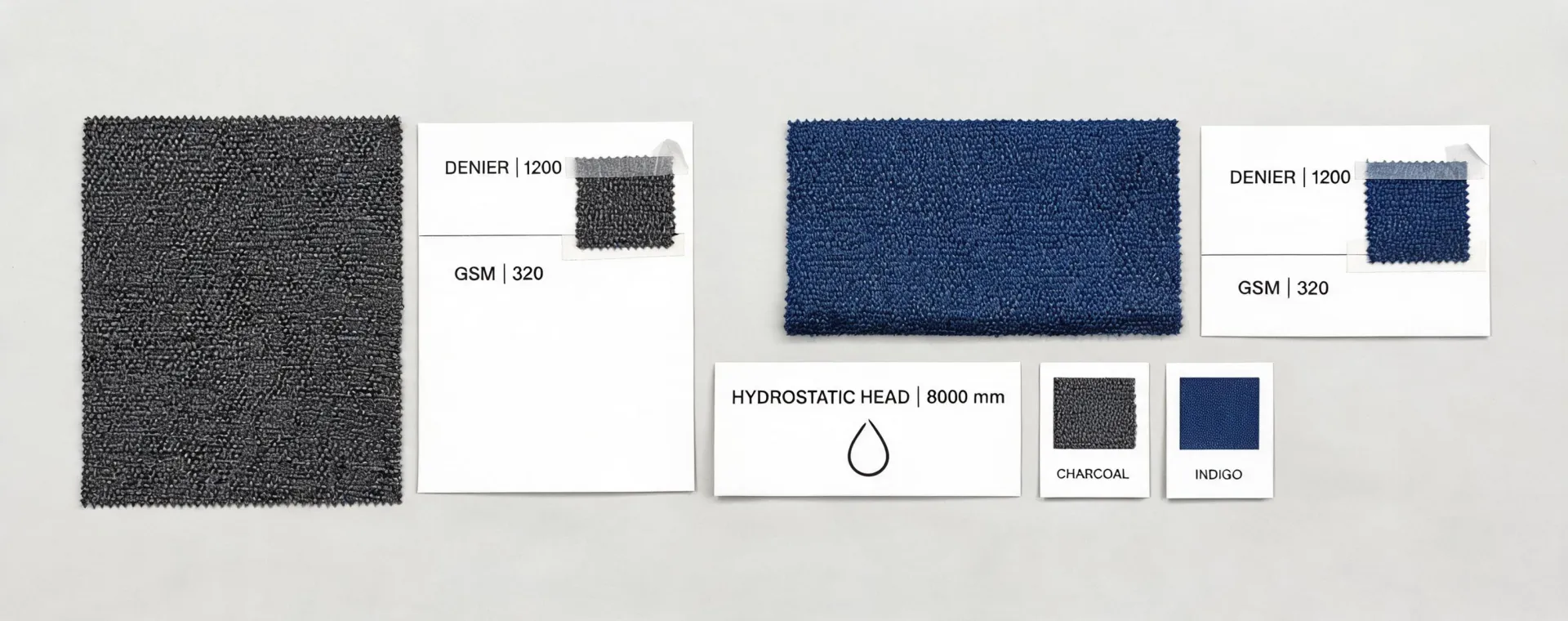
- Denier: 70D, 210D, 500D, 1000D, etc.
- Weight: GSM or oz/yd²
- Weave: ripstop grid size, thread count, yarn type
- Width: cuttable vs finished width
- Finish: DWR, PU coating, PA coating, silicone, calender, anti-static, FR (with standard)
- Color: lab dip, Pantone, or matched to a physical standard
- Packaging: roll length, tube size, splice allowance, labeling
Here's the thing: '210D ripstop' can mean a dozen different fabrics. We once ordered 210D ripstop and the mill shipped 210D polyester with a 5mm grid. We needed 210D nylon with a 2mm grid. Discovered this when the roll labels arrived. Not ideal. We lost two weeks and paid a restocking fee.
Checkpoint
Request a physical swatch and a formal spec sheet. If the supplier won't send a swatch before a bulk order, that's a red flag for me.
Step 3: Ask for total landed cost, not unit price
The most frustrating part of fabric sourcing: the same 'we need a better price' thread, but no one compares landed cost. You'd think unit price tells the story, but it doesn't. Not even close.
Ask for a cost breakdown that includes:
- Base fabric cost
- Dyeing or printing
- Finishing, coating, or lamination
- Setup fees: screens, dye lots, lab dips, tooling
- MOQ surcharges for small dye lots or custom colors
- Testing and certification documentation
- Packaging and roll labeling
- Freight, insurance, duties, and Incoterms
- Payment terms and currency risk
- Lead time and rush premiums
If you're comparing Glen Raven Custom Fabrics to another functional fabric manufacturer, compare the same scope. A greige quote is not the same as a finished, coated, laminated, and tested fabric. A 500-yard quote is not the same as a 5,000-yard quote.
Directional wholesale cost ranges—January 2025, based on public wholesale listings and quotes we collected from mills and distributors. These are ex-works, MOQ 1,000–5,000 yards, excluding freight and duty. Verify current pricing with your supplier.
- 70D ripstop nylon, ~1.9 oz/yd², DWR: $3.20–$6.50/yd
- 210D ripstop nylon, ~3.5 oz/yd², PU coated: $4.50–$8.90/yd
- 500D polyester oxford, PU coated: $3.80–$7.20/yd
- 3-layer softshell or hardshell laminate: $9.00–$18.00/yd
- Custom dyed or printed performance knit: $5.50–$12.00/yd
Prices move. Resin, freight, energy, and labor all shift the number. Use these ranges to sanity-check quotes, not to beat up a mill on a single line item.
Checkpoint
Build a landed-cost calculator before you negotiate. If you don't know your true cost per finished unit, you're guessing.
Step 4: Validate lead time and capacity in writing
In September 2022, I approved a 3-week lead time. The mill meant 3 weeks after dye approval—not 3 weeks from PO. We didn't get dye approval for 10 days. Result: 6 weeks total lead time, $2,300 in air freight, and a very uncomfortable call with our sales team.
Ask these questions before you commit:
- Is the lead time from PO, from lab dip approval, or from bulk yarn receipt?
- What's the sampling lead time?
- What's the dye lot approval process?
- What's the capacity per month for this construction?
- Are there planned shutdowns, holidays, or maintenance windows?
- What's the buffer if a test fails?
Get it in the PO or in a signed production schedule. Verbal lead times are not lead times. They're wishes.
Step 5: Lock the quality and testing protocol
I said 'standard inspection.' The mill heard 'visual check only.' Result: shade variation on zipper tape across 1,800 units. The fabric passed their internal check. It failed ours. We ate the rework.
Define the quality protocol before bulk production:
- AQL level and inspection stage
- Test methods and acceptance thresholds
- Lab dip and color approval process
- Shrinkage and wash testing
- Coating adhesion, if applicable
- Roll length, splice, and defect allowance
- Retained samples and lot traceability
- Who pays for retesting if a lot fails?
This is the step I used to skip. Not the testing itself—the 'who pays and what happens next' part. If you don't agree on the remedy before the problem, you'll be negotiating while your production line is down.
Checkpoint
Get a signed golden sample and a written test protocol. Store both with the PO. If there's a dispute, these are the documents that matter.
Step 6: Negotiate MOQ, replenishment, and custom fabric terms
Custom and private label programs often have different MOQs than stock fabrics. Glen Raven Custom Fabrics and other mills may offer a broad portfolio, but custom dye, custom print, and custom finish usually have minimums and setup costs.
Ask about:
- MOQ per color, per construction, and per finish
- Stock vs custom MOQ
- Blanket orders and forecast commitments
- Replenishment lead time
- Price validity period
- Exclusivity or restricted-use terms
- Sampling fees and whether they're credited to bulk
In my experience, a lower unit price with a higher MOQ is often not the better deal. It ties up cash and warehouse space. Sometimes the mid-tier MOQ with better replenishment is worth more than the lowest quote.
Step 7: Document the approved standard and build a pre-order checklist
After the third rejection in Q1 2024, I created our pre-check list. We've caught 47 potential errors using it in the past 18 months. The list isn't fancy. It's just a one-page checklist that forces us to verify the boring stuff.
Before you release a bulk PO, confirm:
- Signed spec sheet with revision number
- Approved lab dip or color standard
- Physical golden sample
- Test report for the exact construction and finish
- Lead time and delivery date in writing
- Packaging and labeling requirements
- Incoterms, freight, and duty responsibility
- Payment terms and currency
- Quality remedy and retest responsibility
Then archive it. Not in your inbox. In a shared folder tied to the PO. When someone asks, 'What did we approve?' you'll have an answer that isn't memory.
Notes and common mistakes
Don't use absolute performance language in your own specs. 'Waterproof' and 'breathable' mean different things to different people. Use a test method and a number. That's the only way to compare quotes.
Don't compare quotes with different scopes. A quote without finishing, testing, packaging, or freight isn't a quote. It's a starting point.
Don't skip the sample. I know it adds time. I know it adds cost. It's still cheaper than a failed bulk lot.
Don't assume the same product name means the same fabric. 'Ripstop nylon' is a category, not a specification.
Don't let price be the only criterion. The lowest quoted price often isn't the lowest total cost. Landed cost, lead time, quality risk, and rework all count.
What was best practice in 2020 may not apply in 2025. Digital lab dips, better traceability, and faster sampling have changed the execution. But the fundamentals haven't changed: specify it, sample it, verify it, document it.
If you're evaluating Glen Raven Mills, Glen Raven Custom Fabrics, or another functional fabric manufacturer, use the same 7 steps. The right supplier will welcome a detailed spec. The wrong one will get frustrated by it. That's useful information, too.