Start With Delivery Certainty—Price Comes Second
When someone asks me how to evaluate performance fabric manufacturers, my answer is never the one they expect. Don't start with price per yard. Start with this question: "Can you guarantee the delivery date?"
Sounds obvious. It isn't. When you're sourcing ripstop nylon for a product launch and the fabric is the bottleneck, a five-day delay costs way more than a few cents per yard.
I'm not saying price doesn't matter. Of course it does. But here's what I've learned after five years of managing vendor relationships at a 200-person company: the suppliers that quote 15% lower often end up costing 40% more by the time you factor in delays, spec mismatches, and the invoices that finance rejects.
The ones that quote a bit higher but deliver on time? Those are the ones that keep my production schedule intact.
How I Learned This the Hard Way
I'm an office administrator at a mid-size company. I manage all vendor relationships—everything from office supplies to the technical fabrics our product team uses. That's roughly $300,000 annually across eight vendors. I report to both operations and finance, which means I hear about it from both sides when something goes wrong.
In early 2024, I made a mistake that cost us $6,200.
We needed a custom order of waterproof breathable fabric for a client project with a hard deadline. A new supplier quoted us significantly less than our regular source—about 20% lower per yard. Their samples looked good. They promised "delivery within two weeks."
I knew I should get that delivery promise in writing with a penalty clause. But I thought, "What are the odds they miss it? The samples were fine, they seem professional."
They missed the deadline by nine days. When the fabric finally arrived, the coating weight didn't match the approved spec—it was lighter than the sample we'd signed off on. We couldn't use it for the client's order.
We had to rush-order from our original supplier at premium pricing, pay expedited shipping, and absorb overtime costs for the production team. That $6,200 didn't include the hit to our reputation with the client.
Now I verify delivery capability before I place any order. No exceptions.
What I Actually Evaluate Now
Here's the framework I use when assessing any performance fabric manufacturer—whether it's a large operation like Glen Raven Mills or a smaller specialty mill.
1. Delivery Certainty (Not Just Speed)
There's a difference between "fast" and "reliable." I ask:
- Can you commit to a delivery date in writing?
- What happens if you miss it—is there a penalty clause?
- What's your on-time delivery rate for the past 12 months?
For time-sensitive orders, I now budget for the certainty premium. If a guaranteed delivery costs 8% more but eliminates the risk of missing a $15,000 client deadline, that math is easy.
Here's the thing most buyers miss: the cheapest option isn't the cheapest option if it costs you a deadline.
2. Spec Verification—Don't Trust Samples Alone
The question everyone asks is "Can I see a sample?" The question they should ask is "How do you ensure batch consistency?"
I've seen factories that produce beautiful samples and then deliver production runs with visible color variation, inconsistent coating weight, or different hand feel. The sample is marketing. The production run is reality.
I now request:
- Test reports for each production batch (not just the sample)
- Third-party lab verification for critical specs
- Clear tolerance ranges in writing—what deviation is acceptable, what triggers a redo
For custom fabrics—whether it's a specific color, finish, or performance characteristic—I always ask about their OEM and private label process. How do they handle color matching? What's the minimum order for custom runs? What's the standard lead time from approval to delivery?
Companies like Glen Raven Custom Fabrics have established processes for this, but you still need to ask. Don't assume.
3. Communication Clarity
This one burned me early on. I said "standard width." They heard "standard width." We both assumed we meant the same thing. We didn't—their standard was 58 inches, ours was 60. That two-inch difference meant our cutting patterns didn't fit and we wasted 12% of the fabric on every roll.
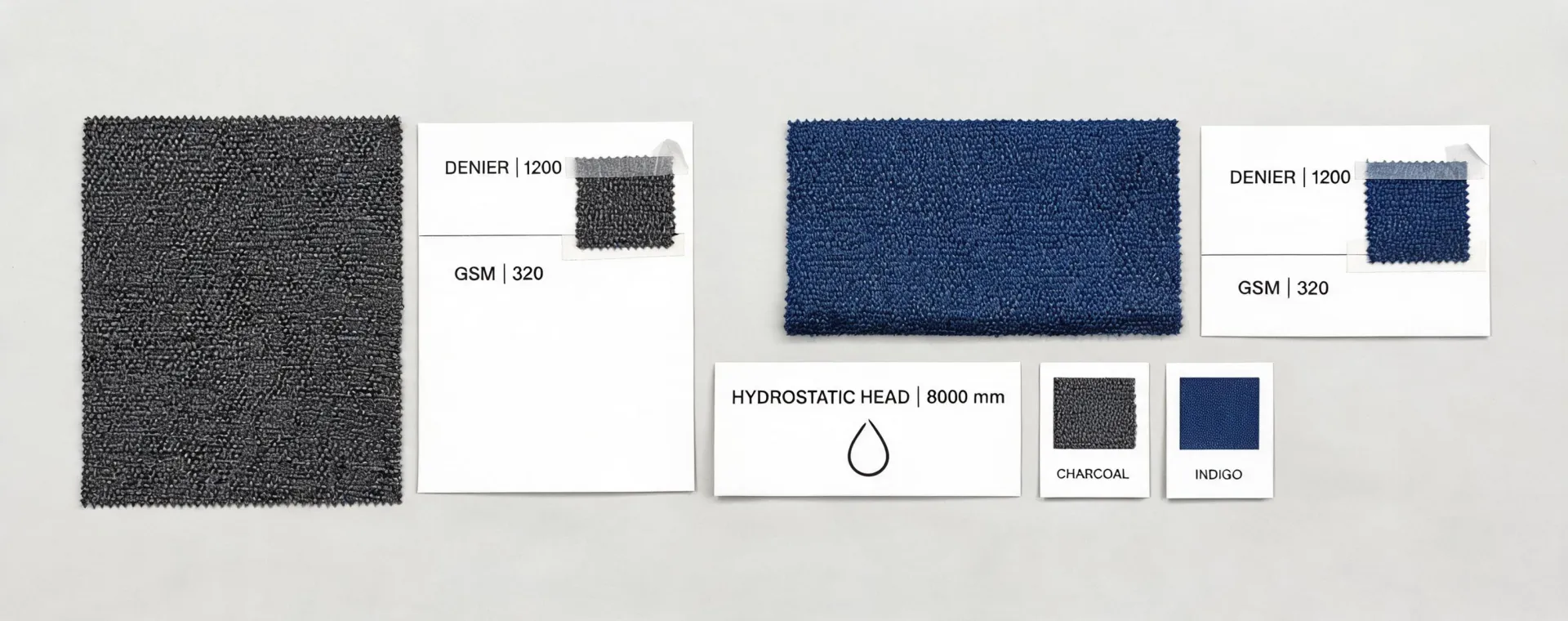
Now I put everything in writing with exact numbers. No adjectives. No assumptions. If they say "waterproof," I ask for the specific hydrostatic head rating. If they say "breathable," I ask for the MVTR number. If they say "durable," I ask for abrasion test results.
Vague language creates expensive misunderstandings.
4. Total Cost, Not Unit Price
The per-yard price is just the starting point. Here's what actually lands on the invoice:
- Base fabric cost
- Setup fees for custom colors or finishes
- Testing and certification costs
- Shipping (and expedited shipping if deadlines slip)
- Duties and import fees if sourcing internationally
- Potential redo costs if quality doesn't meet spec
- Your own labor spent managing problems
I calculate the total landed cost for every option before making a decision. The lowest quote rarely wins after that math.
When the Framework Doesn't Apply
I'm not saying you should always pay more for certainty. That's not realistic or necessary.
If you have buffer time, if the order is standard (not custom), if you've worked with the supplier before and they've been reliable—then price can and should be your primary lever.
The framework I just described matters most when:
- The deadline is fixed and non-negotiable
- The fabric is custom or spec-critical
- The order is large enough that a problem creates real financial exposure
- You're working with a new supplier for the first time
In those situations, the premium for certainty is worth it. In others, it's not.
Bottom line: know what you're paying for and why. That's the whole game.