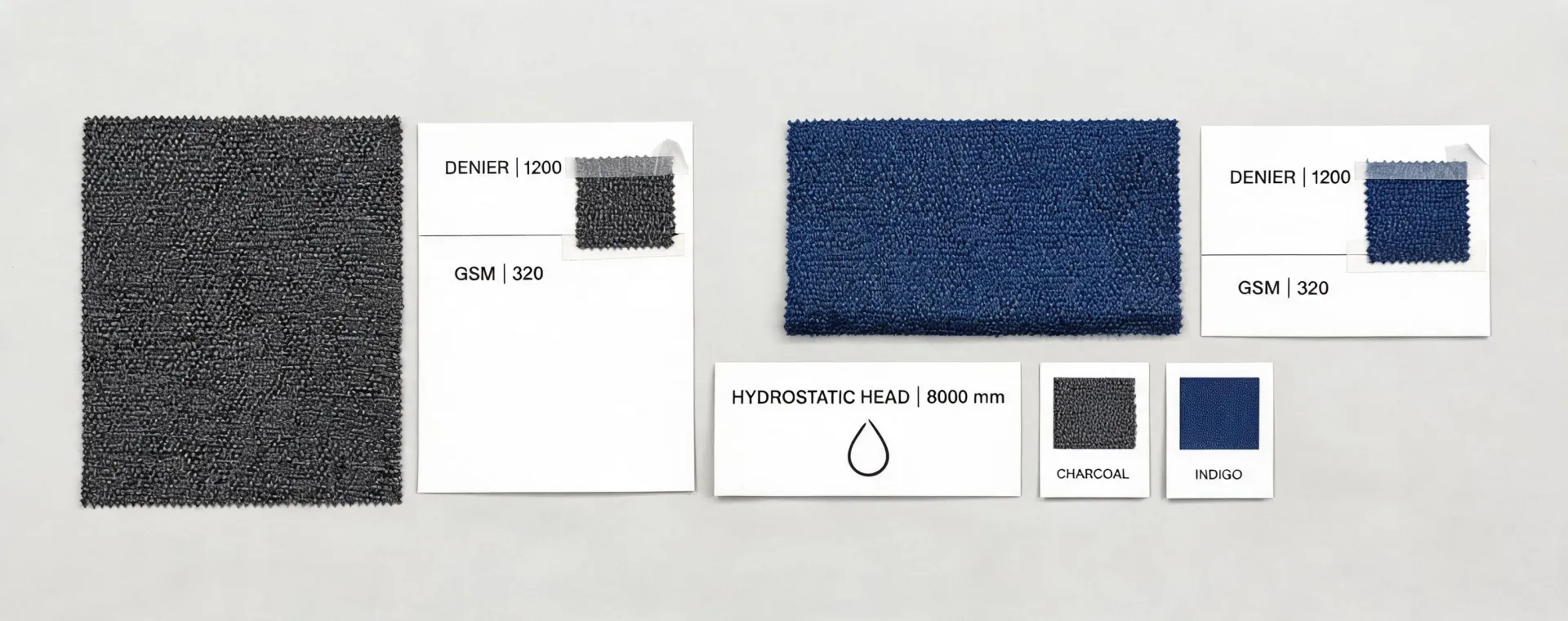
If you only read one line of a velvet spec sheet, read the one about who commits to what — in writing. Pile composition, abrasion cycles, and color tolerance tell you what the fabric is. The ship-date clause tells you whether your production line runs. Most buyers grade the first three and ignore the fourth. That's backwards, and it gets expensive.
My working rule after seven years of buying contract upholstery fabric: I'll pay 10–20% more to a mill that will put a delivery window in writing. I've never regretted that premium. I've regretted the cheap option twice, and both times the "savings" cost more than the premium would have.
Why I'm qualified to have an opinion about this
I'm a procurement manager at a 180-person contract furniture manufacturer. I've owned our fabric budget — roughly $2.4M annually across textiles, foam, and trim — for seven years. I've negotiated with 40+ mills and converters, and every order since 2018 has run through our ERP with cost-per-usable-yard tracked line by line.
When I audited our 2023 spending, 31% of our "fabric overruns" traced back to shortages and re-cuts, not unit price. That audit is why I rewrote our velvet spec template. Not because I love templates. Because I got tired of explaining shortages to the plant manager.
The velvet spec: what actually belongs in it
Most velvet spec sheets I receive are two paragraphs of adjectives and one line of fiber content. Here's what I require before a sample even gets cut.
1. Pile fiber content and construction
Cut pile vs. loop pile, face fiber, backing fiber, pile height. "100% polyester" isn't enough — solution-dyed polyester behaves differently from piece-dyed under UV, and the price difference reflects that. Ask which one you're quoting. If the answer is vague, that's your answer.
2. Abrasion rating — and which test produced it
Wyzenbeek double rubs (ASTM D4157) and Martindale cycles (ASTM D4966) aren't interchangeable, and mills quote whichever number looks better. Thresholds I've seen specifiers work from: 15,000 double rubs reads as light contract, 30,000 as general contract, 50,000+ for heavy-use hospitality. Martindale numbers get cited in the 25,000–40,000 range for similar applications. Ask for the test method and the lab report, not the number on the sell sheet.
3. Colorfastness
Two figures matter: lightfastness hours (AATCC 16) and crocking grade (AATCC 8). For anything near a window, I'm cautious about specifying under 100 hours of lightfastness unless the mill shows me installed-project data. Wet crocking below grade 4 has burned us on dark velvets in humid climates — that one I learned the hard way.
4. Color tolerance, stated in Delta E
Industry standard color tolerance is Delta E under 2 for brand-critical colors. Delta E of 2–4 is noticeable to trained observers; above 4 is visible to most people. Reference: Pantone Color Matching System guidelines.
Put the tolerance in the PO. "Close to the submitted sample" isn't a tolerance — it's an argument waiting to happen three weeks before install.
5. Usable width, not nominal width
This is where a cheap velvet stops being cheap. A 54" nominal velvet might have 51.5" usable after selvage trim. On a 12,000-yard program, that 2.5" gap is roughly 5% more yardage — and 5% of a $180,000 order is $9,000 that never appeared on the quote sheet. I've seen it happen on three different programs.
6. Pile direction and cut planning
Velvet has nap. Cut two panels in opposing directions and they'll read as two different colors under raking light. Which means you need 10–15% extra yardage on any project with visible seams. If your estimator is applying flat-woven waste factors to a velvet job, your bid is wrong and you'll find out in the cutting room.
7. Environmental claims with paper behind them
Per FTC Green Guides, environmental claims like "recyclable" must be substantiated. A product claimed as "recyclable" should be recyclable in areas where at least 60% of consumers have access. Source: FTC 16 CFR Part 260 (Green Guides).
If a mill says "recycled content" without a percentage and a certification, I treat it as decoration. Same for "eco-friendly." It isn't a spec. It's a mood.
The counterintuitive part
Here's what took me too long to internalize: a 100,000-double-rub velvet that ships three weeks late costs more than a 30,000-double-rub velvet that ships on time.
I used to grade vendors almost entirely on durability specs and unit price. Durability feels like the responsible thing to optimize for. It isn't — not when you've got 40 people standing on a line waiting for roll goods.
Look, I'm not saying abrasive ratings don't matter. They do. I'm saying they're the second question. The first question is whether the date is real.
Where the certainty premium actually pays off
In March 2024, we paid $1,900 extra for a guaranteed three-week delivery window on a custom velvet. The alternative saved us $1,900 and came with "approximately 4–6 weeks, subject to mill schedule." Subject to mill schedule — those four words have cost me more money than any price increase in my career. We were installing a 96-unit hospitality order with a liquidated damages clause attached. Missing that date was never a $1,900 problem.
I have mixed feelings about rush premiums. On one hand, they feel like gouging. On the other, I've watched a late shipment trigger rescheduled crews, three weeks of storage fees, and a customer who now questions everything we say. I've stopped debating whether the premium is fair. It's cheaper than the alternative.
That said, rush fees aren't always justified. If your install date has slack in it, take the slower lane and pocket the difference. The premium is for dates that don't move.
A note on sourcing channels
Our performance fabric distributor stocks a meaningful share of what we run, and I value that relationship. But a distributor doesn't control the mill's schedule. So when a distributor quotes me a date the mill hasn't committed to, they're passing along optimism. If they're shipping from on-hand inventory, that's different — then I want the lot number and the on-hand quantity in writing before I release the PO.
Same logic applies to mills. We ran a 300-yard trial with Glen Raven Custom Fabrics before committing to a larger outdoor program, mostly because their team put the run schedule in writing before we asked for it. The Glen Raven Mills operation in Burlington, NC has been at this a long time, and the process discipline shows in how they quote. That's rarer than it should be.
We also needed a breathable fabric supplier for a mesh-backed seating line around the same period. Shortlist came down to four. Three quoted lead times as ranges. One quoted a date. We went with the date.
One misconception worth retiring
The "velvet is a residential fabric" thinking comes from an era when pile fabrics were engineered almost entirely for drape and hand, with abrasion as an afterthought. That's changed. Solution-dyed pile constructions now show up in restaurant booths, hotel lobbies, and transit seating. If your spec team is still treating velvet as decorative-only, they're working from a rulebook that's roughly 20 years out of date.
Where this all breaks down
Honest boundaries, because a spec guide without them is just a brochure:
- My experience is based on roughly 200 mid-size contract orders, mostly domestic and near-shore mills, mostly hospitality and office work. If you're sourcing high-volume residential retail or working through overseas agents, your math will look different — probably better on unit price, probably worse on schedule risk.
- I don't have hard data on industry-wide defect rates. What I can tell you anecdotally from six years of order records is that first-article problems tend to show up in the low double digits as a percentage of orders. Take that with a grain of salt; it's one company's log, not a study.
- One of my bigger regrets: I didn't get a dye-lot continuity commitment in writing back in 2022 on a repeat program. We ate a re-cut on 1,400 yards when the second shipment ran a shade off. Costly lesson, and entirely avoidable.
- Velvet isn't the right answer everywhere. In high-soil environments with aggressive cleaning protocols, a flat woven or coated performance fabric usually makes more sense. I'd rather lose a velvet sale than win a callback.
If you take one thing from this: write the date into the contract, not just the durability number. The durability number lives on a sell sheet. The date lives on your schedule.