March 2024: the order that looked simple
I've been handling fabric sourcing and private-label orders for eight years. I've personally made (and documented) five significant mistakes, totaling roughly $14,000 in wasted budget. Now I maintain our team's pre-order checklist to keep other buyers from repeating my errors.
In March 2024, our small outdoor brand needed two things: about 400 yards of awning fabric for a market-umbrella project, and 150 yards of breathable fabric private label for a pack prototype. We also wanted to compare ripstop fabric wholesale options for a later run. I thought I could handle it in a week. I was wrong.
The quote that saved $480 and cost $3,180
I sent the same spec sheet to five suppliers. Four came back with quotes between $7.20 and $9.80 per yard for the awning fabric. One came back at $5.60 per yard. That looked like a $480 saving on 400 yards. In my opinion, that felt like a win.
Here is what I missed: the lower quote excluded setup, freight, and a required 10% overage. It also assumed a narrower width. By the time we added those back, the gap shrank to about $180. But I had already mentally spent the savings.
The bigger issue was communication. I said 'breathable.' They heard 'air-permeable.' I meant a fabric with controlled moisture-vapor transmission for a pack panel. They sent a lightweight mesh that would fail abrasion. We were using the same words but meaning different things. Discovered this when the sample arrived and it felt like a window screen.
Saved $480 by choosing the lower quote. Ended up spending $3,180 on rework, rush freight, and a missed launch window.
The awning fabric surprise
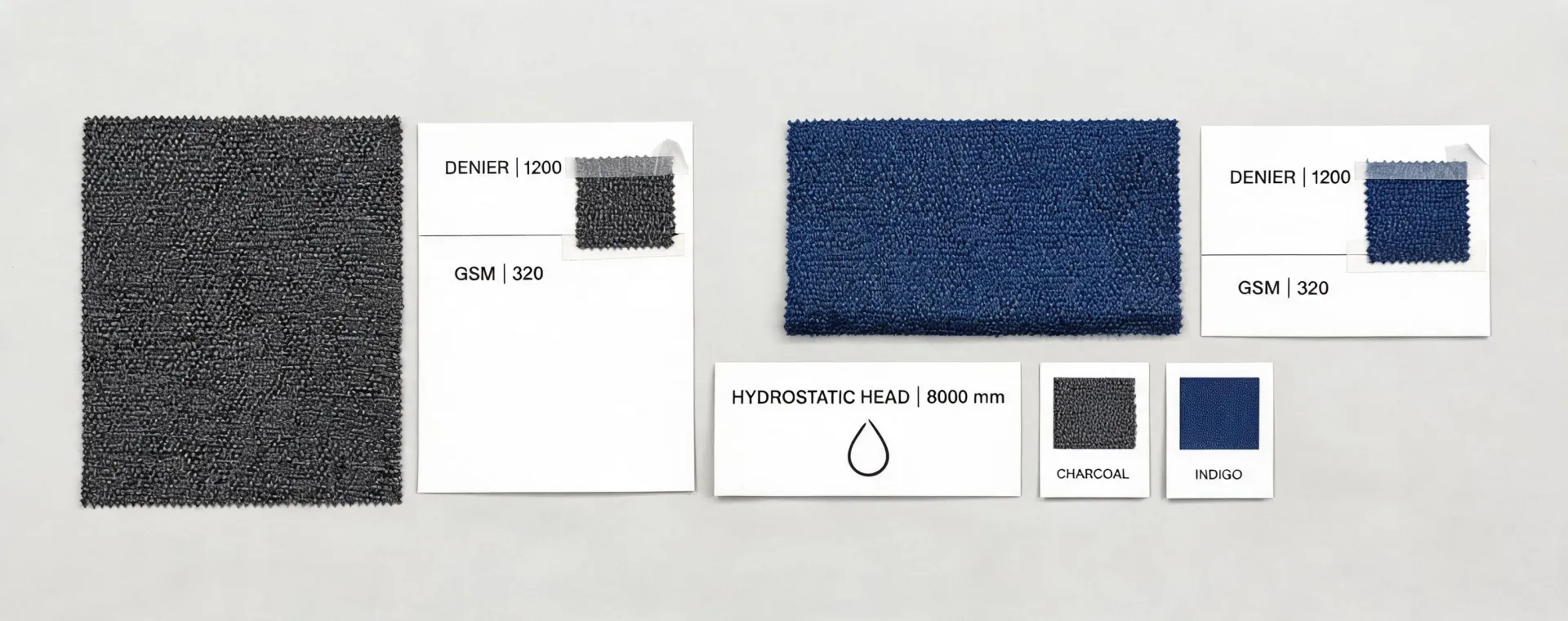
The awning fabric was worse. The budget vendor shipped a 500D polyester oxford with a light coating. It looked fine on the roll. Under our shop lights, the color was off by two Pantone steps. The coating was uneven at the edges. The width varied by almost two inches across the roll.
Never expected the problem to be width. I thought the risk was color. Turns out the uneven width caused more waste than the color mismatch. Our cutting table lost about 12% more fabric per panel. That was another $400 in hidden cost.
The most frustrating part: we had asked for test reports. They sent a one-page PDF with no test method, no lab name, and no date. You'd think a supplier would know that a certificate without a method is just paper. But here we were, three weeks from launch, with fabric we could not use.
The call to Glen Raven Mills
A contractor we trusted told us to call Glen Raven Mills. I was hesitant. We were a small account with a 150-yard trial order. I assumed a company like Glen Raven Custom Fabrics would not care about a small breathable fabric private label run.
I was wrong again. The first call was not a pitch. It was questions: What is the end use? How much UV exposure? What sewing method? What width do you actually need? What test standards matter for your market? They asked about ASTM D751 for coated fabrics, AATCC 127 for hydrostatic pressure, and ASTM E96 for moisture vapor transmission. They did not claim the fabric would pass everything. They asked which tests our brand needed.
That was the surprise. The value was not a lower price. It was a shorter list of unknowns.
To be fair, Glen Raven is not the only supplier that does this. But in our experience, the small-order treatment was different. They quoted the 150-yard trial. They explained MOQ, overage, and lead time. They offered private-label options without pretending the trial was a 10,000-yard program. Small doesn't mean unimportant. It means potential.
A practical awning fabric wholesale cost guide
If you are building an awning fabric wholesale cost guide for your own team, start with the cost buckets we missed:
- Fabric base price: $5-$14 per yard in our Q3 2024 quotes. Custom shades and wider widths pushed toward the top.
- Setup / custom run fee: $250-$900 depending on mill and color.
- Overage: 5-10% is common. On 400 yards, that is 20-40 extra yards you still pay for.
- Freight: $150-$600 for LTL, more for expedited.
- Testing: $300-$1,200 if you need third-party reports for water resistance, colorfastness, or breaking strength.
- Rework risk: This is the one nobody quotes. Ours was $3,180.
Add those together before you compare. A $5.60 quote can become a $7.40 landed cost. A $7.20 quote can stay at $7.20. That difference changes the decision.
What I wish I had tracked
I wish I had tracked total landed cost more carefully from the start. What I can say anecdotally is that the cheapest quote was not the lowest total cost. Not even close.
As of Q3 2024, our quotes for awning fabric wholesale ranged from about $5 to $14 per yard. That range depends on weight, coating, width, colorfastness requirements, and whether the mill is running a stock color or a custom shade. I don't have hard data on industry-wide defect rates, but based on our five years of orders, my sense is that first-delivery issues affect a meaningful share of small private-label runs. Maybe 8-12%. Treat that as a rough estimate, not a benchmark.
For ripstop fabric wholesale, the same logic applies. Ask for: yarn denier, thread count, coating type, tear strength, and shrinkage. Get a yardage sample, not a swatch. Sew it. Wash it. Abrade it. Then decide.
The checklist that came out of it
After the third rejection in Q1 2024, I created our pre-check list. We have caught 47 potential errors using it in the past 18 months. Here is the short version:
- Define the end use in writing. Sun, rain, abrasion, flex, wash cycles, and expected life. 'Outdoor' is not a spec.
- Confirm the test methods. ASTM D5034 for breaking strength, ASTM D751 for coated fabrics, AATCC 127 for water resistance, ASTM E96 for breathability. Ask for lab name and date.
- Calculate total landed cost. Base price, setup, overage, freight, duty, testing, and rush fees. The lowest quote often hides the highest total.
- Lock the width and shade. Width variance and color tolerance are where small orders bleed money.
- Get a production sample. Signed, dated, and kept. A swatch is not a sample.
Three things: specs, samples, total cost. In that order.
What I would tell a smaller buyer
If you are placing a 100-yard or 200-yard order, you are not a nuisance. You are testing a market. A good supplier should respect that. If a mill refuses to explain MOQ or overage, that is a red flag. If a supplier promises '100% waterproof' without a test method, that is another red flag. I cannot speak to every fabric category, but in our context, transparency beat price every time.
This worked for us, but our situation was a small outdoor brand with predictable designs. If you are a distributor buying container loads, the calculus might be different. If you need same-week delivery, your options narrow. Your mileage may vary.
As of January 2025, I still use the same checklist. It is not glamorous. It just keeps $3,180 mistakes from happening twice.