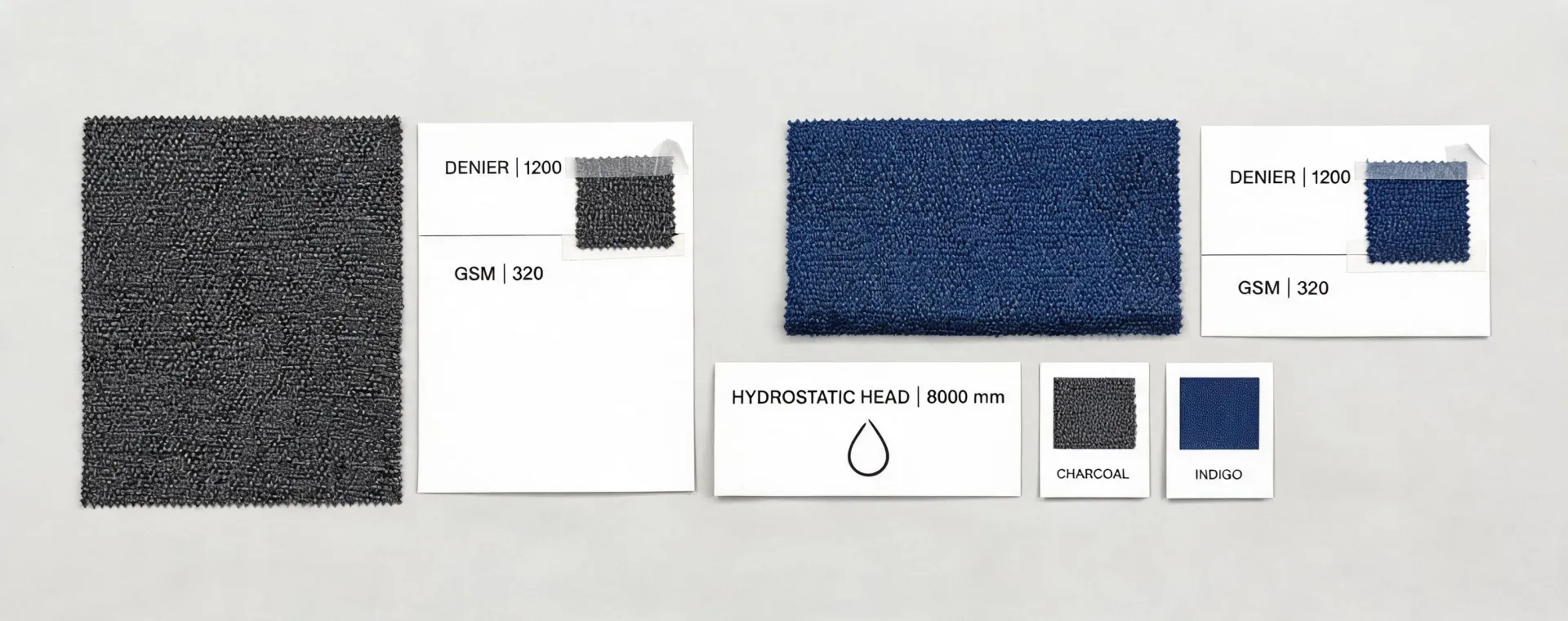
If you've ever stood in a warehouse while a roll of ripstop fabric arrives late and doesn't match the approved swatch, you know the sinking feeling. I've been sourcing technical fabrics for seven years now—maybe eight if you count the year I spent as an assistant. I handle orders for nylon, polyester, waterproof breathables, softshell, hardshell, and custom functional fabrics for OEM and private-label programs.
People expect me to obsess over water-column ratings and hand-feel. Those matter. But when a launch date is on the calendar, the thing I care about most is not on the spec sheet. It's whether the supplier can deliver certainty.
Here's my view: When a deadline is fixed, certainty is worth paying for. The lowest-priced fabric supplier who says 'probably' isn't saving you money. They are gambling with your launch date.
I learned this the expensive way—about $6,900 of documented waste, plus a few gray hairs.
The 31-cent mistake that cost $6,900
In September 2022, we needed around 3,200 yards of 70D nylon ripstop for a private-label outdoor collection. The requirement looked simple: a consistent grid, a specific finish, and one approved color. We got quotes from three suppliers. The cheapest was $0.31 per yard less than the established mill we had used before. On 3,200 yards, that was roughly $992 in potential savings.
It's tempting to think all ripstop fabric suppliers are the same. They're not. Yarn quality, weaving tension, dye lots, finishing chemistry, coating adhesion, and inspection standards all vary. The supplier we chose wasn't malicious. They simply didn't have the process to deliver consistency under production pressure.
The rolls arrived 11 days late. The color was visibly off. A spectrophotometer reading showed Delta E above 4.2. For critical brand colors, industry tolerance is often below 2. At 4.2, you don't need a trained eye to notice. We also found coating inconsistencies that would affect how the fabric sewed and taped.
By the time we paid for rejected yardage, extra testing, air freight on a replacement, and overtime at the sewing plant, the $992 saving turned into roughly $6,900 in unnecessary cost. Looking back, I should have paid the higher quote from the start. At the time, I thought I was negotiating well. I wasn't. I was ignoring the value of certainty.
Ripstop and hardshell fabric suppliers are not commodity vendors
Technical fabrics are not commodities. When you buy from a ripstop fabric supplier, you are buying repeatability. The weave structure matters, but so do yarn supply, finishing, and the ability to reproduce the same result across many lots.
A hardshell fabric supplier is even more dependent on process control. Hardshell is typically a laminate system: face fabric, membrane, and backer. Small shifts in lamination can lead to failures that don't show up in a hand sample. If your marketing claims use words like waterproof or breathable, per FTC guidelines (ftc.gov) those claims need evidence. You need a supplier who can provide it.
That's why Glen Raven custom fabrics came up so often when we evaluated serious suppliers. When we talked to Glen Raven Mills, the conversation went beyond a basic spec sheet. They asked about the intended use, the performance data we needed, and how the fabric would be sewn and laminated. That kind of conversation does not guarantee perfection. But it tells you the mill has real production knowledge, not just a catalog.
Functional fabric OEM vs private label: different labels, same damage
The functional fabric OEM vs private-label discussion often focuses on ownership. If you sell under your own private-label brand, a fabric failure is direct. Your name is on the product. If the color is wrong or delivery misses the selling season, customers look at your company, not at the fabric supplier. You carry the cost of markdowns, returns, and lost trust.
If you're doing an OEM program, you might think the brand owner carries the final risk. In practice, a missed fabric deadline still lands on you: idle sewers, expedited freight, penalty clauses, and a buyer who may not place the next order. The legal paths differ. The operational pain is the same.
For either model, you are really asking a fabric manufacturer for process control. When a supplier like Glen Raven Mills manufactures rather than just resells, there is a direct line between the people who developed the fabric and the ones producing it. That matters when you have to adjust a specification in the middle of an order. It's one of the reasons I now evaluate suppliers for resilience, not only unit price.
Certainty deserves its own line in the budget
I used to be proud of never paying rush charges. Then I realized rush charges often buy speed, but not certainty. What I needed was a supplier that could commit, with evidence, to a date and a specification. Sometimes that meant paying a little more per yard to work with a mill that controlled its own quality process.
Do the math: 1,000 yards of fabric. Supplier A quotes $4.50 per yard. Supplier B quotes $4.80 per yard. The difference is $300. If Supplier A is two weeks late, the cost of that delay in labor, storage, air freight, and lost sales can easily exceed $10,000. The $300 saving is a tiny line on a purchase order. The failure cost can swallow a whole season.
After my 2022 mistake, I changed how I qualify suppliers. Now I ask a different set of questions:
- Where is the fabric actually woven, coated, or laminated?
- What testing data comes with each production lot?
- What color tolerance do they use? We request Delta E below 2.
- What happens if a production lot fails? Who pays for scrapped material and downtime?
- Can they commit to a specific delivery slot in writing?
That last question is the one that reveals the most. A supplier that can commit to a real date, and explain how they will hit it, is offering certainty. A supplier that says 'we will do our best' is asking you to accept their production risk.
Higher price doesn't guarantee perfection. It buys better odds.
I can hear the pushback: a higher-priced supplier can still miss a deadline. True. No one can guarantee every date. But you can tell which suppliers have invested in consistency, technical support, and honest communication. When a supplier can answer specific questions with data and clear contingency plans, their price is not a cost. It's risk insurance.
So here's my advice. If you're sourcing fabric for a program with no fixed launch date, price can be the main factor. But if a retail calendar, customer commitment, or factory booking depends on the delivery, choose certainty. You aren't paying extra just for speed. You're paying to transfer risk away from your own launch and onto a supplier that can manage it.
Certainty is not a luxury. It is a requirement for any deadline-driven fabric order. Verify it, budget for it, and treat a 'probably' as the risk it is.