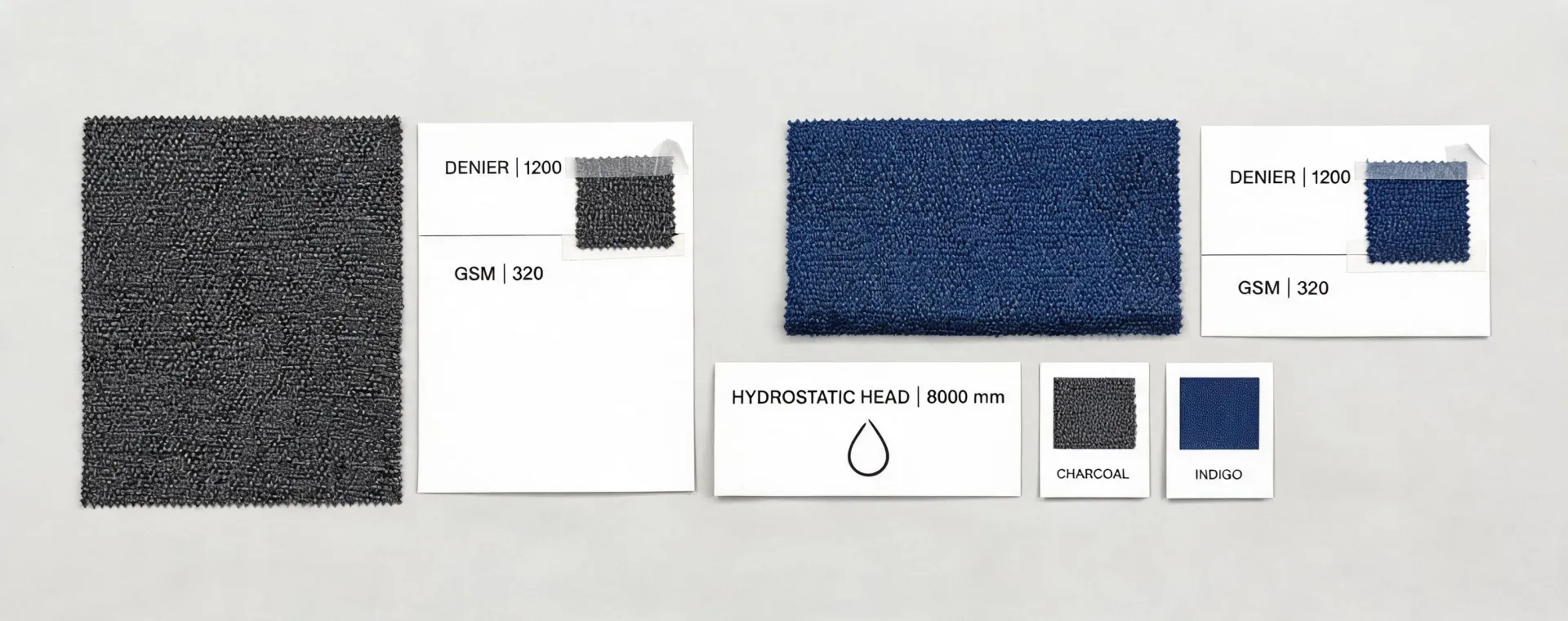
I manage purchasing for a 40-person private label outdoor goods company. Every year, I place about 70 fabric and trim orders across 12 vendors, which adds up to roughly $1.2 million in material spend. I report to both operations and finance. I have been doing this since 2020, and I have made more sourcing mistakes than I like to admit.
If you are sourcing performance fabric for a private label brand, you know the feeling. You ask for waterproof fabric, and suddenly you are looking at nylon oxford, polyester hardshell, and three-layer laminates from suppliers. I have seen price sheets range from $2.80 to $11.40 a yard for fabrics that all claim to be 'performance.' None of the data sheets line up. Two mention hydrostatic head, but they use different test methods. One says 'water resistant.' Another says 'waterproof.' The swatches feel completely different.
I don't say this to make anyone feel bad. I do not mean that vendors are dishonest. I mean that most sourcing problems start with a vague request.
The Real Problem: 'Performance Fabric' Is Not a Spec
Here's a surprise: 'performance fabric' is a marketing term, not an engineering category. It can mean stain resistance, breathability, an antimicrobial finish, UV resistance, abrasion resistance, or any combination of those. Ordering 'performance fabric' by name is like ordering 'a vehicle' and expecting a van.
When I took over purchasing in 2020, I didn't understand that. I assumed 'same specifications' meant identical results across vendors. Didn't verify. Turned out each mill had its own interpretation. One roll came with a durable water repellent finish. The other didn't.
The bigger problem isn't carelessness. It's that buyers compare prices before they define the end use. You can't source a technical fabric until you know what it has to do.
Why Waterproof Fabric Sourcing Goes Wrong
Let's say you need a waterproof shell. Are you looking for a coated nylon, a laminated hardshell with a membrane, or a softshell with a durable water repellent finish? All three get called 'waterproof' in product descriptions. They behave differently in use, especially after washing, compression, or long exposure to sunlight.
Waterproof is not a fabric property. It's a system: fabric, finish, membrane, seams, and care.
If you don't specify a test method and a condition, you're not sourcing waterproof fabric. You're hoping.
As of January 2025, the test specs I ask for are AATCC 127 or ISO 811 for hydrostatic pressure, AATCC 22 for spray rating, and ASTM D751 for coated fabrics when there's a coating involved. But standards get updated. I still see old versions floating around in supplier spec sheets. Verify current requirements at the AATCC or ISO source before you finalize anything.
So instead of asking 'is this waterproof?' ask 'what hydrostatic head do you test to, and after how many washes?' That single question will separate a technical mill from a fabric dealer.
The Custom Fabric Assumption
The word 'custom' causes the same confusion. Custom fabric can mean a custom color, a custom weave, a custom width, a custom finish, or a full from-scratch development. Each has a different lead time and a different minimum. They are not the same service.
I learned this during our 2024 vendor consolidation project, when I narrowed our list from 12 mills to four approved partners. The mill that annoyed me most at first, because they asked questions instead of sending a quote, turned out to be the most valuable. They didn't just say 'yes.' They asked what the fabric would be used for, how often it would be washed, and what tolerances would be acceptable.
That's the kind of experience you want in a Glen Raven custom fabrics project. Not because the company is perfect, but because the conversation is technical. You get a performance fabric private label solution that starts with your use case, not with a catalog page.
The Velvet Fabric Wholesale Cost Guide Trap
Velvet is another place where this goes wrong. I get asked about the velvet fabric wholesale cost guide more often than you'd expect, because people see a low price per yard and think they've found a deal.
Two fabrics can both be called velvet and still be completely different. One is a cotton velvet with a latex backer. The other is a performance polyester velvet with a stain-resistant finish and a flame-retardant treatment. The second costs more upfront. But if your end use requires flame retardancy, the first one needs backcoating that can add $1.40 per yard, shift the color, and add ten days to the lead time.
The surprise wasn't the price difference. It was how much hidden value came with the 'expensive' option, in this case, support, testing, and fewer surprises. That's why any useful velvet fabric wholesale cost guide should list fiber content, finish, weight, backing, flame retardancy, abrasion test results, and minimum order quantities. If those details are missing, the guide is just a price sheet.
What This Costs When You Get It Wrong
The cheap option is often the expensive one. In 2021, I ordered 1,200 yards of what the supplier called 'water-resistant nylon oxford.' I didn't verify the hydrostatic head or the coating. The first production run leaked. The supplier was technically right: they never promised 'waterproof.' But our launch date moved, we paid for replacement fabric, and the brand lost close to $18,000 in retail orders. Actually, $18,400 including chargebacks. I ate it.
No one at the mill was trying to trick me. I used vague language, and I got a vague result.
Those mistakes add up in less direct ways, too. Every return, every test failure, every delayed shipment makes the next internal approval harder. I have also had a vendor that couldn't provide proper invoicing cost us $2,400 in rejected expenses. That's what happens when you skip the boring checks.
What Actually Helped Me
The fix isn't a magic fabric. It's a better starting point. Before you ask for samples, write a one-page spec that includes application, expected lifespan, washing or cleaning protocol, UV and flame retardancy and abrasion requirements, stretch and recovery if applicable, and your target price per finished yard. Then send that to mills with technical experience.
That's why we now include Glen Raven mills in our process. I won't say they're the cheapest, and I don't think any good mill should be chosen on price alone. But their team asks the questions I used to forget: What is the seam tape? What is the wash test? What color standard are we matching? What's the acceptable construction tolerance?
For a small brand, that's the practical meaning of performance fabric private label. You get the performance data, the color work, and the label claim you can defend. You also get a supplier that buys into your timeline instead of just filling a roll.
If you're about to search 'waterproof fabric sourcing' again, stop and write the spec first. If you're comparing mills for a custom project, ask for the test methods behind every claim. And if you're reading any velvet fabric wholesale cost guide, look at the details behind the price.
What was best practice in 2020 may not apply in 2025. The fundamentals haven't changed, but the execution has transformed. I'd rather be the buyer who asks too many questions than the one who has to explain why a shipment doesn't work.
I should add that I don't have all the answers. I just have the scars to prove that vague sourcing is expensive. Start with the use case, not the price. The rest gets a little easier.