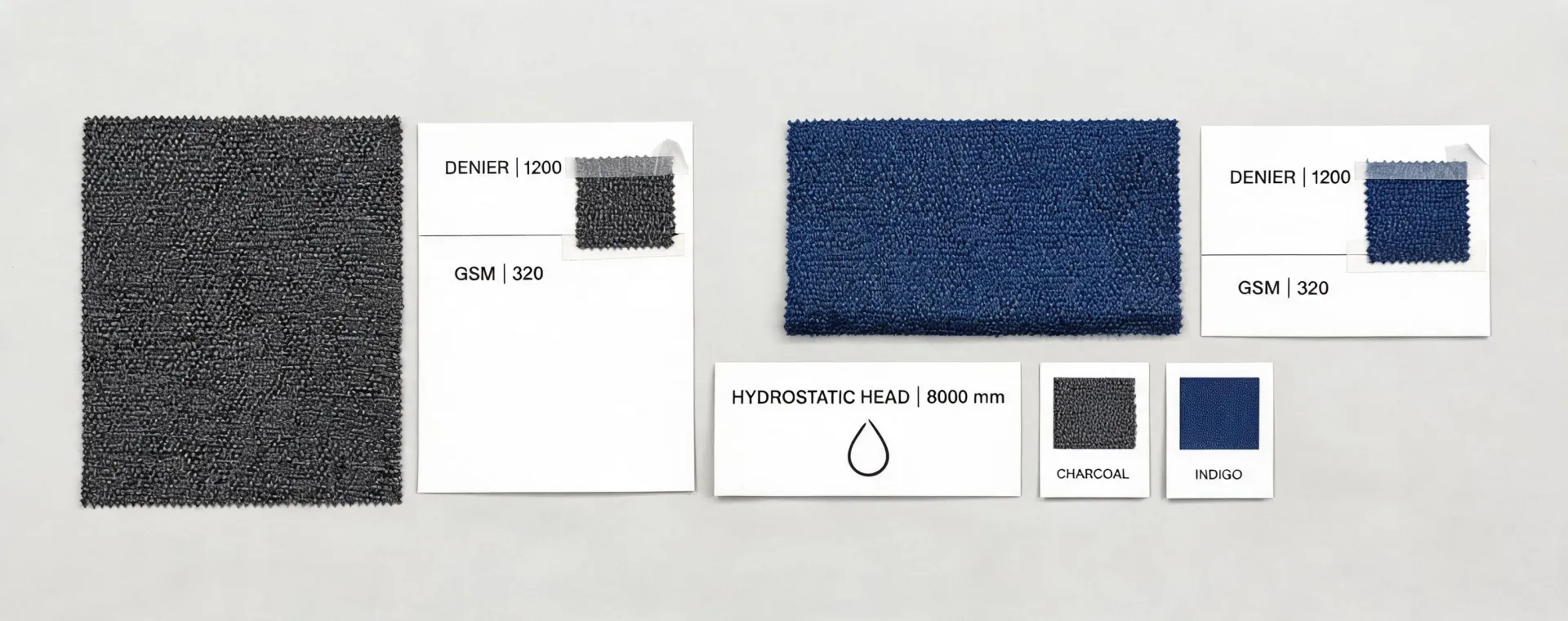
I still remember the day I signed off on a 5,000-yard ripstop order that ended up in the reject pile. The client's spec sheet said 'water resistant.' The mill's test report said 'passed.' But when the first roll hit the production line, a quick water-spray test showed beading on row one and immediate soak-through on row two. $6,200 of bulk water resistant fabric, scrapped. Replacing it cost $2,100 extra and pushed the launch by three weeks.
I work on the Glen Raven custom fabrics side, mostly with OEMs and wholesale buyers. I've handled around 200 technical fabric orders over the last five years — maybe 180, I'd have to check my notes. And I've personally made enough mistakes to fill a folder. Eleven of them were big enough that I documented the PO number, the photos, and the exact dollar cost. Roughly $24,000 in wasted budget, plus the credibility hit that doesn't show up in a spreadsheet.
This article is not a supplier-shaming post. It's a problem-deep-dive from someone who has watched the same ripstop fabric compliance mistakes happen repeatedly — including in my own early orders. If you're a ripstop fabric distributor or a procurement lead comparing Glen Raven Mills custom fabric options, I hope this saves you from my learning curve.
The Surface Problem: 'The Fabric Failed'
When a customer rejects a ripstop order, the first reaction is usually 'the supplier sent bad fabric.' Sometimes that's true. More often, though, the issue isn't just the fabric. It's a mismatch between what you specified, what the supplier tested, and what your customer actually needs.
Here are the three failure modes I've seen most:
- Water resistance that wasn't reproducible. The lab sample passed. The production batch didn't. The finish washed off, or the coating was applied thinner at the end of the run.
- Color that was 'close enough' until it wasn't. A custom navy looked right under warehouse lights, then turned up greenish under the client's showroom lighting.
- Compliance paperwork that didn't cover the finished product. The test report was for the base nylon fabric, not the coated, dyed, finished ripstop.
Those sound like three different problems. Underneath, they're actually the same problem.
The Deeper Cause: Vague Requirements Produce Vague Results
Let's start with the phrase 'water resistant.' It sounds clear. It isn't. There's no single pass/fail standard for 'water resistant.' It can mean a DWR (durable water repellent) finish, a membrane, a coating, or a tight-weave construction. Each one behaves differently and each has different testing requirements.
In my first year at a previous job — before I moved to Glen Raven Mills — I approved a bulk water resistant fabric order with just the words 'water resistant' on the PO. That's the kind of mistake that should be illegal. The mill met their own internal standard, but not the customer's intended application. When I compared the rejected batch against a second sample from another supplier side by side, I finally understood the real issue: we had never agreed on what 'passing' meant.
What I mean is this: for performance fabrics, the test method is part of the specification. You don't just specify a result. You specify the exact test method, the minimum value, and the conditioned state of the fabric. If you leave that open, the supplier has to guess. And guess-worthy specs usually lead to the cheapest interpretation, not the most reliable one.
The 'Water Resistant' Trap
For a coated ripstop, 'water resistant' might mean a hydrostatic head requirement. For a lightweight packable jacket, it might mean a water repellency spray test after five washes. Both are legitimate. They test different things. And if you don't write them down, you're basically rolling dice with your customer's deadline.
I knew I should ask for the finished-fabric test report before production on one big 12,000-yard order. But I thought, 'we've used this mill for years, what are the odds?' Well, the odds caught up with me. The coating on that run failed after two industrial washings. That was the one time skipping the report mattered — and it cost us a week of production time plus a rush re-do.
The Custom Fabrics Blind Spot: Color Tolerance
Color is another place where 'looks right to me' fails. For Glen Raven custom fabrics, buyers often ask for a Pantone reference. That's helpful, but a Pantone number alone doesn't guarantee batch-to-batch consistency.
According to Pantone Color Matching System guidelines, Delta E under 2 is the common tolerance for brand-critical colors. Delta E between 2 and 4 is noticeable to trained observers, and above 4 is visible to most people.
I wish I had known that before we got a batch of 'forest green' ripstop that looked perfect in the sample room, then made a customer's entire product line look slightly olive. We didn't have a stated tolerance in the spec. The supplier technically matched their own first sample, but the difference from the original Pantone chip was too high. My mistake was assuming Pantone numbers did the work for us. They don't.
Compliance Requirements Are Not a 'Nice-to-Have'
Ripstop fabric compliance requirements are probably the most misunderstood area in technical textiles. I don't have hard data on how many ripstop orders fail compliance industry-wide, but based on the 200+ orders I've handled, my sense is that unclear end-use requirements are behind at least a third of rejected batches.
The reason is simple: compliance is application-specific. A ripstop for outdoor apparel might need to meet certain water resistance, seam strength, and durability standards. The same base cloth used for upholstery might need flammability documentation. A distributor can't honestly say 'this fabric is compliant' without knowing where it's going and how it's going to be used.
This is why I get a little uncomfortable when a buyer asks me to 'just make sure it's compliant.' Compliant with what? As of January 2025, the requirements that matter will depend on your market, your customer's end product, and the country where the finished goods are sold. The right answer is usually 'here's the pile of documents we have, and here's what we need from you to verify the rest.'
Put another way: compliance is a conversation, not a checkbox. If someone gives you a one-line statement like 'passes all certifications,' that's a red flag, not a comfort.
The Real Cost of 'Cheaper' Ripstop
Now let's talk money, because this is where my value-over-price bias shows up.
I've lost count of how many times a $200 savings turned into a $1,500 problem. One order comes to mind: a buyer found a supplier charging $0.30 less per yard for what looked like the same ripstop. On a 4,000-yard order, that's $1,200 in savings. But the fabric failed the water-repellency test after the customer received it. The re-testing, rush freight, and replacement material ate up the savings and then some. The customer ended up paying more than if they had gone with the higher quote from the start.
Do I have hard data on every comparison? No. But I track my own orders, and I can say this: the lowest quote has cost us more in most of the cases where we chased it. Not because cheaper suppliers are always bad, but because price pressure tends to reduce the things you can't see — documentation, testing, finishing consistency, and buffer stock.
When you're buying bulk water resistant fabric for a production run, the unit price is only one line of the total cost. The other lines are:
- Testing costs and sample approvals
- Finishing and coating consistency across rolls
- Compliance documentation completeness
- Delay costs if a batch fails incoming inspection
- Your own team's hours spent chasing answers
Add those up, and the $0.30 per yard 'savings' often disappears entirely.
What I Check Now (and Wish I Had Checked Earlier)
The good news is this problem is preventable. Here's the short version of the checklist I now use for every Glen Raven custom fabrics order — and the one I'd force myself to read if I were starting over:
- Write the test method into the PO. Don't just say 'water resistant.' Say what test, what minimum value, and which side of the fabric is being tested.
- Request finished-fabric test reports. The report should be for the final product: same dye lot, same coating, same finishing line. A greige fabric report is not enough.
- State your color tolerance in writing. 'Match Pantone 286 C with a Delta E under 2' is a real specification. 'Similar to this chip' is a wish.
- Ask for the compliance file before production. Not after. The file should include test reports, date of testing, lab name, and a clear description of what was tested.
- Verify with one finished sample. A 1-yard cutting from the actual production run can save you from a 5,000-yard mistake. It costs a little time and a few dollars. It's the cheapest insurance you'll buy.
When I look back at the eleven mistakes that shaped this checklist, here's the uncomfortable pattern: almost every one came from confidence, not chaos. I thought I knew what the customer meant. I thought the mill would catch the difference. I thought the third order would be the same as the second. It wasn't.
Now, every bulk ripstop order goes through the same pre-check. We've caught 47 potential errors using this checklist in the past 18 months. That number isn't a flex — it's proof that the system works when you actually use it.
So if you're buying ripstop fabric from a distributor, or comparing Glen Raven Mills custom fabric options, don't ask 'is this the cheapest?' Ask 'what exactly am I getting, and how do we both prove it?' The answer to that question is what you're really paying for.