Let me start with something I learned the expensive way: there isn't one right way to buy performance fabric wholesale. There's a right way for your situation. I spent my first years in textile procurement treating every order like it should follow the same path. That cost me roughly $8,400 in rejected material, re-cut charges, and one very awkward client meeting.
I'm not a salesperson, and I'm not here to tell you which mill to use. I'm the person who documents the mistakes so our team doesn't repeat them. Since 2017, I've personally made and documented three significant mistakes, totaling roughly $8,400 in wasted budget. Now I maintain our team's sourcing checklist.
Here's the thing: no one should order custom technical fabric without a written spec and a pre-production sample. But the details change depending on who you are. So before anything else, here are the four scenarios I see most often:
- Scenario A: You're an OEM or private label brand developing a product that needs a custom construction or a specific weave like ripstop fabric OEM.
- Scenario B: You're a distributor buying performance fabric wholesale to resell to your own customer base.
- Scenario C: You're handling an interior or contract project and need a realistic curtain fabric wholesale cost guide before you commit.
- Scenario D: You're a small brand or designer testing the market before you're ready for volume.
If you're in more than one scenario, pick the one where your decision gets budget approval. That's usually the scenario that matters most.
Scenario A: Ripstop Fabric OEM and Custom Glen Raven Fabrics
If you are building a product around the fabric, the fabric is a component, not a commodity. That's a mindset shift. I used to assume the biggest mill with the most impressive name was the safest choice. Not true. The safest choice is the mill that asks the most questions before it asks for a PO.
I remember a 2021 order where I submitted a PO for 'white ripstop fabric, waterproof'. That's all I wrote. The mill had to assume what I meant. The production run came back with a heavier coating than the sample, and stitch holes opened up at the seam line. That was a $4,200 lesson in writing a real spec.
If you're evaluating Glen Raven custom fabrics, or any custom mill, bring these four things:
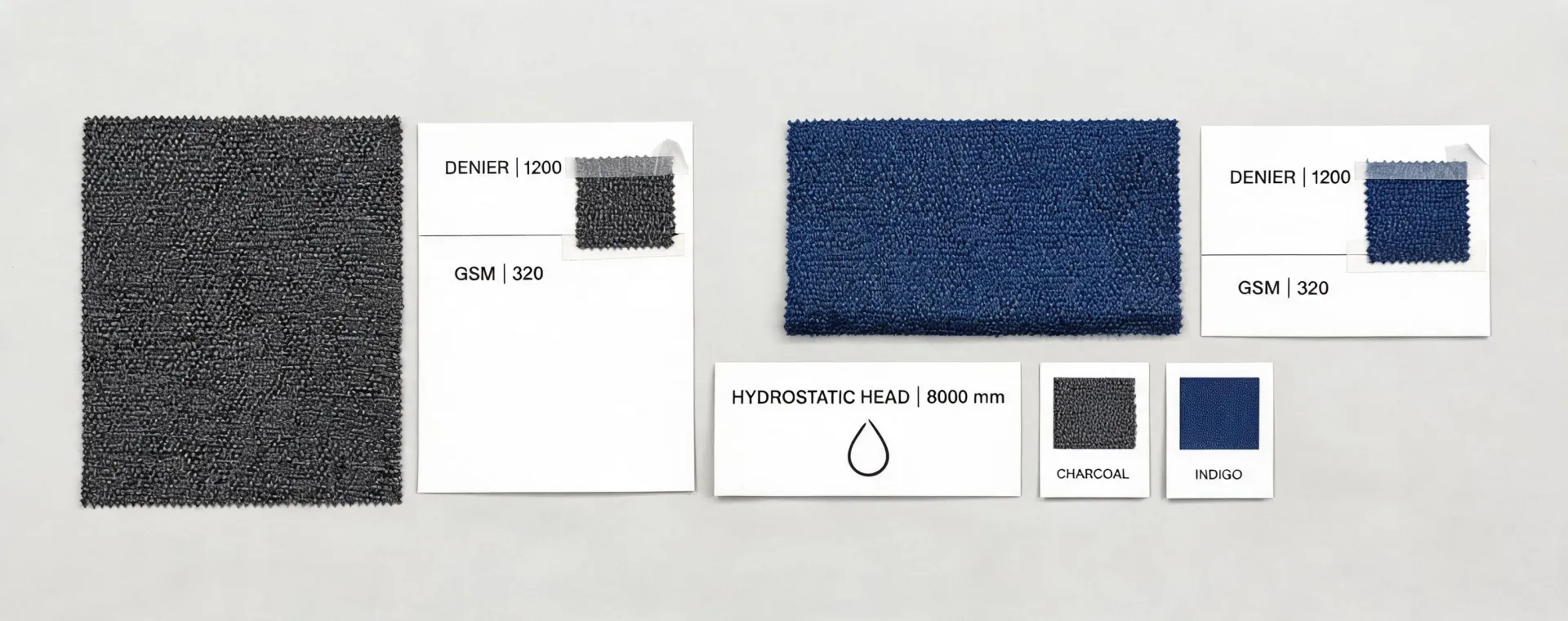
- A construction spec. Don't just say '70D ripstop.' Include weight, finish, coating type, stretch, tear strength if it matters, and hydrostatic head or water repellency. If water repellency matters, ask for the test method and target number. AATCC 22 spray ratings are one example.
- A color standard. Use a PANTONE reference and request a physical lab dip. Industry standard color tolerance is Delta E < 2 for brand-critical colors; Delta E of 2-4 is noticeable to a trained eye. Don't approve a color from a low-res photo.
- A pre-production sample yard. This is not the same as a lab dip. The lab dip is the color quickly dyed to check the shade. The pre-production yard is the actual woven and finished fabric. They can feel completely different.
- A clear finish expectation. The same 70D ripstop can be soft and breathable or stiff with a heavy coating. If you specify only the weave, you haven't specified the fabric.
Here's the counterintuitive part: for a custom OEM program, the price quote isn't the most important document. The spec sheet is. An incomplete spec sheet makes a low quote useless, because you'll pay for the misunderstanding later.
Color management is where I see the most arguments. In 2019, I approved a lab dip based on a photo sent over email. The actual production fabric looked different in natural light. We had to re-dye with a $890 redo charge and a one-week delay. That's when I learned to always request a physical swatch and evaluate it next to the original standard under 6500K light.
Glen Raven Mills gets mentioned a lot in this space. I've seen their name come up in conversations about technical fabrics, marine fabrics, and custom programs. That reputation is earned. But even a good mill needs a good client. The best mills I've worked with appreciate a buyer who knows what to ask for.
Scenario B: Performance Fabric Wholesale for Distributors
Scenario B is for distributors buying performance fabric wholesale for resale. Your customers might ask for 'something like the last outdoor collection' or 'the same black oxford we bought in spring.' Those are dangerous requests, not because people are lying, but because memory is a terrible spec.
I once reordered 'black oxford 420D' by name. The mill changed the shade slightly in the dyeing process. My customer rejected 1,200 yards because the panels from the new roll did not match the old panels in a furniture batch. The complaint cost us $1,880 in credits and a two-day production stop. The fabric itself was fine. It just wasn't consistent with the previous visual appearance.
For performance fabric wholesale, keep a physical record of each production lot. When you reorder, ask for a shade band or range sample before committing to the full quantity. It takes extra time and feels overly cautious, but it's the difference between a repeat order and a return.
Some other questions to ask:
- What is the normal dye lot tolerance for this construction?
- Are roll lengths and off-gauge tolerances specified?
- Does the finish vary by batch, especially on coated or laminated fabrics?
- What test reports can the mill provide for the exact construction you plan to buy?
If you're considering a mill like Glen Raven, my advice for a distributor is different: start with their existing product families before asking for custom development. Stock programs move faster and reduce your risk.
Scenario C: A Curtain Fabric Wholesale Cost Guide You Can Actually Use
When someone asks me for a curtain fabric wholesale cost guide, they usually want a number. I understand that. I also know that a per-yard number without context is worthless.
The real question is not 'what does curtain fabric cost per yard?' It's 'what does it cost per finished drape, fully landed and compliant?' Those are different numbers.
In Q2 2024, I priced a 300-yard run of 118-inch blackout polyester with an FR finish. The mill quoted $4.20 per yard. Using 54-inch fabric, the quote was $3.60 per yard. The per-yard comparison made the 54-inch look better. After accounting for vertical repeat, seam allowances, and panel width, the 118-inch was actually cheaper per finished panel. The wider fabric used fewer yards per panel and less labor.
So here are the cost drivers I use on every curtain program:
- Fabric width and yield. A wider fabric usually costs more per yard but fewer yards per panel. Calculate cost per panel, not cost per yard.
- Vertical repeat. If the pattern has a 27-inch repeat and your panels are 96 inches long, you'll lose a slice of every panel to matching. Ask the mill for the exact repeat before you calculate waste.
- Fire compliance. For contract or hospitality projects, ask for a dated test report for NFPA 701 or the standard that applies to your market. Don't accept 'it's FR' as a verbal answer. I don't care how good the salesperson is; oral compliance promises are not a valid test report.
- Finish and coating. Blackout coatings, water-resistant backings, and anti-bacterial finishes add cost. Some also change the hand feel. You don't want to pick a finish after the fabric is woven.
- Minimums and customization. If you need a custom PANTONE color or a custom weave, expect development charges. From quotes I've seen in Q3 2024, custom development can run in the $1,500-$5,000 range depending on the loom setup, finishing line, and testing requirements.
My own repeat mistake was ignoring the vertical repeat. In 2022, I ordered 400 yards of a striped polyester drapery fabric. The stripe repeat was 9.5 inches, and the panels needed to be 96 inches long. We wasted about 8% of the fabric cutting around the repeat. The mill met its spec, so I had no claim. That's on me, not the mill. I still kick myself for not asking for the repeat on the first call.
That doesn't mean you should never buy curtain fabric wholesale. It means you need to do the yield math before you compare quotes.
Scenario D: Small Brands, Designers, and First-Time Buyers
If you're not buying volume yet, don't ask a mill to make something completely new. Ask what's already in their line. Most mills have stock colors and standard constructions that will take a small order. Custom development is for when you know the product will sell.
I made the opposite mistake when I started. I asked for a custom ripstop with a low minimum, got a quote that looked possible, and then spent money on development that I didn't budget properly. The fabric was nice. The quantity wasn't enough to matter, and I couldn't afford to reorder at the custom pricing level.
Here's the contrarian advice that goes against what most first-time buyers do: if you're doing a custom color, order more than you think you need for the first run. A 500-yard custom order is not that much more expensive per yard than a 250-yard order, but the second 250-yard order later, if the shade doesn't match, will cost you more in hassle, urgency, and returned goods.
And I regret not overordering my first custom color. The reorder came out $0.95 per yard higher and didn't match the original shade. I accepted it anyway because a canceled project was worse. The project survived, but the fabric stacks didn't look right together.
Also: request a sample and actually test it before you buy. Wash it, sew it, drape it, run it through a sewing machine, and if it will be outdoors, leave it in the sun. In 2020, I approved a sample based on hand feel only. The production lot had enough coating that the seam slippage was terrible. I only noticed when I sewed the full order. $2,300 later, I learned to always sew a test seam before signing the PO.
If you're not ready for a full custom program, look at standard performance fabric wholesale options first. You can still build a brand with a standard construction and a well-chosen color.
How to Tell Which Scenario You're In
Here's a simple shortcut:
- If you're sewing the fabric into a product and selling it under your brand, you're in Scenario A or D. The difference is volume and whether you need a unique spec.
- If you're buying to keep inventory for customers, you're in Scenario B. Focus on consistency, shade continuity, and available stock.
- If you're buying fabric for a specific interior project, you're in Scenario C. Focus on yield, repeat, fire compliance, and the cost per finished panel.
- If your annual volume is under 500 yards and your spec is standard, treat it as Scenario D. You can still call a mill like Glen Raven, but ask about existing products first.
One more thing: use a spec sheet even when the mill doesn't ask for one. It does not have to be fancy. It needs to list fiber content, weight, weave or knit type, finish, color standard, width, and any test requirements. That one page saves more money than any discount you can negotiate.
Real talk: the best supplier will not be the one who knows everything. It will be the one who asks you the right questions and sends you the right samples before you place the order.
I still use mills like Glen Raven when the situation fits. The keyword there is fit. There is no universal right answer in performance fabric wholesale. But there is a right answer for your spec, your volume, and your project timeline. Write it down before you call anyone.