There isn't one right fabric supplier. I know that's not the answer you were hoping for, but it's the honest one. The right mill depends on what you're ordering, how custom it needs to be, and whether you're buying railcar quantities or pilot runs.
I've been a procurement manager for a mid-sized outdoor gear company for six years, and I've tracked every fabric invoice since 2019. I've compared bids from North Carolina mills, overseas weaving partners, and specialty houses that only make one type of fabric. That experience taught me to stop asking 'which supplier is the best?' and start asking 'which supplier is best for this order?' Glen Raven is a name that will come up in almost any conversation about performance and custom technical fabrics. That doesn't mean it's the right answer for every fabric, though.
Three Sourcing Scenarios: Which One Are You In?
If you take nothing else from this article, take this: sort your project into one of three scenarios before you request quotes. The first is high-volume waterproof and performance fabrics. The second is custom technical or oxford fabrics. The third is something like chenille, where a specialist is usually the better call. Each scenario has a different set of priorities.
Scenario 1: You're Buying Bulk Waterproof Fabric at Scale
If you're sourcing bulk waterproof fabric—say, 10,000 yards or more for a shell jacket, tent floor, or backpack line—you're not just buying a material. You're buying consistency. A tiny variation in coating thickness that wouldn't matter in a 500-yard sample run becomes a major problem when it's repeated across 40,000 yards.
In this scenario, I look for three things: test data, production capacity, and total cost per usable yard.
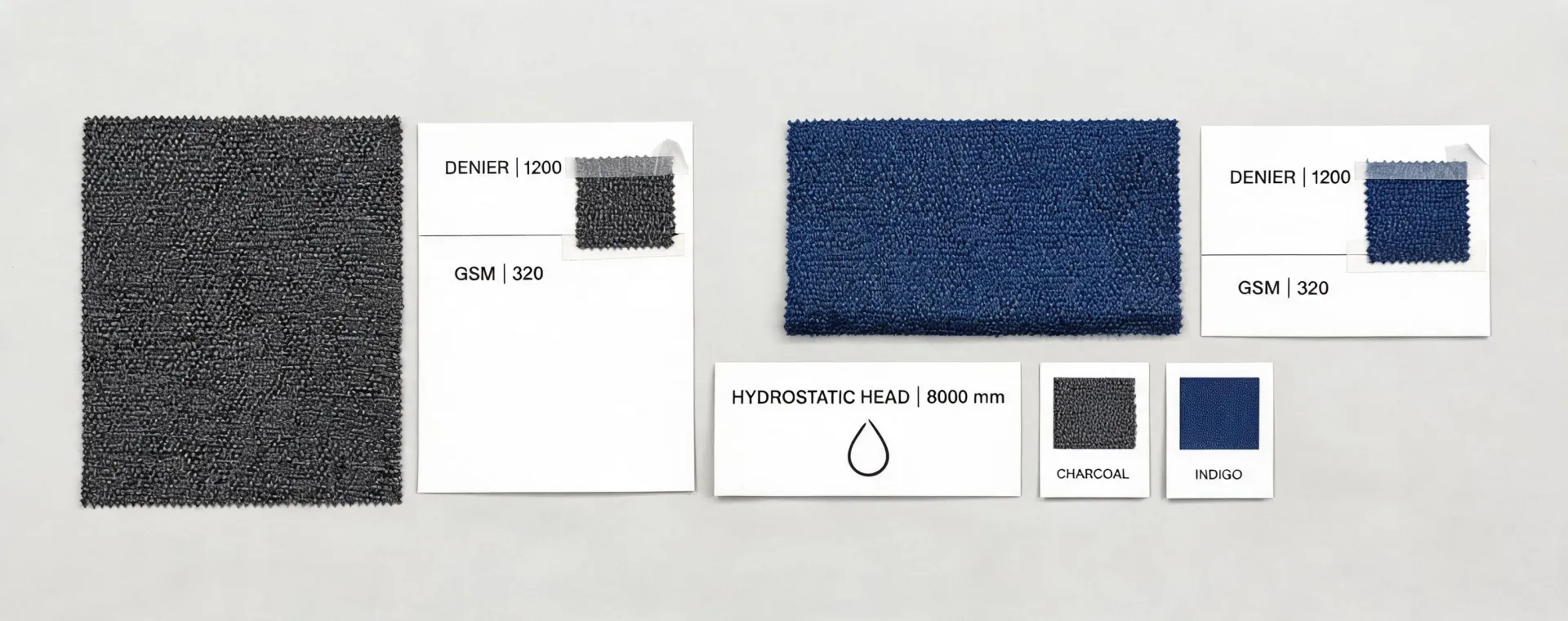
First, ask for the hydrostatic head test report (that's the number that tells you how much water pressure the fabric can take before leaking). Per FTC advertising guidelines (ftc.gov), performance claims need to be truthful and substantiated. If a supplier says 'waterproof' but can't produce test data for the exact fabric and finish they're quoting, treat it as a red flag. Same for 'eco-friendly' or 'recyclable' claims—the FTC Green Guides require evidence.
Second, capacity matters. A large mill like Glen Raven Mills has the finishing capacity that most mid-size suppliers don't. That's not a knock on smaller mills; it's just a fact. If you need 50,000 yards delivered on a fixed schedule, you want a supplier who lives at that scale and isn't going to bump your run for a bigger customer.
Third, run a TCO calculation before you sign anything. I almost switched suppliers in 2023 because the unit price was $0.14 lower per yard. The upside was about $8,400 in annual savings. The risk was an unproven mill and a tight fall deadline. I plugged both quotes into my TCO spreadsheet. The cheaper supplier charged for color matching, sample approval, and a warehousing fee that the other quote included. The 'savings' turned out to be a 7% premium. We stayed, but I learned to never compare unit prices without comparing line-item fees.
If you're in this scenario, Glen Raven's bulk waterproof fabric program is worth a conversation. But ask the same questions you'd ask anyone: test reports, lead times, roll-length consistency, and what happens if a lot fails inspection.
Scenario 2: You Need a Custom Oxford Fabric Manufacturer
The second scenario is when 'standard' isn't good enough. You need a custom oxford fabric manufacturer—maybe a specific denier, a tighter weave, a PU coating that isn't in the catalog, or a color that has to match your brand across three seasons.
This is where Glen Raven custom fabrics comes up a lot (for good reason). A vertical mill that spins, weaves, and finishes in-house can control the variables that matter: yarn quality, weave density, coating adhesion, and color consistency. When you're ordering custom fabric, the communication loop is shorter, and that can save weeks.
Here's what I'd put in your spec sheet:
- Yarn denier (e.g., 200D, 300D, 600D) and filament type (nylon vs. polyester).
- Weave density, or threads per inch. This affects tear strength and hand feel.
- Finish specifications: PU, PVC, TPU coating, or a laminated membrane, plus any DWR treatment.
- Width, roll length, and acceptable shade variation across dye lots.
One thing I wish every buyer knew: sample approval costs are part of the total cost. If you're comparing a lower-priced overseas mill against a domestic custom fabric supplier, include the cost of samples, the time for re-approval, and the risk of a shade mismatch. I've seen a $0.30 per yard savings disappear when a customer had to pay for air freight and a second round of lab dips.
I'm not a textile engineer, so I can't speak to coating chemistry. What I can tell you from a procurement perspective is to get the technical spec in writing and test it before production. If a vendor says 'this isn't our strength' on something outside their core line, that's actually a good sign—it means they're paying attention to fit, not just filling the order.
Scenario 3: What to Look for in a Chenille Fabric Supplier
Now for the curveball. If you're searching for 'what to look for in a chenille fabric supplier,' a large technical mill like Glen Raven is probably not the first call you should make. Chenille is a different world. It's a yarn construction (meaning it can be made from cotton, acrylic, rayon, or blends), and it's used in upholstery, throw pillows, and apparel accents. It has different quality drivers than waterproof technical fabric.
This is where a specialist beats a generalist most of the time. A generalist can say 'yes, we can source that,' but a specialist will ask you about yarn twist, pile height, backing weight, abrasion cycles, and shade consistency across rolls. Those are the details that make or break a chenille order.
What to look for in a chenille fabric supplier:
- A clear process for managing dye lots and shade bands—chenille can be surprisingly hard to match.
- Transparent sampling terms. Will they send strike-offs before production? What does that cost?
- An honest answer about MOQ. If you're a furniture brand ordering 5,000 yards, you don't want a supplier whose sweet spot is 50,000 yards.
- A defect and reclamation policy. Ask how they handle A-grade vs. B-grade fabric and what recourse you have if a roll doesn't meet spec.
I've seen buyers assume that bigger is better. It isn't always. The right supplier is the one whose processes match your product and order profile. Glen Raven has built a reputation on technical and custom fabrics. Chenille isn't their core strength—and a supplier who says that out loud is more trustworthy than one who says 'we can do everything.'
How to Tell Which Scenario You're In
Still not sure? Answer these four questions:
- What fabric are you buying, and how is it used? Waterproof technical fabric? Custom oxford for bags or outerwear? Chenille for upholstery and decor?
- What volume are you ordering? Truckload quantities push you toward a large mill. Short runs and pilot programs often fit better with a specialty supplier.
- How custom is the spec? If you can use a standard SKU, compare on price and capacity. If you need a proprietary finish, you need a mill that does custom work.
- What are you actually optimizing for? Unit price, lead time, or quality consistency? There's no free lunch.
This approach worked for us because we're a mid-size B2B company with predictable reorder cycles. If you're a furniture manufacturer with seasonal spikes, or a startup doing small runs, the calculus will be different. That's the point—the best supplier isn't a name on a list. It's the one that fits your scenario, your product, and your total cost model.