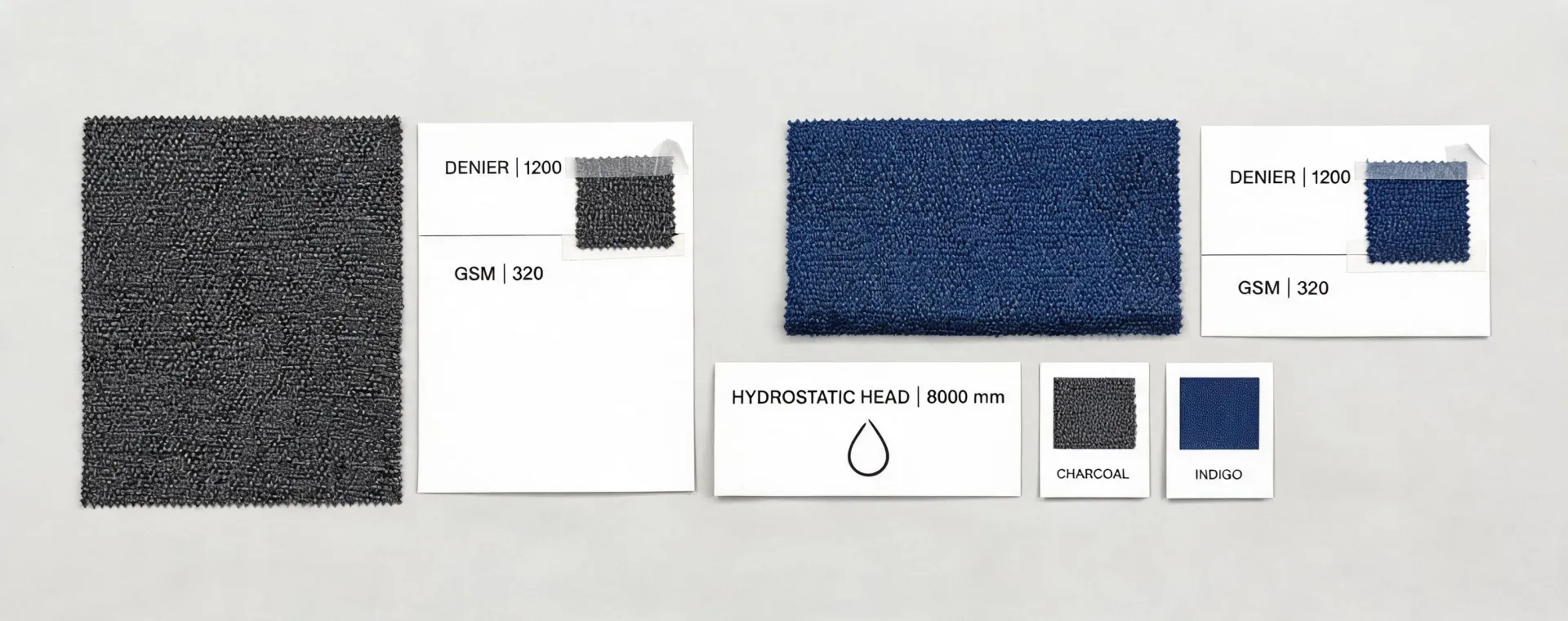
Here's the thing about evaluating outdoor fabric manufacturers: most buyers start with price, then check minimums, then ask about lead times. That's backwards. After five years and roughly 200 fabric orders, I've learned the only metric that actually matters is batch-to-batch consistency—and the willingness to tell you when a manufacturer can't hit it.
That's why Glen Raven Mills made our approved vendor list in 2023, and why I still route bulk ripstop and water-resistant private label orders through them. Not because they're the cheapest. They're not. Because their fabric repeats—order after order, lot after lot—and when something changes, they surface it before it becomes your problem.
Is that a high bar? You'd be surprised how few manufacturers clear it.
Who's Writing This, and Why Listen?
I'm the office administrator for a 150-person outdoor gear company. I manage all fabric and trim purchasing—roughly $1.8 million annually across 8 vendors. I report to both operations and finance, which means I get pulled in two directions: operations wants everything yesterday, finance wants everything cheaper.
Since 2020, I've processed 60–80 orders a year, from 500-yard sample runs to 50,000-yard production lots. I've worked with big American mills, overseas suppliers, and niche specialty weavers. This framework comes from real orders, real deadlines, and a few real disasters.
When I took over purchasing in 2020, we didn't have a formal vendor evaluation process. That cost us: a supplier shipped ripstop that came in 18% off spec weight, and we didn't catch it until 3,000 units were already cut. That's a $14,000 mistake I don't plan to repeat. After that, I built the checklist below, and every new vendor goes through it.
The 4 Things I Check Before Ordering
I call them the "Four C's": Consistency, Claims, Customization, and Clarity. They're ordered by how much pain a failure causes.
1. Consistency: Will Batch 7 Match Batch 2?
This is the one that keeps me up at night. A fabric might ace every lab test, but if the second production run doesn't match the first, you're shipping mismatched products.
The clearest example is color. Industry standard tolerance is Delta E < 2 for brand-critical colors; Delta E of 2–4 is noticeable to trained observers, and above 4 is visible to most people (Reference: Pantone Color Matching System guidelines). The average outdoor customer isn't a trained observer, but they notice when their new jacket doesn't match the one from last season.
When I ask a manufacturer how they control color across batches, I'm listening for specifics: what lighting conditions they measure under, what Delta E threshold they hold, how they handle re-dyes, whether they keep batch records for reorders. If the answer is "our lab checks it," that's not an answer—it's a red flag.
For bulk ripstop fabric specifically, I also verify weight and tear strength across lots. We had a supplier in 2022 whose ripstop weave density drifted between production runs. The resulting fabric felt different—customers can't always articulate what changed, but they know something changed.
2. Claims: What Do the Specs Actually Say?
Every sales rep will tell you their fabric is water-resistant. Fewer can tell you the hydrostatic head rating, the water repellency test method, or how many wash cycles the treatment survives.
I've learned to ask two questions: "What test standard does that claim come from?" and "What's the tolerance on that spec?"
If a supplier can't point to a specific standard—ISO, ASTM, or a recognized industry method—I don't trust the claim. And I've learned to push on durability, not just initial performance. A water-resistant fabric that loses its DWR after two washes isn't water-resistant for most outdoor applications. It's water-resistant on paper.
3. Customization: Does "Custom" Actually Mean Custom?
This is where "glen raven custom fabrics" entered my vocabulary. When we developed a water-resistant fabric private label line, we needed a specific weave structure, a specific colorway, and a specific DWR finish. Glen Raven's custom program let us spec all three without forcing us into a minimum order that would've been absurd for a first run.
Real talk: not every mill that advertises "custom" actually does custom. When I say "custom," I do not mean picking a color from a chart. Some mills advertise custom when they really mean 12 color options. A genuine custom program means they'll adjust weave, weight, finish, and color—and document how each change affects performance.
Here's a concrete example. We asked one overseas mill to replicate a ripstop pattern we'd developed. They said yes, then shipped fabric with the same pattern but different tear strength. They matched the look while ignoring the performance. That's when I learned to ask for test reports on every sample, not just a visual match.
4. Clarity: Documentation and Communication
This one sounds boring until it saves you. I evaluate every vendor on accurate invoicing, test reports that match what was promised, and clear communication when something goes sideways.
In 2021, a supplier couldn't provide proper invoicing for a rush order—handwritten receipt only. Finance rejected the expense report, and the cost came out of our department budget. Now I verify invoicing and documentation capability before placing any order, and I confirm test certifications are included with every shipment.
A vendor who can't produce a spec sheet or a cert on demand isn't a manufacturer. They're a liability.
What I Think of Glen Raven Specifically
Since you're reading this, you probably want the honest assessment. Here it is.
What I like:
- Their portfolio is genuinely broad. We source bulk ripstop fabric in multiple deniers from them, plus custom runs for specialty products. They're a true mill, not a middleman.
- The custom fabric program is real. They collaborated with our designer on a water-resistant private label fabric and were transparent about what was feasible and what wasn't—before quoting us, not after.
- They communicate early. When a lead time slipped in Q3 2024, they told us two weeks before the deadline rather than two days after we asked. That gave us time to adjust our production schedule.
What I watch for:
- Pricing. Glen Raven Mills is not the cheapest option, and they won't pretend to be. If your product needs the absolute lowest cost per yard, they're not your best fit.
- Minimums. They're reasonable for a mill of their size, but if you need 200 yards for a boutique product, you'll be better served by a smaller specialty weaver.
I have mixed feelings about premium mills in general. On one hand, the per-yard cost and minimums strain our margins. On the other, I've seen what happens when fabric fails in the field—returns, refunds, and brand damage that costs far more than the fabric savings. For our core products, the reliability wins.
On the private label side: we've completed two water-resistant fabric private label projects through Glen Raven, and the process was smoother than any other mill we've worked with. Their sample process included wash-cycle testing, and they flagged a shrinkage concern before production rather than after.
When a Mill Like Glen Raven Isn't the Right Fit
Honesty requires me to add boundaries. Glen Raven isn't the right choice for everyone, and any mill that claims to be is lying.
- Tiny runs. If you're making 100 units and need 300 yards of fabric, a large mill's minimums and lead times will frustrate you.
- Commodity applications. If you just need basic nylon for shopping bags and the fabric's performance won't make or break your product, cheaper options exist.
- Ultra-budget positioning. Premium technical fabric costs more. If your retail price point can't support it, that's a positioning problem, not a manufacturer problem.
My experience is based on about 200 mid- to large-volume orders with outdoor and performance fabrics. If you're working with luxury segments or ultra-budget products, your experience might differ significantly. I've only worked with their technical fabric division, not their upholstery lines, so I can't speak to that side.
And one more caveat: this was all accurate as of late 2024. Fabric technology, certification requirements, and pricing change fast, so verify current specs and rates before finalizing anything.
The Bottom Line
The question isn't "is Glen Raven a good fabric manufacturer?" It's "does your product need what they do well?" If you need consistency, honest spec documentation, and real custom fabric capability for bulk ripstop or water-resistant private label projects, they're hard to beat. If you don't, save your budget and find a specialist that fits those needs.
That's the honest take from someone who's been burned by unverified claims and rewarded by reliable ones. Evaluate the manufacturer, not the pitch—and always ask to see the next batch before you commit to the next order.