-
Who this checklist is for
-
Step 1: Define the exact end use and exposure
-
Step 2: Ask for current, traceable test reports
-
Step 3: Verify custom capability and MOQ before sampling
-
Step 4: Get landed cost per yard, not just quote price
-
Step 5: Request a production-representative sample
-
Step 6: Audit communication and invoicing early
-
Step 7: Run a small bulk order and inspect against AQL
-
Common mistakes to avoid
Who this checklist is for
I’m the office administrator for a 120-person company. I manage all custom order purchasing—roughly $180,000 annually across 11 vendors. I report to both operations and finance. When I took over purchasing in 2020, I thought buying fabric was like buying office supplies. It’s not. The spec sheet can look perfect and the roll can still fail in production.
This checklist is for B2B buyers evaluating waterproof fabric wholesale suppliers. It also works if you need to know how to evaluate leather fabric manufacturers—you just swap a few tests and add tannery or faux-leather backing checks. I’m not a textile engineer, so I can’t tell you which coating chemistry is best for your end use. What I can tell you from a procurement perspective is how to force vendors to document their claims before you wire money.
There are 7 steps. Do them in order. Skipping step 2 is the most expensive mistake I see.
Step 1: Define the exact end use and exposure
“Waterproof fabric” is not one spec. It’s a goal. A jacket for a rainy commute has different requirements than a boat cover, a hospital curtain, or an upholstery cushion. Before you ask for quotes, write down:
- Indoor or outdoor use?
- Rain, immersion, or splash only?
- How many wash or clean cycles per year?
- UV exposure hours?
- Colorfastness requirements?
- Flame retardancy or chemical restrictions?
For leather fabric manufacturers, add: full-grain, top-grain, bonded, or faux leather? What’s the backing—knit, woven, nonwoven? What rub count (Martindale or Wyzenbeek) do you need?
Most buyers focus on price per yard and completely miss the exposure profile. If you don’t define it, every vendor will quote their easiest product. That’s not a fair comparison.
Step 2: Ask for current, traceable test reports
This is the step most people skip. A certificate on a website is not a test report for your lot. Ask for:
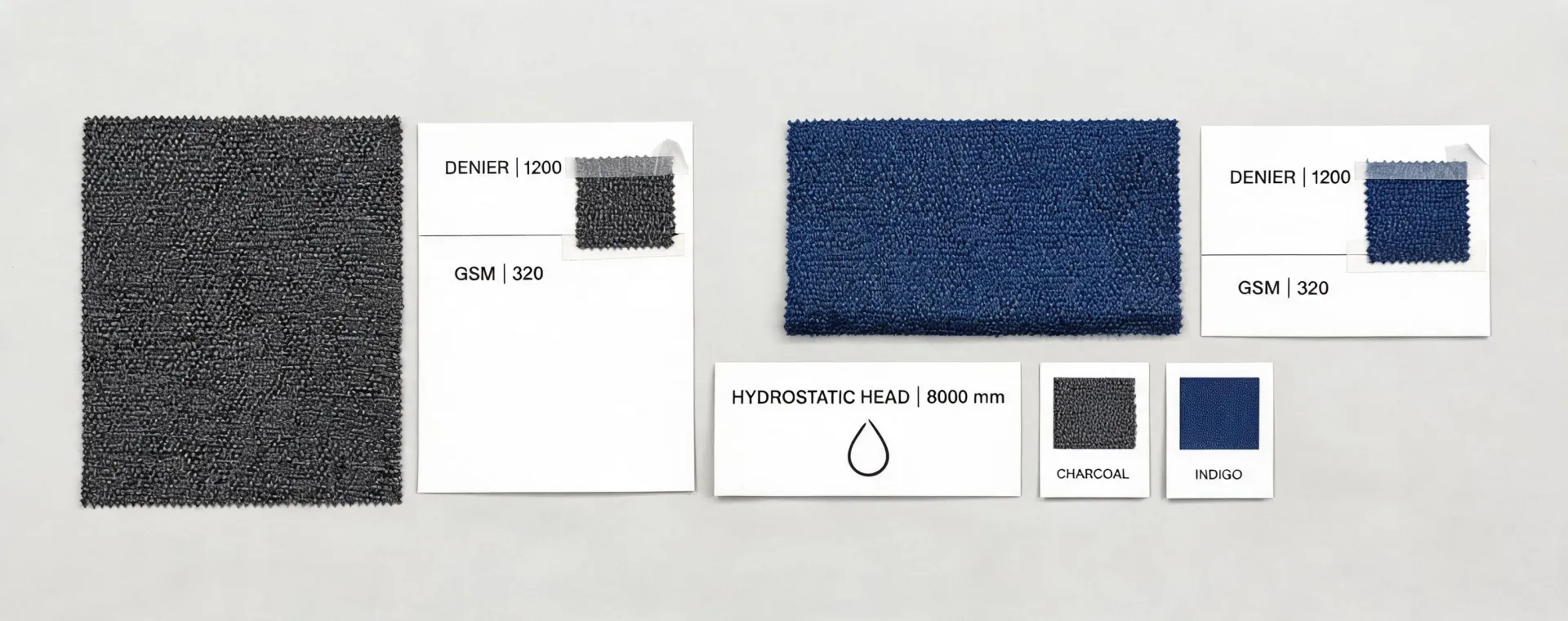
- Hydrostatic head test (often ISO 811) for waterproofness.
- MVTR or breathability test, if relevant.
- Abrasion test (Martindale, Wyzenbeek, or Taber).
- Colorfastness to light, crocking, and washing.
- OEKO-TEX Standard 100 or equivalent, if skin contact matters.
- FTC-required fiber content, country of origin, and care instructions.
According to the FTC (ftc.gov), most textile products sold in the U.S. must disclose fiber content, country of origin, and care instructions. That’s not just a retail issue—mislabeling can cause customs delays and chargebacks.
Check the report date, lab name, lot number, and whether it matches the fabric you’re buying. A red flag is when a vendor says “all certifications” but can’t send a PDF within 24 hours. I still kick myself for not requiring test reports on a cheap waterproof fabric lot in 2023. The savings were about 18%, but our QC rejected the roll because the hydrostatic head was below our minimum. I ate $6,800 out of the department budget. Now I verify test reports before placing any bulk order.
Step 3: Verify custom capability and MOQ before sampling
If you’re looking at Glen Raven Custom Fabrics—or searching for glen-raven or glen raven mills—ask three questions upfront:
- What’s the minimum order quantity for a custom color or finish?
- What’s the sampling lead time and cost?
- Will the production fabric match the sample within a documented tolerance?
Glen Raven Mills has a broad technical fabric portfolio, and Glen Raven is often on shortlists for performance upholstery, outdoor, and waterproof applications. But even with a reputable mill, your exact construction and end use still need to be matched. Don’t assume the brand name replaces your own checklist.
For leather fabric manufacturers, MOQ often depends on dye lot and embossing pattern. Ask whether the sample is from a stock lot or a production run. A hand-cut swatch from a stock lot can hide backing defects that show up in a full roll.
Step 4: Get landed cost per yard, not just quote price
The lowest quoted price is usually not the lowest total cost. I learned that the hard way. Ask for a landed cost breakdown:
- Base fabric price per yard
- Custom color or finish setup
- Testing and certification fees
- Freight, duties, and tariffs
- Packaging and roll labeling
- Rush fees, if needed
- Potential reprint or replacement cost
From the outside, a low quote looks like a win. The reality is hidden setup, freight, and reprint costs can erase the savings. I can’t give you a ballpark without knowing the spec—fiber, coating, width, and certification all move the number. Get three written quotes for the exact same spec and compare landed cost.
Step 5: Request a production-representative sample
Don’t accept a pretty swatch. Ask for a production-representative sample that comes from the same line, same coating, and same finishing process. Then test it in your own workflow:
- Sew it, weld it, or laminate it the way your factory will.
- Wash or clean it according to your care instructions.
- Check shrinkage, color shift, and delamination.
- For waterproof fabric, recheck hydrostatic head after abrasion.
- For leather fabric manufacturers, check grain consistency, backing adhesion, and flexibility.
Never expected the budget mill to outperform the premium one on sample communication. Turns out their sample process was tighter—they sent a full test report and a 3-yard roll. The premium vendor sent a 2-inch swatch with no lot number. That was a deal-breaker for me.
Step 6: Audit communication and invoicing early
This is the step finance will thank you for. Before you place a bulk order, send a test PO and a test invoice question. See how they handle:
- PO numbers and line-item detail
- Currency, payment terms, and bank fees
- Invoice matching to PO and receiving report
- Change orders and cancellations
- Quality claims and return authorization
I’m not a legal compliance expert, so I can’t speak to import regulations for every country. What I can tell you from a procurement perspective is: if they can’t provide a proper invoice or traceable test report, they’ll be a problem when something goes wrong. One vendor who couldn’t provide proper invoicing cost us $2,400 in rejected expenses. That’s a no-brainer walk-away.
Step 7: Run a small bulk order and inspect against AQL
Before you commit to a full production run, place a small bulk order—one roll, one pallet, or one container depending on your size. Inspect against an AQL sampling plan. Check:
- Width and length accuracy
- Shade consistency roll-to-roll
- Coating defects, pinholes, and streaks
- Backing adhesion and hand feel
- Packaging and roll labels
- Test report lot traceability
More often than not, the first bulk order reveals the vendor’s true process control. If they resist an AQL inspection, that’s a red flag. If they welcome it, that’s a good sign.
Common mistakes to avoid
- Buying on price alone. Landed cost and reprint risk matter more.
- Accepting “waterproof” as a spec. Ask for hydrostatic head, MVTR, and test method.
- Skipping compliance checks. Verify FTC labeling and any required certifications.
- Not documenting verbal promises. If it’s not in the PO or spec sheet, it doesn’t exist.
- Assuming a big name replaces QC. Even with Glen Raven Mills or Glen Raven Custom Fabrics, your spec and inspection still matter.
This approach worked for us, but we’re a mid-size company with fairly predictable ordering patterns. If you’re seasonal with demand spikes, your MOQ and lead-time calculus might be different. I can only speak to domestic procurement. If you’re dealing with international logistics, there are probably factors I’m not aware of.
Bottom line: a good fabric supplier will make it easy to verify claims. A bad one will make you feel like you’re asking for too much. The checklist above helps you tell the difference before the money leaves your account.