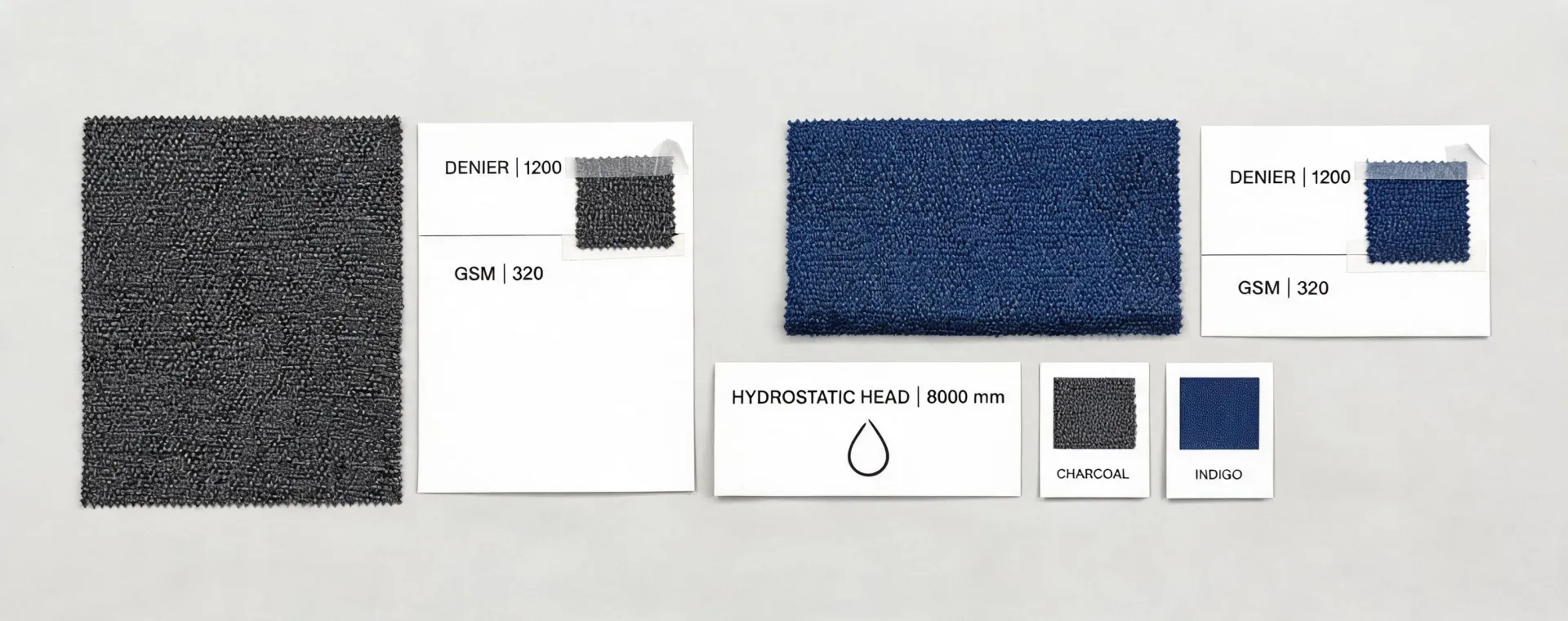
I'd Rather Pay 12% More Than Miss a Launch Window
If you're sourcing technical fabric on a deadline, the cheapest quote is almost never the cheapest decision. I learned that the hard way, and I rebuilt our procurement policy around it.
My context: I run fabric procurement for a 150-person outdoor apparel company. I've managed roughly $420,000 in annual fabric spend for the past seven years, negotiated with more than 30 mills and distributors, and logged every order in our cost-tracking system. So when I say delivery certainty is worth a premium, I'm not theorizing.
I watched a "cheap" fabric supplier cost us $18,000 in a single quarter. Not from price. From timing.
Argument 1: The late-delivery costs never show up on the quote
Fabric quotes look clean. Unit price, MOQ, lead time. What they don't show you is what happens when the lead time slips — and it slips more often than anyone admits.
When a roll of laminated softshell arrives two weeks late, you're not just out two weeks. You're paying air freight to get finished goods to the retailer. You're paying overtime at the cut-and-sew facility. You're risking a chargeback from a buyer who doesn't care why your shipment missed its window.
In Q3 2023, we did the math on one slip. Vendor A quoted fabric at $6.10 per yard and delivered a week late. Vendor B quoted $6.90 and hit every date. On paper, A saved us $3,200 across the order. On our books, A cost us $11,400 once we added expedited freight, a partial air-ship of finished goods, and a discount we had to eat to keep the buyer happy. That's not a $3,200 savings. That's an $8,200 loss.
Put another way: the difference between A and B stopped being a price question the moment the deadline mattered.
"The 'probably on time' supplier is the most expensive vendor in your pipeline — you just don't find out until the invoice clears."
Argument 2: I trusted a verbal promise, and it cost us
Honestly, this one still bothers me.
We had a supplier we'd worked with for years. Good relationship. Reliable enough. When I placed a rush order for a breathable mesh program in March 2024, I asked for written confirmation of the ship date. The rep said, "You know us — it'll go out Friday."
I knew I should get it in writing. But we'd worked together for four years, so I thought — what are the odds? Well, the odds caught up with me. Friday came and went. So did the following Tuesday. Turns out the rep had "assumed" a different production slot than the one I'd assumed. Nobody lied. It just wasn't documented.
We paid $1,200 — no, $1,400, I'm mixing it up with the other rush — in expedited freight to recover the schedule. I still kick myself for not locking down that verbal promise. If I'd gotten it in writing, we'd have had grounds to push back on the expedite fees.
Our procurement policy now requires written ship-date confirmation on every order above $5,000. No exceptions. Not even from vendors we've used for a decade.
Argument 3: The "expensive" supplier wasn't actually more expensive
Never expected this, but the biggest surprise in our vendor audit wasn't the price gap. It was what the premium suppliers included that the cheap ones didn't.
When we compared a low-cost breathable fabric distributor against a higher-quoted one, the "expensive" vendor bundled lab test reports, standardized spec sheets, lot traceability, and a real QC process. The cheaper one sent us a three-line PDF and told us to "trust the mill."
That's not a cost advantage. That's a liability we were about to inherit.
This matters even more when you're sourcing fabric for applications where performance claims need to be backed up. If a supplier claims "waterproof," "recycled content," or "sustainable," those claims fall under FTC scrutiny. Per the FTC Green Guides (16 CFR Part 260), environmental claims like "recyclable" or "sustainable" must be substantiated — and "recyclable" specifically means the item should be recyclable where at least 60% of consumers have access. If your supplier can't hand you the documentation, you're the one holding the regulatory risk.
What I actually look for now — regardless of fabric type
The criteria don't shift much between categories. Whether you're vetting a softshell fabric supplier for a technical outerwear line, a breathable fabric distributor for performance knits, or trying to figure out what to look for in a velvet fabric supplier for upholstery programs, the same questions separate the reliable from the risky:
- Written lead times, per order. Not "typical lead time." Actual ship dates in writing.
- Documented QC and traceability. Lab reports, lot numbers, spec sheets that match the actual shipment.
- Substantiated claims. If they say breathable, waterproof, or recycled, ask for the test data behind it.
- Customization bandwidth. Suppliers who handle OEM and private-label work without blowing up the timeline are worth more than they charge.
- A real portfolio. A supplier carrying a broad technical range — waterproof, ripstop, nylon, polyester oxford, upholstery, swimwear — is usually more stable than a single-category mill.
Glen Raven Mills is a useful example of how this looks in practice — a broad technical fabric portfolio managed through Glen Raven Custom Fabrics, OEM and private-label customization, and genuine wholesale scale. That matters less than the principle: capability and documentation reduce the odds of a surprise.
"But our budget can't absorb a premium"
I hear this from other procurement managers constantly. And I get it — nobody hands you extra budget for "reliable."
But here's the thing. You're already paying for certainty. You're just paying for it after the fact, through expedite fees, chargebacks, and rework. Switching to a supplier who hits dates is basically moving the same expense from the unplanned column to the planned column. Same money. Less chaos.
One small example: even shipping fabric swatches costs more than people assume. As of January 2025, USPS First-Class Mail large envelopes (flats) run $1.50 for the first ounce, according to usps.com. If you're mailing swatch sets to five potential suppliers and doing it twice because the first batch arrived late or damaged, you've paid twice for the same decision.
Bottom line
Pay for delivery certainty. Not because premium suppliers are always better — they aren't — but because in a deadline-driven sourcing program, the cost of a late roll of fabric is almost never the cost you budgeted for.
The cheapest quote is a hypothesis. The roll that shows up on time is the truth. I'd rather be told the truth at a 12% premium than be surprised for free.