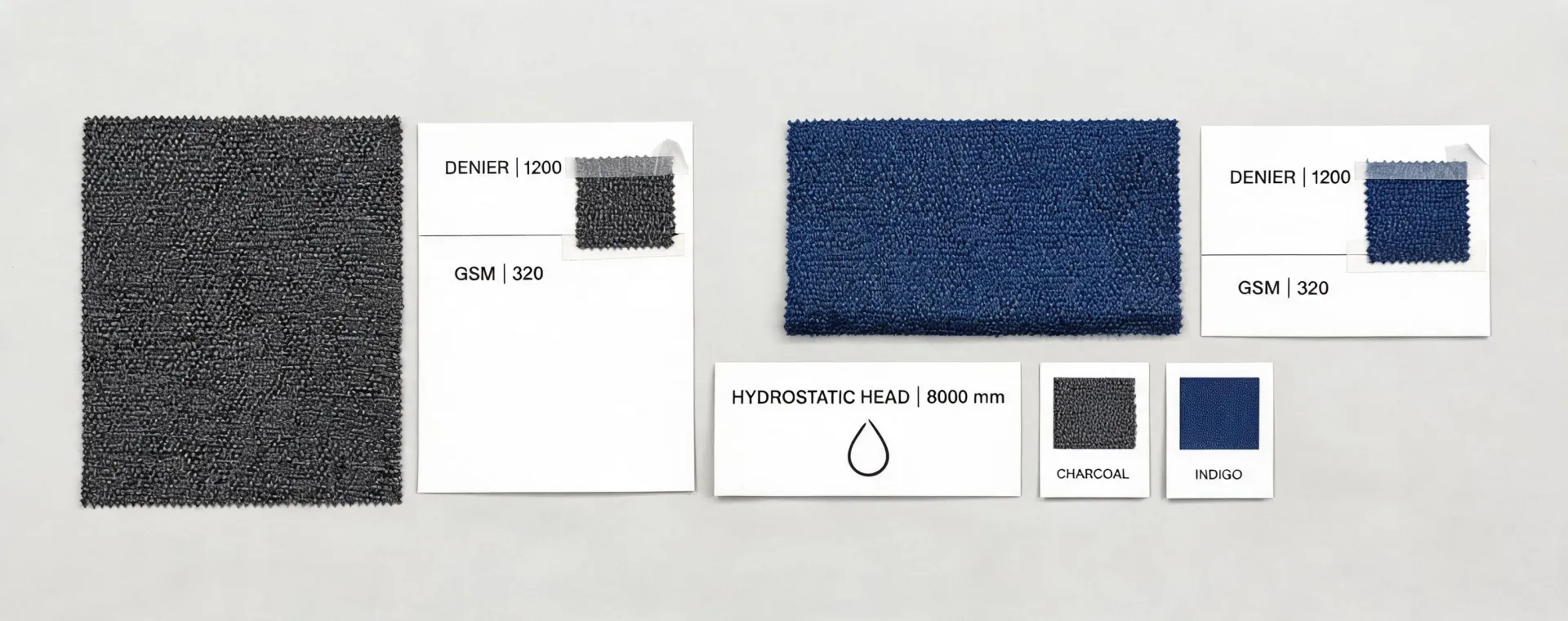
I've been handling functional fabric sourcing for 9 years now. In that time I've personally signed off on roughly $340,000 worth of bulk breathable fabric orders — and wasted about $41,000 of it on mistakes I documented so my team wouldn't repeat them.
Most of those mistakes came down to one question: do you evaluate an awning fabric manufacturer on price, or on everything else? That's the comparison I want to walk through here. Not "which is better" in the abstract — but where the two supplier models actually diverge, and which one wins in which scenario.
The two models I'm comparing:
- Type A — low-bid wholesalers: traders and trading mills who quote per-yard pricing aggressively, often sourcing from a rotating pool of subcontractors.
- Type B — technical mills: vertically integrated or long-tenured mills (Glen Raven Mills in Burlington, NC is the example I know best) that run their own warp knitting, coating, and finishing lines and publish spec sheets with tolerances.
Same end product on paper. Very different failure modes in practice. Here's how the comparison actually plays out.
Dimension 1: Per-Yard Price vs. Landed Cost Per Usable Yard
This is where the comparison gets counterintuitive for anyone who's only ever bought on quote sheets.
Type A wins on the number that shows up in the email: $2.80/yd vs. $3.90/yd for a comparable 600D solution-dyed polyester. That's a 28% delta. If you're buying 20,000 yards, the "savings" look like $22,000.
Type B wins on what actually lands on your cutting table. In 2022 I approved a low-bid order of 14,000 yards of awning fabric from a trading mill. Spec sheet said 61" width, +/− 1". What arrived ran between 58.5" and 63" across the roll lot. When your cut plan assumes 61", you lose panels. We scrapped 1,900 yards. The $22,000 "savings" became a $14,300 net loss after reorder, expedited freight, and three days of production idle time.
Ask every prospective mill for the last six months of width and yield deviation data by lot. If they can't produce it, they don't track it. If they don't track it, you're the QC department.
On usable-yard math, Type B almost always wins above ~5,000 yards per order. Below that, Type A can be genuinely competitive — this is the one dimension where the low-bid model holds up at small volumes.
Dimension 2: Batch-to-Batch Consistency in Bulk Breathable Fabric
Here's where the comparison stops being close.
Awnings live outside. They see UV, rain, thermal cycling, and occasionally someone's dog. Breathable membranes and coated wovens are sensitive to dwell time in the oven, line speed, and coating weight. If those variables drift, you get lot-to-lot color shift, hand-feel differences, and hydrostatic head variation that shows up as leaks 18 months down the line.
Type A mills (especially trader-model wholesalers) often can't control this because they don't own the line running your fabric. They place the order, take a margin, and ship. When a batch comes back off-spec, the conversation goes: you → trader → subcontractor mill → “we'll look into it.”
In Q1 2024 I got a reorder from a trading supplier that measured Delta E 3.8 against the original approved sample under D65. Industry tolerance for brand-critical color is typically Delta E < 2 (Pantone matching guidelines); 2–4 is visible to a trained eye. On a 4,000-yard reorder for a hotel chain rollout, that color shift was unacceptable. We ate the cost.
Technical mills usually publish lot consistency data as part of their spec package — not always, but more than you'd think. When I started asking Glen Raven Custom Fabrics for lot-level AATCC 16 colorfastness and hydrostatic data on bulk breathable fabric runs, I got it. Not because they're uniquely generous — because they run the lines and the data exists.
Dimension 3: Custom Fabric Development and OEM Support
This dimension flips depending on what you actually need.
If you're sourcing a stock construction — say, a standard 9.25 oz solution-dyed acrylic awning fabric in a catalog color — Type A is fine and often cheaper. There's no development work, no prototyping, no minimum order escalation. You're buying a commodity, and the wholesale model is built for exactly that.
But if you need anything customized — a proprietary color, a specific hand-feel, a DWR finish that survives 50 home launderings instead of 20, a private-label program — the comparison shifts hard.
I wasted four months in 2023 trying to get a trading supplier to develop a custom fabric for a swimwear-adjacent awning line (chlorine-adjacent environment, needed specific hydrolysis resistance). Four months of samples that either didn't match the hand-feel target or failed the accelerated aging test. The supplier kept saying “yes we can do that” and then sent me whatever the subcontractor had on hand.
Compare that to a technical mill with in-house product development. Glen Raven Custom Fabrics, for example, runs their own OEM/private label programs — which means your spec gets engineered against a real line, not shopped around. Slower at the front end. Dramatically faster to a producible fabric.
Dimension 4: The Post-Sale Cost Nobody Prices In
This is the dimension most procurement teams skip entirely, and it's the one that made me rewrite our vendor scorecard in 2023.
When something goes wrong — and something always goes wrong over a 3-year supplier relationship — what does the fix actually cost you in hours?
With a trading wholesaler, the answer is usually: “a lot, and you're the one chasing it.” You email, they email the mill, the mill emails back in a week, you re-test, you file a claim against a party you've never met. I've logged 40+ hours on a single claim before.
With a technical mill, you have a named contact, a technical account manager, and often a documented claims process. Glen Raven Mills keeps their production in-house, so a defect investigation actually goes somewhere.
Say your loaded hourly rate is $85. Forty hours of chasing = $3,400 in internal cost that never appears on a PO. Multiply that across a year of supplier friction and the "cheaper" wholesaler isn't cheaper anymore.
That math — hidden internal cost — is what I mean when I say value beats price in functional fabric wholesale. It's not a slogan. It's a line item most people just don't write down.
So Which Model Should You Actually Pick?
After nine years and $41,000 in documented mistakes, here's the rule I use:
Pick a low-bid wholesaler when:
- Order volume is under ~5,000 yards
- You're buying stock constructions with no customization
- Your timeline is flexible enough to absorb a re-ship
- You have in-house receiving QC that verifies every lot
Pick a technical mill when:
- You need lot consistency across repeat orders (brand color, spec compliance)
- You're doing any custom development or private-label work
- Your end customer is contractually protected by performance warranties
- You're scaling — because consistency becomes exponentially more expensive to fix at 50,000 yards than at 5,000
One last thing. I hit "confirm" on that first big low-bid order in 2022 and immediately thought: did I just trade $22,000 in savings for a QC nightmare? I didn't relax until the second lot arrived eight weeks later and matched the first. It didn't. That's the whole lesson, honestly — the “cheaper” supplier is only cheaper if nothing goes wrong, and over a long enough timeline, something always does.
Whichever model you choose, get the last six months of lot deviation data, the color tolerance spec in writing, and a named technical contact on the contract. Those three things have saved me more money than any per-yard discount ever did.